On this page
A car engine is meant to run warm, so when it is cold the coolant is kept away from the radiator. Once the engine warms up, a valve opens and lets the coolant through. In most cars that valve has no wires and no sensor. It is pushed open by a small cup of wax that melts. The physics is Class 11: wax swells when it melts, a liquid barely compresses, and Pascal's law turns that swelling into a strong push.
Why does an engine need a thermostat at all?
The coolant loop carries heat from the engine to the radiator, as explained in why a car engine needs a radiator and coolant. On a cold start you do not want that. MAHLE, a maker of engine cooling parts, notes in its workshop guide to vehicle cooling that the engine's operating temperature matters for performance, fuel consumption and low emissions, so until it is reached the coolant goes straight back to the engine through a short bypass. The thermostat is the valve that decides.
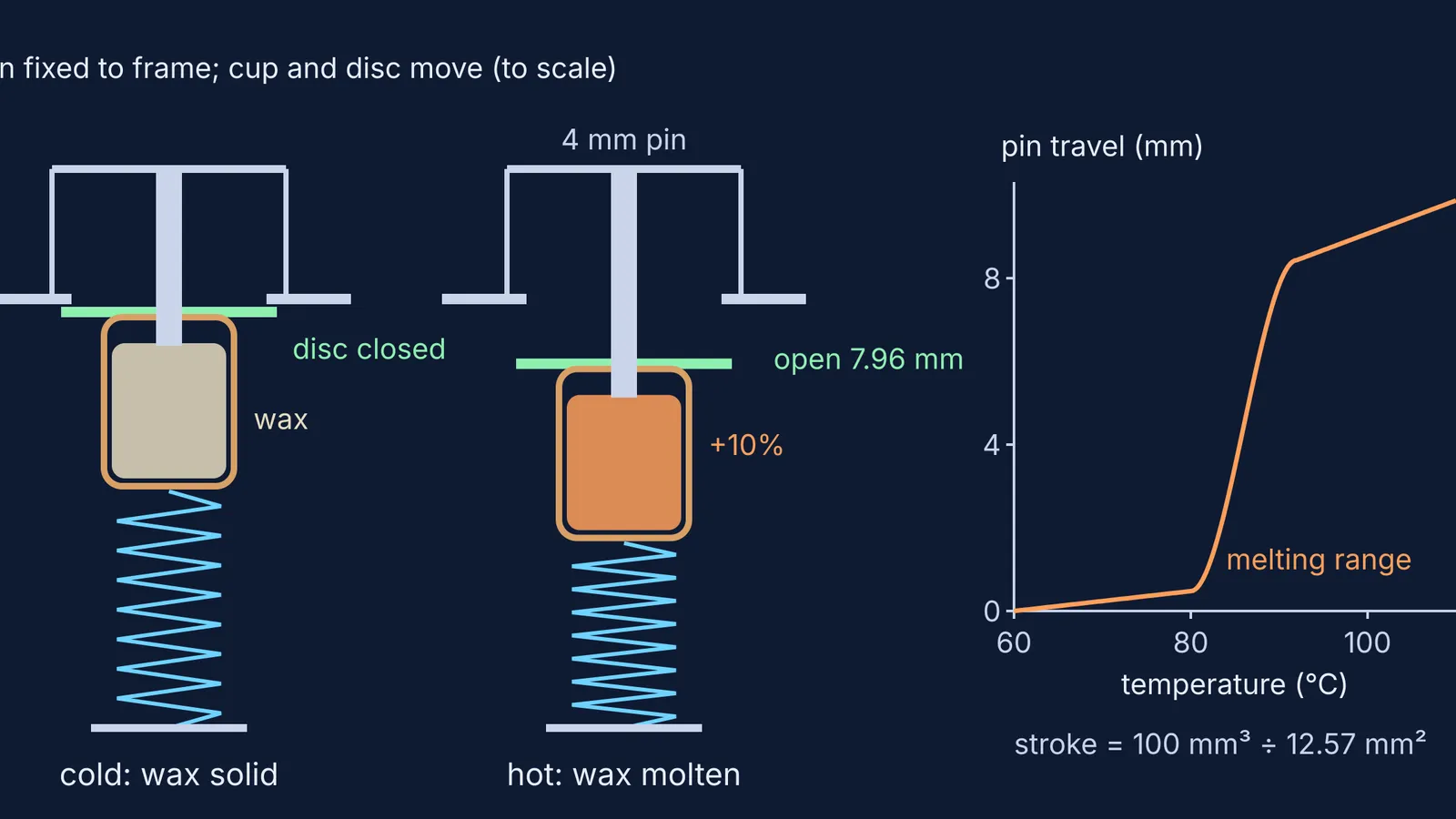
The same guide describes the classic design. When heated above 80 °C the wax filling melts; as its volume increases, the metal container moves along a fixed working piston, opening the radiator circuit and closing the bypass. When the temperature drops below 80 °C the wax solidifies and a return spring pushes the container back. The exact opening temperature depends on the wax blend chosen by the maker.
How much does wax swell when it melts?
Most solids swell a little on melting, because molecules in a liquid pack less tightly than in a crystal. Paraffin wax swells a lot. A 2024 study in Scientific Reports on passive thermal regulators notes that paraffin wax expands by up to 15% in volume on melting, and that changing the length of the wax's carbon chains sets the melting temperature.
Compare that with plain thermal expansion of a liquid. Oils typically expand by less than 10⁻³ of their volume per kelvin: a 2021 study of thermally actuated valves tabulates 7.5 × 10⁻⁴ per K for olive oil. Over a 10 K rise, 10⁻³ per K gives at most a 1% swell. Melting gives about ten times that in the same few degrees. That is why the thermostat is built around melting, not ordinary expansion. For how the expansion coefficient of a gas compares, see why the volume expansion coefficient of an ideal gas equals 1/T.
How far does the pin move? A worked example
Problem (illustrative values). A thermostat cup holds 1.0 cm³ of wax that swells by 10% on melting. The swelling pushes out a pin 4.0 mm across. The valve disc is 30 mm across. How far does the pin move, and is the valve fully open?
Extra volume. ΔV = 0.10 × 1.0 cm³ = 0.10 cm³ = 100 mm³.
Pin area. A = π(2.0 mm)² = 12.57 mm².
Stroke. The wax cannot go anywhere else, so the pin must sweep out the extra volume: x = ΔV/A = 100 ÷ 12.57 = 7.96 mm, about 8 mm.
Opening of the valve. When a disc of diameter d lifts by h, coolant flows through a ring-shaped gap of area πdh (the side of a short cylinder). Here πdh = π × 30 × 7.96 = 750 mm².
Compare with the hole. The disc's own area is π(15 mm)² = 707 mm². The gap is now larger than the hole, so lifting further would not help: the valve is fully open. The rule of thumb is h ≥ d/4, and 7.96 mm is just above 30/4 = 7.5 mm.
Units: mm³ ÷ mm² gives mm; mm × mm gives mm².
Compare ordinary expansion of molten wax, at an upper-end 10⁻³ per K over 10 K: ΔV = 1,000 mm³ × 10⁻³ × 10 = 10 mm³, so the pin moves 10 ÷ 12.57 = 0.80 mm. That lifts the disc only a tenth as far, leaving a gap of 75 mm², about a tenth of the hole.
How strong is the push?
The valve has a return spring, so the wax must push the pin out against it. Say the spring pushes back with 150 N when the valve is open (an illustrative value). The pressure in the wax must then be:
p = F/A = 150 N ÷ 12.57 × 10⁻⁶ m² = 1.19 × 10⁷ Pa, about 12 MPa or 119 bar.
That is far above the 1.0 to 1.5 bar at which, according to the same MAHLE guide, a car's cooling circuit runs. A liquid that hardly compresses can do this: almost all of the 100 mm³ goes into moving the pin, not into squeezing the wax. The pressure acts equally on every wall of the cup and on the pin, which is Pascal's law at work. The work done is only F × x = 150 × 0.00796 = 1.2 J, but it is delivered with a large force over a short distance.
In real thermostats the pin is usually held still by the frame and the cup moves instead, as MAHLE's description says. The stroke is the same either way, because it is set by the change in volume.
Why does the valve take time to respond?
Melting needs latent heat. A review of carbon-filled phase change materials gives commercial paraffins a latent heat of about 200 kJ/kg, and a Chemical Society Reviews article on phase change materials gives paraffin a density of around 900 kg/m³. So 1.0 cm³ of wax has a mass of about 0.9 g and needs about 0.9 g × 200 J/g = 180 J to melt, on top of the heat to warm it to its melting range. That heat has to flow in from the coolant through the metal cup, so the valve opens over seconds, not instantly. The same idea, why a phase change soaks up so much heat, is covered in why latent heat of vaporisation is greater than fusion. An iron's thermostat uses a different trick, a strip that bends, explained in how a bimetallic thermostat works.
Is it safe to look at a car's thermostat?
Never open the radiator cap or the coolant tank cap on a hot engine. The cooling system is under pressure when warm, and MAHLE's guide warns of a risk of scalding if it is opened suddenly. Wait until the engine has cooled completely, and leave thermostat checks to a mechanic or an adult who knows the car.
To see how latent heat and thermal expansion fit together across the syllabus, the Concept Library has a lesson on every concept in physics, chemistry, biology, mathematics and computing.
Quick checklist
A car thermostat is a valve worked by a cup of wax that melts at around 80 °C or so, set by the wax blend.
Paraffin wax swells by up to about 15% on melting, far more than a liquid expands over a few kelvin.
Stroke = ΔV ÷ pin area; 100 mm³ through a 4 mm pin gives about 8 mm.
A disc of diameter d is fully open once it lifts d/4.
Pressure = spring force ÷ pin area; 150 N on 12.57 mm² is about 12 MPa.
Melting 0.9 g of wax takes about 180 J, so the valve opens over seconds.
Never open a coolant cap on a hot engine.