

On this page
When you heat a material, it expands. For solids and liquids, this expansion is tiny and mostly constant across normal temperatures. But for gases, the story is completely different.
The coefficient of volume expansion (often written as γ, α, or β) measures how much a material expands for every degree it is heated. For an ideal gas at constant pressure, this coefficient isn't a fixed number at all—it equals 1/T.
What is the coefficient of volume expansion?
The coefficient of volume expansion (γ) is defined as the fractional change in volume per unit change in temperature, kept at a constant pressure.
Mathematically, it is written as: γ = (1/V) × (dV/dT)_P
This formula tells us what fraction of its original volume the material adds for each Kelvin (or degree Celsius) rise in temperature. If you have a block of metal and you raise its temperature by one degree, γ tells you the percentage increase in its volume. For most everyday materials, this number is a constant property of the substance. For gases, however, the expansion is so dramatic that the starting temperature plays a massive role in how much more it will expand.
Why does the coefficient of volume expansion of an ideal gas equal 1/T?
To find the coefficient for an ideal gas, we do not need to look up a table of materials. We can derive it directly from the ideal gas law: PV = nRT
Here, P is pressure, V is volume, n is the number of moles, R is the universal gas constant, and T is the absolute temperature in Kelvin.
If we keep the pressure constant and rearrange the formula to solve for volume, we get: V = nRT / P
Next, we differentiate the volume V with respect to the temperature T. Because P, n, and R are all constant during this process, the derivative is simple: (dV/dT)_P = nR / P
Now, we substitute this result back into the original definition of the volume expansion coefficient: γ = (1/V) × (nR/P)
Since we know from our rearranged gas law that V = nRT / P, we can replace the V in the denominator: γ = (P / nRT) × (nR / P)
The pressure P, the number of moles n, and the gas constant R all cancel out perfectly, leaving us with the final result: γ = 1/T
If you get stuck on thermodynamics derivations like this, the Fermi Concept Library breaks down the underlying physics into clear, logical steps.
Why do gases expand so much more than solids?
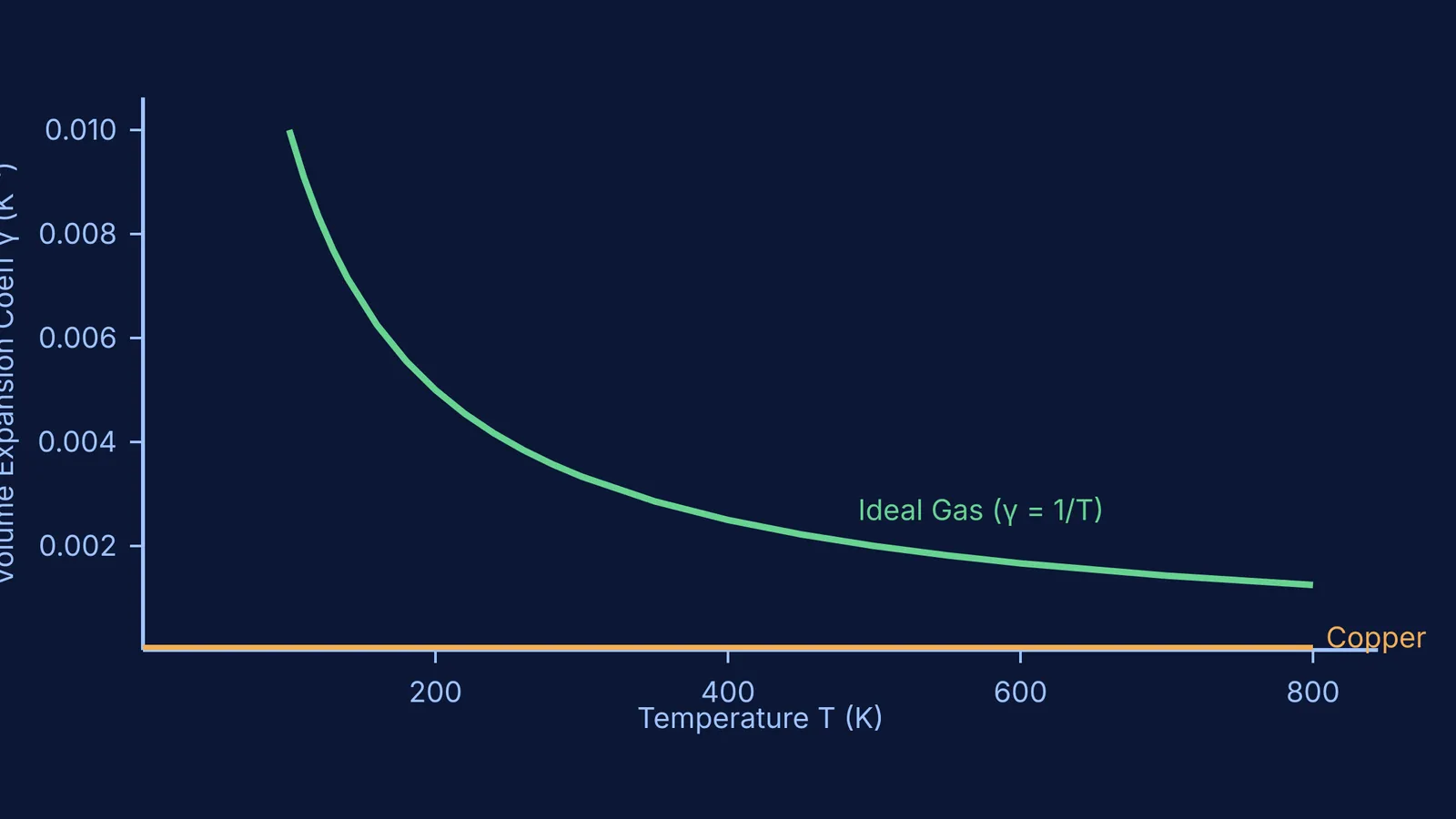
Because a gas's expansion coefficient is 1/T, it is enormous compared to a solid, and it drops steadily as the gas heats up.
At room temperature (around 293 K), the coefficient of volume expansion for an ideal gas is 1/293, or approximately 3.4 × 10⁻³ K⁻¹.
Compare this to copper. The linear expansion coefficient of solid copper is 16.7 × 10⁻⁶ K⁻¹, making its volume expansion coefficient roughly 5.0 × 10⁻⁵ K⁻¹. This means that at room temperature, a gas expands nearly 68 times more than copper for the exact same rise in temperature.
However, as the gas gets hotter, T increases, so the value of 1/T gets smaller. The hotter the gas, the less aggressively it expands for each additional degree of heat. At 600 K, the expansion coefficient halves to roughly 1.6 × 10⁻³ K⁻¹.
How to use this in thermodynamics problems?
In exams, knowing that γ = 1/T saves you time when working through Ideal gas problems: gas laws, Dalton's law and the units trap.
Whenever a question asks for the fractional change in volume of an ideal gas at constant pressure, you do not need to know the pressure or the amount of gas. You only need the initial temperature.
Here is a quick worked example. If an ideal gas is heated from 300 K to 301 K at constant pressure, the fractional increase in volume is simply 1/300, which is approximately 0.33%. You can apply this same shortcut logic when Converting PV, PT and VT graphs of ideal gas processes to quickly find the slope of the V-T graph without plugging in P and n.
Keep in mind that if you are working on a process that is not at constant pressure, such as the Free expansion of an ideal gas: why work and ΔU are both zero, this standard volume expansion coefficient does not apply because the pressure is dropping as the gas expands. The γ = 1/T rule is strictly an isobaric (constant pressure) property. Practising these different scenarios with the Fermi Problem Library offers worked problems with a step-by-step solver that explains the reasoning, helping you spot the difference between constant-pressure and free-expansion problems instantly.


