

On this page
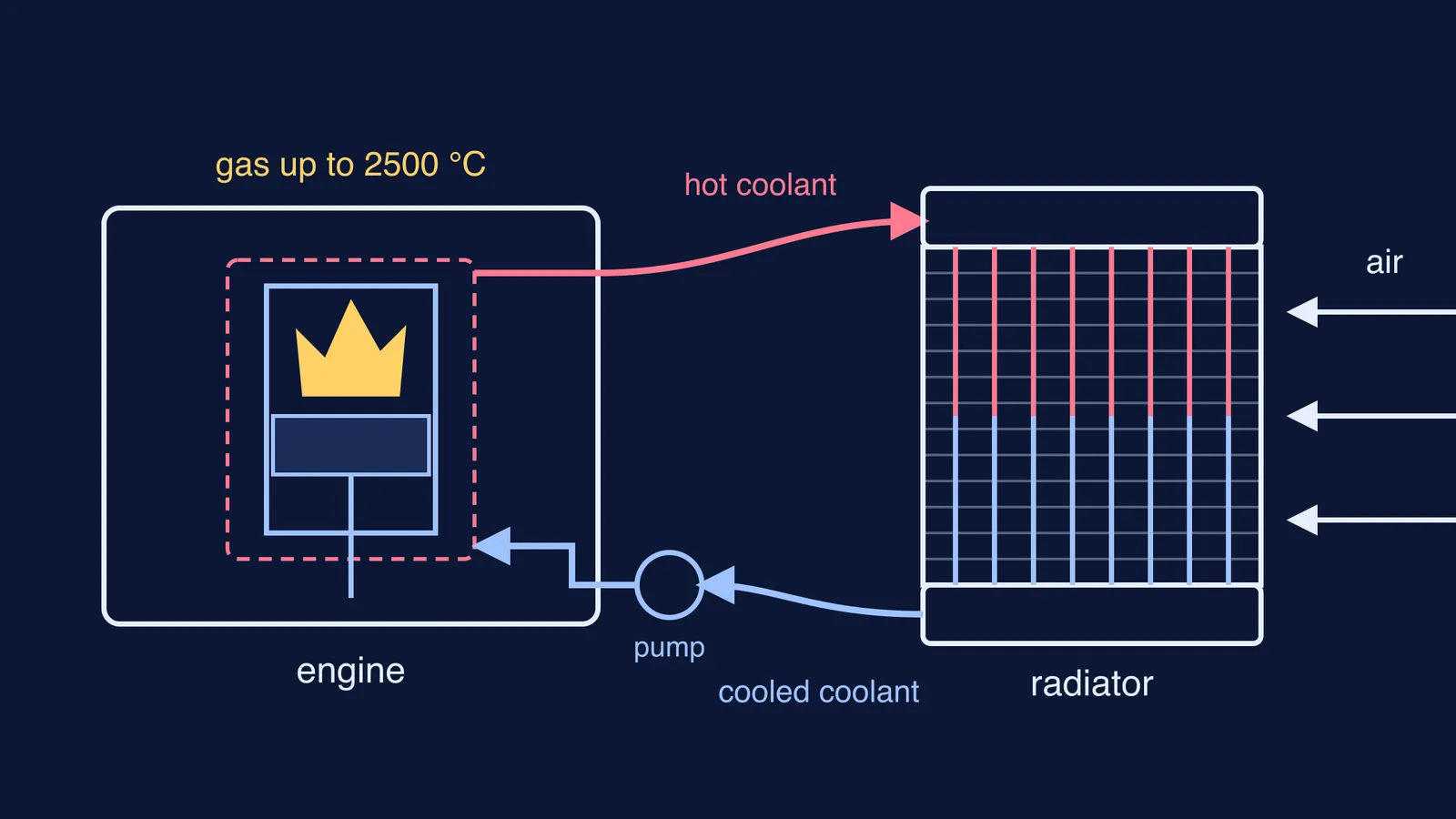
Soon after you start it, a car engine is too hot to touch, yet it runs for years without melting. The reason is a loop of liquid and a radiator, a clear everyday use of heat transfer and specific heat from Class 11 physics.
Why does a car engine get so hot?
An engine turns the chemical energy in petrol or diesel into motion, but most of that energy never reaches the wheels. The US Department of Energy says only about 12% to 30% of the fuel's energy moves a conventional car, and that most of the rest is lost in the engine, primarily as heat. In combined driving, the same page puts engine losses at 68% to 72%.
The heat is fierce where it is made. Peak gas temperatures in the combustion chamber can reach up to 2,500 °C, according to CAR magazine. For comparison, aluminium melts at about 660 °C. The burning gas is far above the melting point of a common engine metal, so the engine needs a steady way to pull heat out of its walls.
What does the coolant actually do?
A pump pushes liquid through passages around the cylinders. The liquid picks up heat from the hot metal by conduction, carries it away by flowing (forced convection), and gives it up in the radiator. An engineering overview from Edumech describes the system's job as removing excess heat from combustion and friction and holding the engine within a narrow temperature range. It also notes that the loop is kept under pressure on purpose, because higher pressure raises the coolant's boiling point.
Coolant is not plain water. A 50% (by volume) ethylene glycol mixture boils at 107.2 °C and freezes at −36.8 °C, according to Engineering Toolbox, and Edumech adds that coolant protects against corrosion. The trade-off is that the mixture's specific heat is about 20% lower than water's, by the same Engineering Toolbox page.
Why is water so good at carrying heat?
Specific heat capacity is the energy needed to raise the temperature of 1 kg of a substance by 1 °C. Water needs 4,184 joules to warm 1 kg by 1 °C, while copper needs only 385 joules, according to the US Geological Survey. That makes water's specific heat about 11 times copper's, so each kilogram of water carries away a lot of heat while warming only a little. CAR magazine notes that air's specific heat is roughly four times lower than water's per kilogram, which is why modern high-output engines rely on water cooling.
Mixing up specific heat and heat capacity? Our explainer on specific heat vs heat capacity sorts it out.
In the radiator, hot coolant spreads into many thin tubes joined by metal fins, which give a large surface for air to sweep past. More surface means more heat lost each second, the same idea behind why heat sinks have fins.
How much coolant has to flow each second?
CAR magazine gives a real-world figure: a car using 6 litres per 100 km at a steady 100 km/h burns about 57 kW of chemical energy, and about 19 kW of it leaves through the cooling system, one-third of the total. Use the heat equation per second, P = ṁcΔT, where ṁ is the mass of coolant flowing each second.
Assume the coolant warms by 10 °C per trip through the engine (our assumption, not a measured figure).
Plain water, c = 4,184 J/(kg·°C): ṁ = 19,000 ÷ (4,184 × 10) ≈ 0.45 kg/s, or about 27 kg of water every minute.
50% glycol mix, c about 20% lower: ṁ ≈ 0.45 ÷ 0.8 ≈ 0.57 kg/s, about 34 kg a minute.
Air instead of liquid, c roughly four times lower: ṁ ≈ 4 × 0.45 ≈ 1.8 kg/s, a huge volume of light air.
Water allowed to warm by only 5 °C: ṁ doubles to about 0.91 kg/s.
The pattern: halve the allowed temperature rise and you double the flow; lower the specific heat and you need more flow. This is also why a car crawling through summer traffic can run hot. The engine still makes heat, but much less air rushes through the radiator.
If a loop like this is hard to picture from text, the Fermi Simulation Lab has interactive simulations for ideas that are easier to see than to read. For ṁcΔT practice, the Fermi Problem Library has worked problems with a step-by-step solver that explains the reasoning.
How do you explain this in an exam answer?
A four-line answer covers "Why does a car engine need a radiator?":
Source: burning fuel releases energy, and most of it becomes heat, not motion.
Problem: the gas is far hotter than the engine's metal can bear.
Carrier: water's high specific heat lets coolant absorb much heat for a small temperature rise; pressure raises its boiling point.
Exit: the radiator's finned tubes give a large surface, and air carries the heat away by convection.
For where this rejected heat fits in an engine's energy accounts, see our worked example on work from a heat engine, W = Q1 − Q2.


