

On this page
Your iron clicks off, cools a little and clicks on again while it is plugged in. In a basic iron, a strip of two metals that bends when hot does the switching.
How does a bimetallic thermostat work in an iron?
A bimetallic strip is two metals with different expansion rates joined together, so it bends one way when heated and the other way when cooled (Wikipedia: Bimetallic strip). In a thermostat, one end of the strip is fixed and connected to the supply, and the free end carries an electrical contact; in an electric iron those contacts can switch the heater power directly (same source).
The cycle runs like this:
Cold: the strip is straight and its contact presses on a fixed contact. Current flows through the heating element.
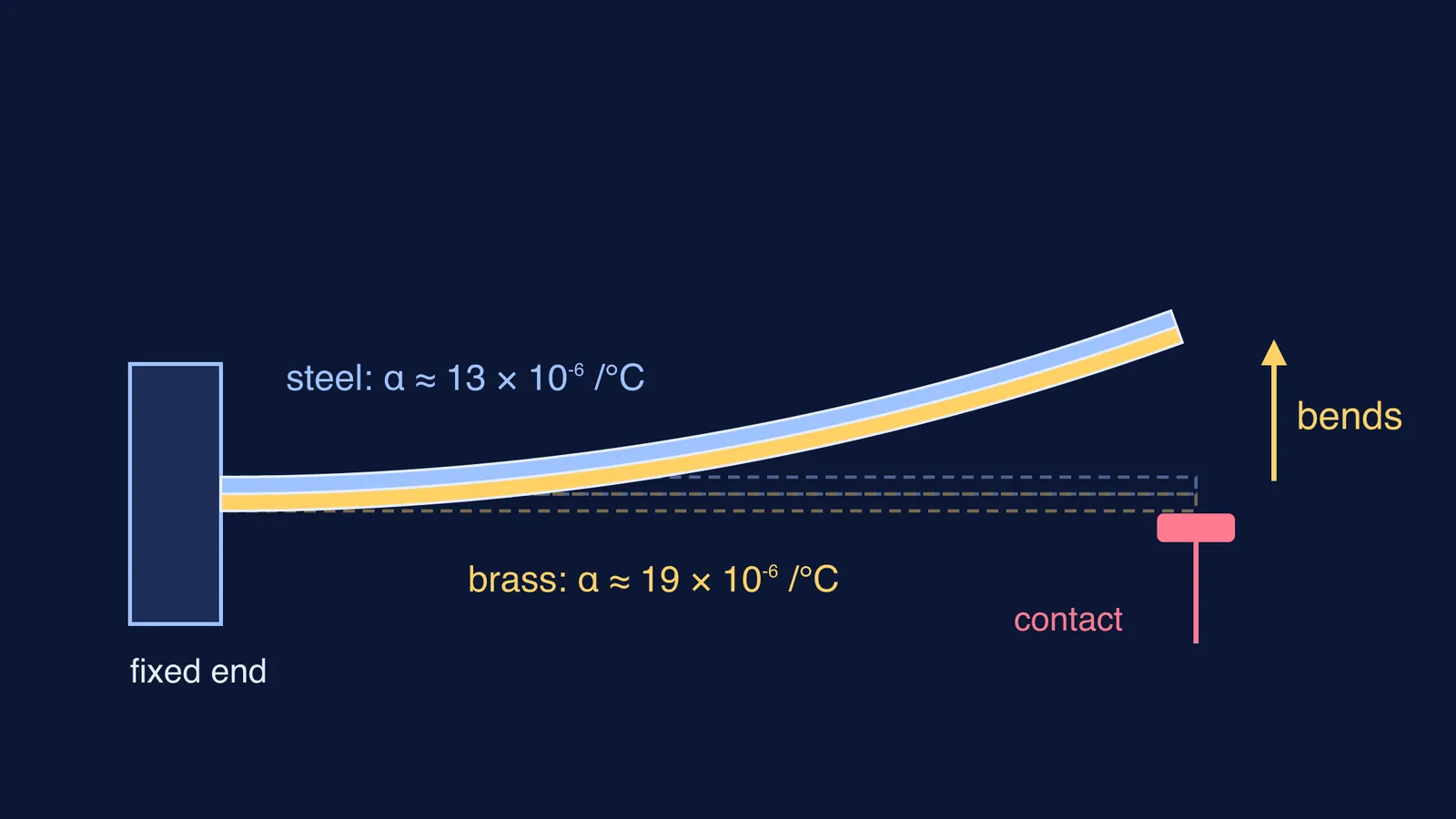
Heating: brass grows more than steel, so the strip curls with the brass on the outside of the curve.
Set temperature: the free end lifts off the fixed contact, the circuit opens and the heater stops. That break is the click.
Cooling: the strip straightens, the contacts touch again and heating restarts, so the temperature swings a little around the setting.
Why does the strip bend instead of just getting longer?
Each metal on its own grows by ΔL = αLΔT. The HyperPhysics expansion table gives α as 19 × 10⁻⁶ per °C for brass and 13 × 10⁻⁶ per °C for steel.
Bonded together, neither metal can take its own length. The only shape that lets one face be longer than the other is an arc, just as the outer lane of a running track is longer than the inner lane. The metal with the larger α ends up on the outside. For the sign conventions, read which way a bimetallic strip bends when heated.
How far does the strip actually move?
Stephen Timoshenko published a classic analysis of bimetal thermostats in 1925 in the Journal of the Optical Society of America. His radius-of-curvature formula, reproduced in a 2013 paper by Angel, Haritos and Campbell, includes the thickness ratio and the ratio of Young's moduli of the two layers. For layers of equal thickness and equal stiffness, it simplifies to 1/ρ = 3(α₂ − α₁)ΔT / 2t, where t is the total thickness.
A worked example for an illustrative strip (not a measured part from a real iron): brass on steel, each layer 0.5 mm, so t = 1 mm; length L = 40 mm; heated from 30 °C to 200 °C, so ΔT = 170 °C. Stiffnesses are treated as equal, with α from HyperPhysics.
Difference in expansion: Δα = 19 − 13 = 6 × 10⁻⁶ per °C.
Curvature: 1/ρ = 3 × 6 × 10⁻⁶ × 170 / (2 × 0.001 m) ≈ 1.53 per metre, so ρ ≈ 0.65 m.
Tip movement for a small bend: about L² / 2ρ = (0.04 m)² × 1.53 / 2 ≈ 0.0012 m, or roughly 1.2 mm.
Per degree: 1.2 mm / 170 °C ≈ 0.007 mm per °C.
Over the same 170 °C, the 40 mm brass layer on its own would grow by about 0.13 mm and the steel by about 0.09 mm, a difference of only 0.04 mm. Bending turns that mismatch into about 1.2 mm of movement at the tip, roughly 30 times more. That amplification lets a small temperature change move the contact a usable distance.
For unequal layers and the full geometry, see bimetallic strip bending: direction and radius of curvature.
What does the temperature dial change?
In an adjustable thermostat, the fixed contact is positioned by a knob or lever, which sets the switching temperature (Wikipedia: Bimetallic strip). Turning the dial up moves that contact further along the direction the strip bends, so the strip must curl more, and get hotter, before it lets go.
With our example strip at about 0.007 mm per °C, moving the contact by just 0.1 mm shifts the cut-off by roughly 14 °C, so the adjustment has to be very fine. For the household side, read how an electric iron stops getting too hot.
Can you answer these exam-style checks?
Which metal sits on the outside of the curve when heated? (The one with the larger α, brass here.)
What if both metals have the same α? (No bending; the strip only gets longer.)
What if the strip is cooled below room temperature? (It bends the other way.)
If you double t, what happens to the tip movement? (It halves.)
If the scaling questions tripped you up, the Fermi Concept Library gives every physics concept its own lesson and its place in the map. For more numericals like the one above, the Fermi Problem Library has worked problems with a step-by-step solver that explains the reasoning rather than printing an answer.
Next time your iron clicks, you will know a bend of about a millimetre is doing the work.


