

On this page
A bimetallic strip is one of the classic demonstrations of thermal expansion. It consists of two different metals—often brass and iron, or brass and steel—welded or riveted tightly together along their length. When the temperature changes, the strip curls.
If you are studying for physics exams or trying to understand how a mechanical thermostat works, you need to know not just that it bends, but *which way* it bends. The answer lies in the metals' different rates of expansion.
Why does brass expand more than iron?
Different materials respond to heat differently. At a microscopic level, when a metal is heated, its atoms vibrate more vigorously. As this kinetic energy increases, the average distance between the atoms grows, causing the entire material to expand outward. We measure this property using the coefficient of linear expansion (α), which tells us how much a material's length changes per degree of temperature change.
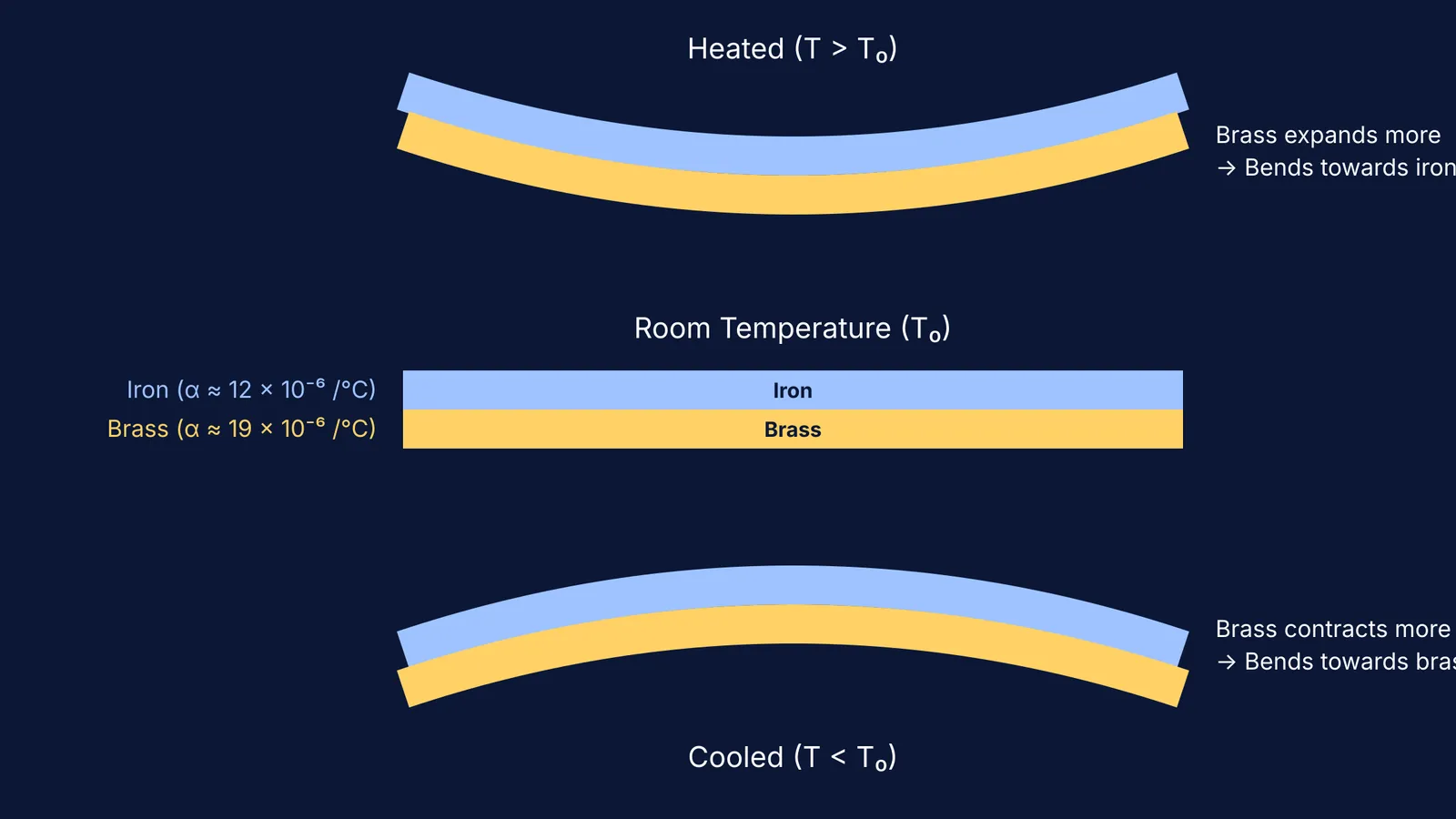
The coefficient of linear expansion for brass is approximately 19 × 10⁻⁶ /°C (Engineering ToolBox). The coefficient of linear expansion for iron is approximately 12 × 10⁻⁶ /°C.
Because the coefficient for brass is about 1.6 times greater than that of iron, a brass rod will lengthen significantly more than an iron rod when both are heated by the same amount. (You will find this same property creates problems in precision timekeeping, as seen in the pendulum clock thermal expansion).
Which way does a bimetallic strip bend when heated?
When you heat a bimetallic strip made of brass and iron, both metals try to expand. However, the brass tries to expand more than the iron. Because the two metals are bonded together and cannot slide past one another, the longer brass side is forced to take the "long way" around the curve.
As a result, the strip bends towards the iron (Wikipedia). The iron forms the inside of the curve, while the brass forms the outside.
Visualising how these forces push and pull can be challenging when reading from a textbook. In the Fermi Simulation Lab, you can change the temperature of different metal pairs and watch the resulting curvature adjust in real time, making the abstract coefficients immediately visible.
Which way does a bimetallic strip bend when cooled?
When the same strip is placed in an ice bath and cooled below room temperature, the process reverses.
Both metals contract, but the brass contracts more than the iron. Because the brass is now trying to be shorter than the iron, it forces the strip to curve in the opposite direction.
When cooled, the strip bends towards the brass. The brass forms the shorter, inside path of the curve, and the iron forms the longer, outside path. (If both ends of a single rod were fixed so it could not bend or contract, it would instead experience severe forces; this is the basis of thermal stress in clamped rods).
How does a bimetallic strip work in a thermostat?
The bending action of a bimetallic strip is not just a laboratory trick; it is a highly reliable mechanical switch used in everyday appliances. In a traditional heating thermostat, the strip forms part of an electrical circuit.
When the room temperature drops too low, the strip cools and curls enough to touch a metal contact. This completes the electrical circuit and switches your heater on. As the room warms up, the strip heats, straightens out, and eventually curves the other way, breaking the connection and turning the heater off. This simple, robust design requires no complex electronics or software to maintain a steady temperature.
A simple framework for predicting the bend
If you are facing a multiple-choice question with unfamiliar metals, use this three-step plan to find the answer without guessing:
Identify the active metal: Find which metal has the higher coefficient of thermal expansion (α). The metal with the higher coefficient is the "active" component that drives the movement. For example, in a strip made of brass and Invar (a special steel alloy with an extremely low coefficient of thermal expansion), brass is strongly active.
Determine the length change:
If the system is heated, the active metal expands the most and becomes the *longest* side of the strip.
If the system is cooled, the active metal contracts the most and becomes the *shortest* side of the strip.
Shape the curve: The physical geometry of a curve dictates that the longest side must always form the outer arc, while the shortest side forms the inner arc.
By applying this logic step-by-step, you never need to memorise the bending directions. You can simply derive them from the fundamental properties of the metals. This structured approach is especially useful in exams where questions often substitute brass and iron for unknown metals labelled simply as Metal A and Metal B.


