

On this page
Have you ever wondered why your clothes iron clicks periodically while you are using it? That click is the sound of an automatic switch turning the heating element on and off to maintain a steady temperature. If an iron simply heated up continuously, it would quickly melt synthetic fabrics and start a fire. Instead, it relies on a brilliant application of physics: thermal expansion.
How does an electric iron stop getting too hot?
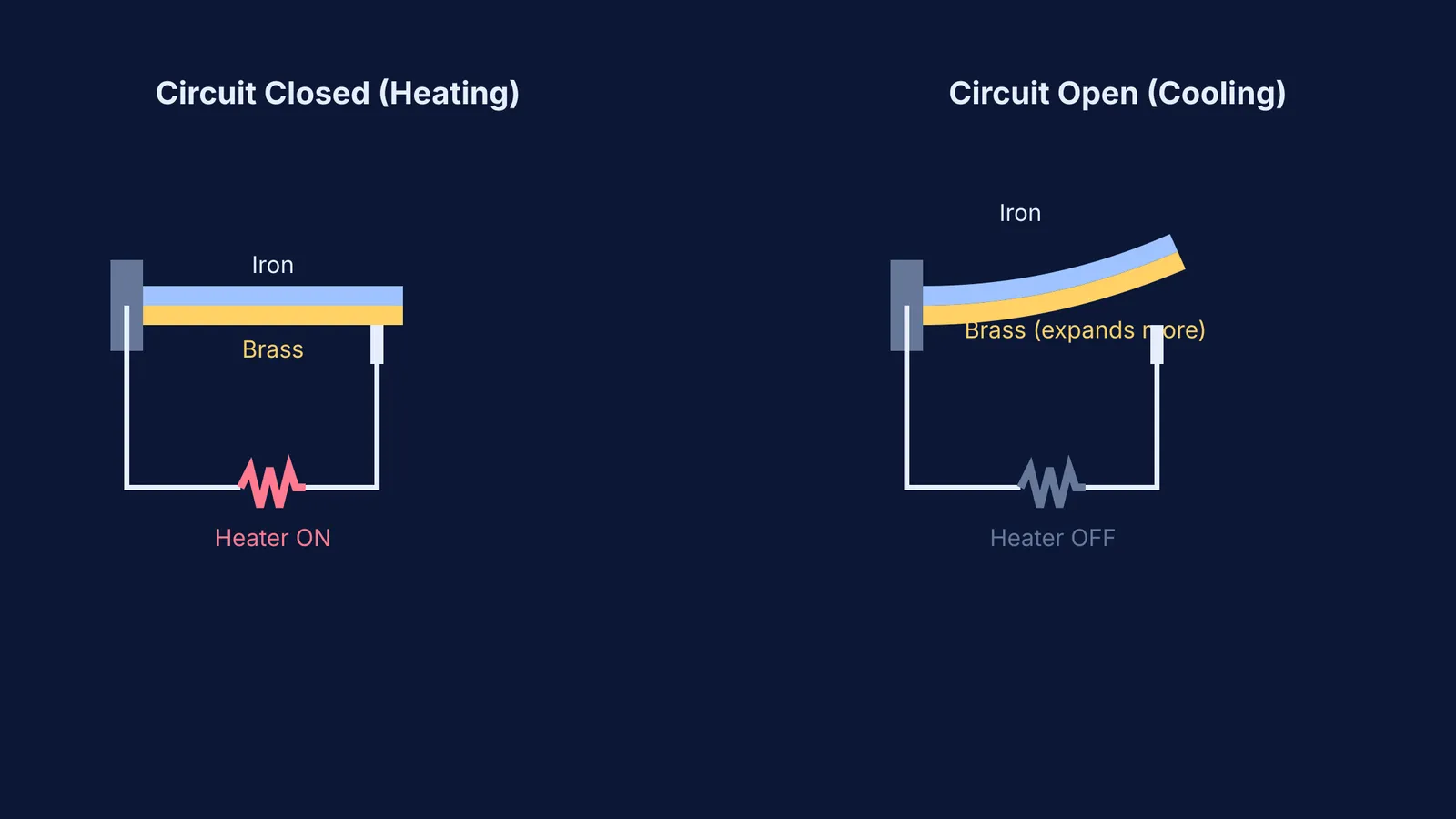
The secret inside your iron is a bimetallic strip thermostat. This thermostat is wired directly into the electrical circuit that powers the iron's heating element.
When you plug the iron in, electricity flows through a closed circuit, and the heating element gets hot. As the iron's soleplate warms up, so does the bimetallic strip. Once the iron reaches its maximum safe temperature, the strip physically bends away from an electrical contact point. This opens the circuit, cutting off the electricity and allowing the iron to cool.
As the iron cools down, the thermostat straightens back out, eventually touching the contact point again and completing the circuit to restart the heating cycle. This continuous on-and-off cycling keeps the average temperature exactly where you need it. If you want to explore how materials change shape under heat interactively, the Fermi Simulation Lab offers interactive simulations for the ideas that are easier to see than to read.
What is a bimetallic strip?
A bimetallic strip is made by securely bonding two different metals together—typically brass and iron, or sometimes copper and steel.
All metals expand when heated, but they do not expand by the same amount. This property is measured by the coefficient of linear expansion (α). Brass has a coefficient of linear expansion of roughly 19 × 10⁻⁶ / °C, while iron is significantly lower at around 12 × 10⁻⁶ / °C.
Because brass expands over 50% more than iron for the same rise in temperature, heating the bonded strip creates uneven stress. The brass side lengthens faster than the iron side, forcing the entire strip to curve. It always bends towards the metal that expands less—in this case, the iron. This is the exact same physical principle that results in a pendulum clock losing time in summer as its metal rod grows longer in the heat.
In the iron, the brass layer is positioned so that as it expands, the strip arcs away from the electrical contact, neatly and safely breaking the circuit.
How does the temperature dial work?
If a bimetallic strip bends predictably based purely on temperature, how can one iron press both delicate silks and sturdy cottons?
The temperature dial on your iron does not change the physical properties of the bimetallic strip. Instead, turning the dial simply changes the physical distance between the strip and the electrical contact point.
Low setting: For delicate fabrics, the dial moves the contact point closer to the strip. The strip only needs to bend a tiny amount to break the circuit, which happens at a relatively low temperature.
High setting: For tough fabrics, the dial moves the contact point further away. The strip must curve significantly more to reach and break the circuit, allowing the soleplate to get much hotter before the heat shuts off.
If you are studying for exams and need to calculate the exact bending radius of a strip or the electrical work done by a heating element, the Fermi Problem Library has worked problems with a step-by-step solver that explains the reasoning rather than printing an answer. (Similarly, you can learn more about how physical changes affect circuits by reading about stretching a wire: how its resistance changes with length).
Setting the right temperature for your clothes
To protect your clothes, international care labels use a standard "dot" system that matches the thermostat settings on your iron. These dots correspond to the maximum soleplate temperatures regulated by the bimetallic strip:
One dot (●): Low heat, approximately 110 °C (230 °F). This is used for synthetics like nylon and acrylic, which can easily melt if the strip allows the iron to get any hotter.
Two dots (●●): Medium heat, approximately 150 °C (302 °F). This is used for wool and silk.
Three dots (●●●): High heat, approximately 200 °C (392 °F). This is used for cotton and linen, which require significant heat and steam to relax their strong plant fibres.
Troubleshooting an overheating iron
If your iron is scorching clothes even on the lowest "one dot" setting, the bimetallic strip's contacts might be fused together (welded shut by an electrical spark over time), or the dial mechanism itself may be physically broken. In this scenario, the circuit never breaks, and the iron will continue heating uncontrollably.
Fortunately, modern irons feature a secondary safety device: a thermal fuse. If the bimetallic strip fails, this one-time fuse will melt at a critically high temperature to prevent a fire. If your iron stops heating entirely after a period of running far too hot, that thermal fuse has likely blown, meaning the appliance has safely sacrificed itself and needs professional repair.


