On this page
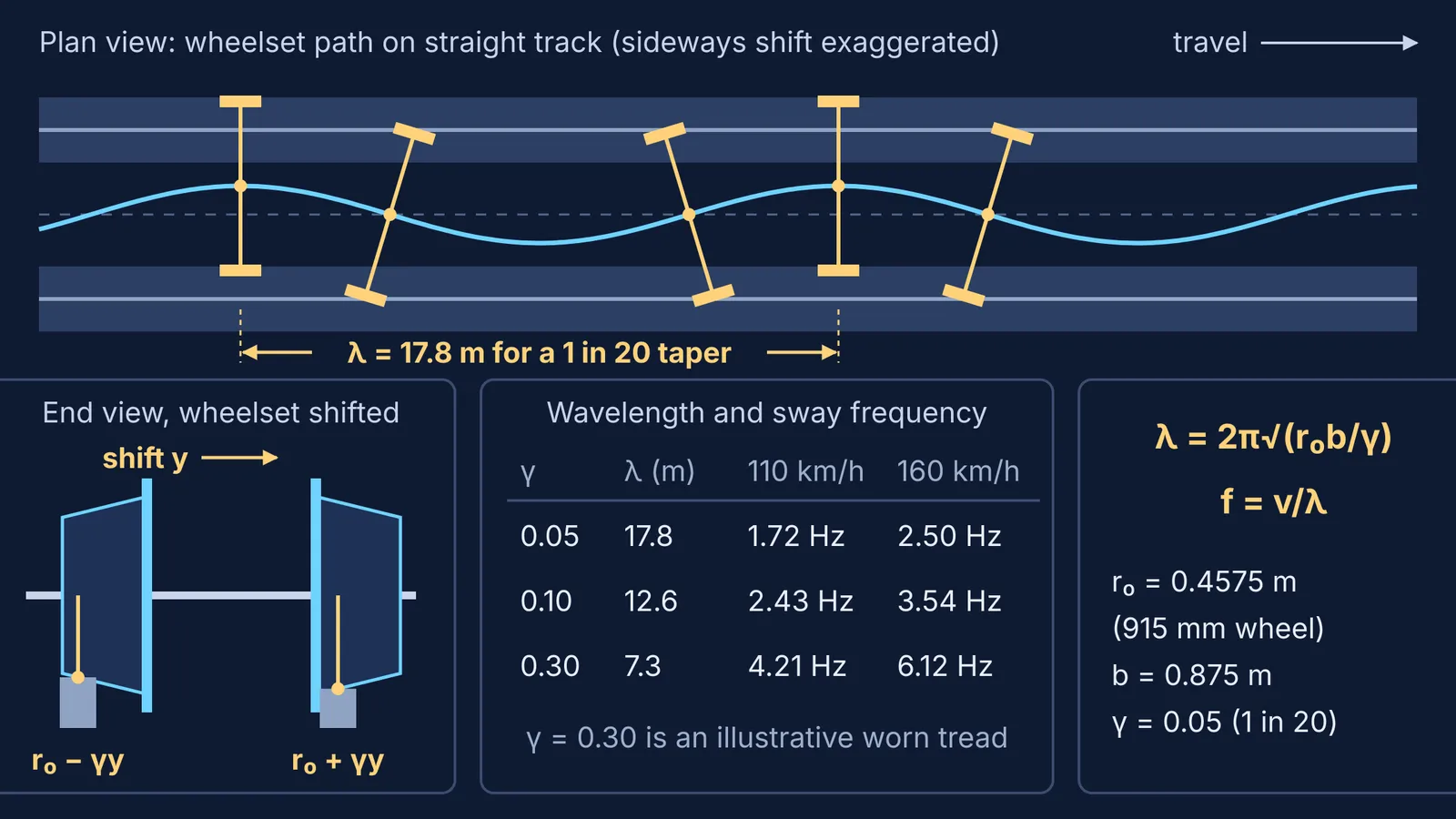
Watch a coach roll past on straight track and you may see a faint side-to-side weave. That is what a coned wheelset does on its own: it rolls back and forth across the rails in a sine wave. For a classic 1 in 20 taper on an Indian broad-gauge coach wheel, one full weave takes about 17.8 m of track. At 160 km/h that is a sideways shake of 2.5 times a second.
Why the wheels are coned in the first place, and how the cone steers a solid axle round a curve, is explained in why train wheels are shaped like cones. That post names hunting in one sentence. Here we work out the length and frequency of the weave with Class 11 kinematics and oscillations.
A safety note first: never walk on or near railway tracks. Everything here can be watched from behind the platform's yellow line or worked out on paper.
Why does a coned wheelset sway from side to side?
A wheelset is two wheels fixed on one solid axle, so both turn at the same angular speed ω. Each tread slopes, so its rolling radius depends on where it touches the rail.
Let the wheelset drift sideways by a small distance y. Call the nominal rolling radius r₀ and the slope of the tread γ (the conicity: 0.05 for 1 in 20). Then:
The wheel that has moved towards its rail now touches nearer its flange, on a radius r₀ + γy.
The other wheel touches further out, on r₀ − γy.
Same ω, different radii, so one wheel moves forward at ω(r₀ + γy) and the other at ω(r₀ − γy).
The faster wheel gets ahead, so the axle turns (yaws) back towards the centre line. But nothing stops it exactly at the centre. It crosses over at an angle, the radii swap, it turns back, and so on: a steady weave.
What is Klingel's formula for the wavelength?
J. Klingel published the small-oscillation model of a coned wheelset in 1883. A clear modern derivation is given by Antali, Stépán and Hogan in Multibody System Dynamics. Here it is in student form. Let b be half the distance between the two contact points, and v the forward speed.
Yaw rate. The two wheels differ in speed by 2γy × (v/r₀). Divided by their separation 2b, this turns the axle at dψ/dt = −vγy/(r₀b).
Sideways speed. If the axle points at a small angle ψ to the track, it drifts sideways at dy/dt = vψ.
Combine. Differentiate step 2 and use step 1: d²y/dt² = −(v²γ/(r₀b)) y.
That is simple harmonic motion, with angular frequency ω = v√(γ/(r₀b)). Since the wheelset covers v in one second, the length of track per cycle is:
λ = 2π√(r₀b/γ), and the frequency is f = v/λ.
Speed cancels out of λ. The path is a fixed sine wave in space, set by geometry alone; go faster and you run along it sooner, so f rises with speed. If the sine-wave picture needs a refresher, see SHM and the reference circle.
Klingel's model assumes a small cone angle and rolling without slip, and Antali and co-authors show the exact answer can differ noticeably. Treat λ as a first estimate.
How long is the weave on an Indian broad-gauge coach?
Gauge. Indian broad gauge is 1676 mm, as listed in the Indian Railways profile on the IRCEP site.
Wheel size. ICF and LHB coach wheels are 915 mm in diameter when new, according to IRIMEE's notes on wheelsets and wheel profiles, the Indian Railways mechanical engineering institute. So r₀ = 0.4575 m.
Taper. The same notes describe the coaching wheel profile: curved sections near the flange, and an inclination of 1 in 20 on the outer part of the tread. A real profile is not a perfect cone, so we use γ = 0.05 as the textbook value.
Contact spacing. The contact points sit a little outside the gauge line. We take 2b = 1.75 m, so b = 0.875 m. This is a round illustrative value.
Worked example: 1 in 20 taper at 110 and 160 km/h
r₀b/γ = 0.4575 × 0.875 / 0.05 = 8.006 m².
√8.006 = 2.829 m.
λ = 2π × 2.829 = 17.8 m.
At 110 km/h, v = 30.6 m/s, so f = 30.6/17.8 = 1.72 Hz.
At 160 km/h, v = 44.4 m/s, so f = 44.4/17.8 = 2.50 Hz, one weave every 0.40 s.
Units: r₀b/γ is in m², so its root is a length.
If the wheelset drifts 5 mm, the two rolling radii differ by 2 × 0.05 × 0.005 m = 0.5 mm. That half-millimetre is enough to steer a coach.
What happens when the wheels wear?
The square root makes λ sensitive to conicity. Keep r₀ and b fixed and vary γ:
γ = 0.05 (1 in 20): λ = 17.8 m; f = 1.72 Hz at 110 km/h and 2.50 Hz at 160 km/h.
γ = 0.10 (1 in 10): λ = 12.6 m; f = 2.43 Hz and 3.54 Hz.
γ = 0.30: λ = 7.3 m; f = 4.21 Hz and 6.12 Hz.
The last line is a round illustrative value for a worn tread. Wear hollows the tread so it hugs the rail head, and the rolling radius changes faster with sideways shift. Engineers call the result an equivalent conicity (the cone slope with the same wavelength), and it varies widely. A smaller wheel shortens the wave a little: 825 mm, the ICF condemning size in the same IRIMEE notes, gives 16.9 m at γ = 0.05.
A standard-gauge wheelset (b = 0.75 m, r₀ = 0.46 m, illustrative) at γ = 0.05 gives 16.5 m.
Why does the gentle weave turn into hunting at high speed?
Klingel's wheelset is free: no springs, no bogie, no coach. A real wheelset is held in a bogie by springs and dampers. At low speed the weave is slow and the suspension follows it. As speed rises, so does v/λ. Above a critical speed the mass and springs of the bogie start feeding the motion instead of damping it, and the weave grows until the flanges strike the rails. That violent, self-sustaining motion is hunting.
The critical speed cannot be read from λ, because it depends on the suspension. What λ gives is the trend: a steeper or worn profile means a shorter wave and a higher frequency at the same speed, one reason wheels are re-profiled on a schedule. Coned wheels are not unsafe; hunting is controlled by design and maintenance.
Cars solve the different-wheel-speeds problem with gears instead of cones: see how a car differential works.
To revise simple harmonic motion and how wavelength links to frequency, the Concept Library explains each idea step by step.
Quick checklist
Drift y changes the rolling radii to r₀ ± γy, which steers the axle back and makes it overshoot.
Klingel: λ = 2π√(r₀b/γ), independent of speed; f = v/λ.
1 in 20 taper, 915 mm wheel, b = 0.875 m: λ ≈ 17.8 m, 2.50 Hz at 160 km/h.
Larger conicity or a smaller wheel gives a shorter wave.
Hunting needs the bogie's mass and springs; λ alone does not give the critical speed.
Watch trains from the platform, never from the track.