

On this page
When a car turns, its two driven wheels cannot turn at the same rate. The outer one runs round a bigger circle in the same time, so it has to spin faster. A box of bevel gears on the axle, the differential, allows this. It also has a catch that every driver meets sooner or later: if one wheel sits in mud, the car can stay put even though the other wheel is on firm ground. Both facts follow from v = ωr and a torque balance.
Why does the outer wheel have to turn faster on a turn?
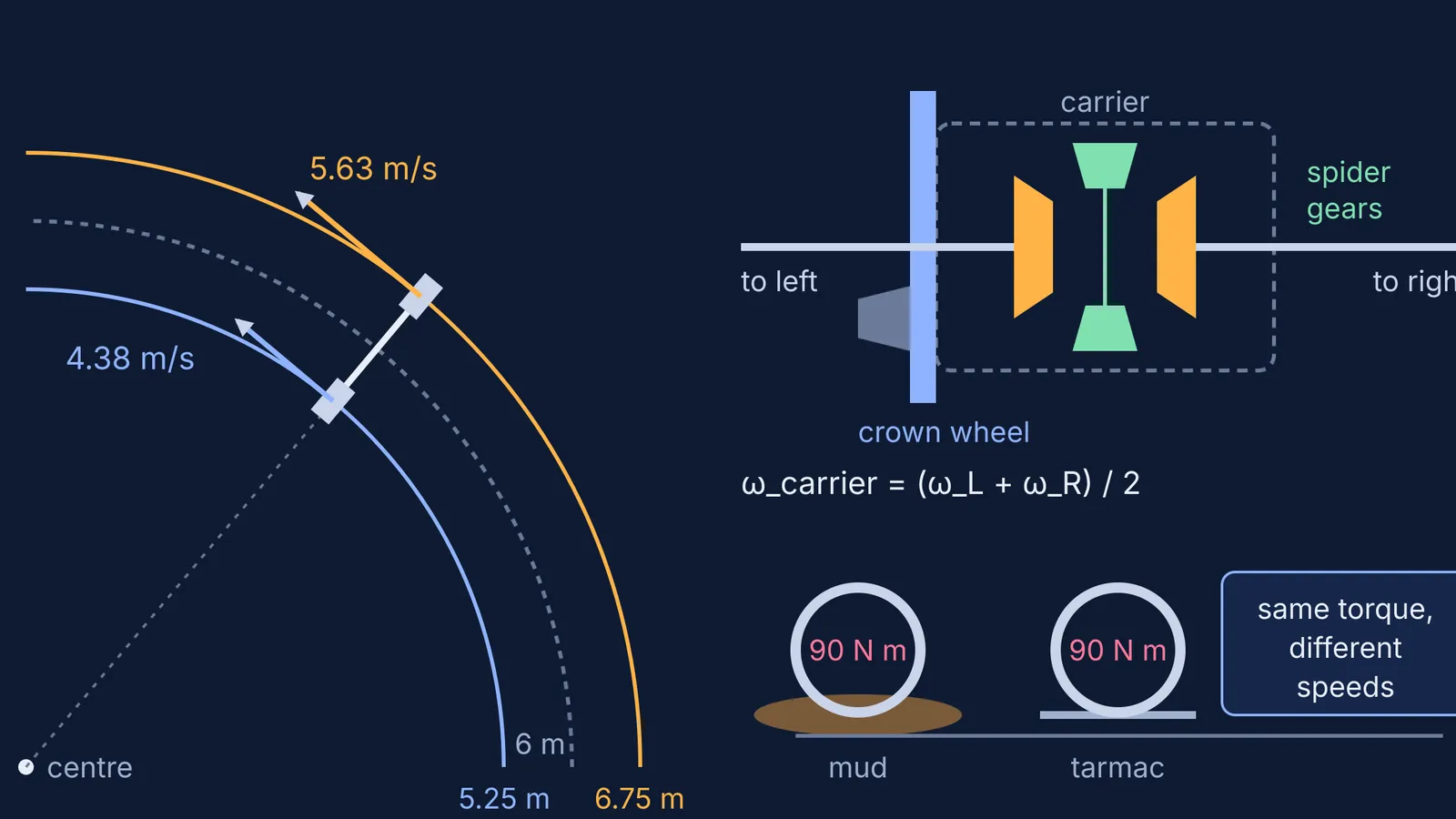
A turning car rotates about a centre point. Every part of it has the same angular speed Ω about that point, so each wheel's speed is v = Ω × (its own radius). The wheels on the outside sit further from the centre, so they move faster. Railways solve the same problem a different way, with coned wheels on a solid axle, as explained in why train wheels are shaped like cones.
If the two rear wheels were joined by one solid axle, they would have to turn at the same rate. On a turn, one tyre would then have to slide or scrub along the road. That wears the tyre and fights the steering.
How does a differential let the two wheels turn at different speeds?
The engine's drive comes through a small pinion to a large crown wheel (ring gear). Bolted to the crown wheel is a cage called the carrier. Inside the carrier, two small spider gears sit on a pin. They mesh with two side gears, one on each half-shaft that goes to a wheel.
Going straight. The spider gears do not spin on their pin. They act like a solid lock, and the whole carrier, both side gears and both wheels turn together.
Turning. The spider gears start to spin on their pin. As they do, one side gear gets ahead and the other falls behind by the same amount.
The result is a simple rule, stated in COMSOL's differential gear model notes: the average of the two wheel speeds equals the input speed, and an increase in one is balanced by a decrease in the other.
ω_carrier = (ω_L + ω_R) ÷ 2
Here ω_carrier means the crown wheel's rate after the final reduction. The gear ratio from engine to wheel is covered in why vehicles need gears; the differential adds the averaging rule on top of it.
Worked example: how much faster does the outer wheel spin?
Take a car turning on a circle of radius 6 m, measured to the middle of the rear axle. The rear track (distance between the wheels) is 1.5 m, each wheel's radius is 0.30 m, and the middle of the axle moves at 5 m/s. These are round illustrative values.
Angular speed of the car. Ω = v ÷ R = 5 ÷ 6 = 0.833 rad/s.
Radius of each wheel's path. Inner: 6 − 0.75 = 5.25 m. Outer: 6 + 0.75 = 6.75 m.
Speed of each wheel along the road. Inner: 0.833 × 5.25 = 4.38 m/s. Outer: 0.833 × 6.75 = 5.63 m/s.
Spin rate of each wheel. ω = v ÷ r. Inner: 4.375 ÷ 0.30 = 14.6 rad/s (139 rpm). Outer: 5.625 ÷ 0.30 = 18.8 rad/s (179 rpm).
Ratio. 18.75 ÷ 14.58 = 1.286, so the outer wheel spins 28.6% faster. This is just 6.75 ÷ 5.25.
Carrier. (14.58 + 18.75) ÷ 2 = 16.7 rad/s, the same as 5 ÷ 0.30, the rate a wheel at the middle of the axle would turn.
Through a 90° turn. Inner path = (π/2) × 5.25 = 8.25 m. Outer path = (π/2) × 6.75 = 10.6 m. The outer wheel covers 2.36 m more, which is 2.36 ÷ (2π × 0.30) = 1.25 extra turns.
Without a differential, the tyres would make up those 2.36 m by sliding.
Why does a differential give both wheels the same torque?
Look at one spider gear. It is free to spin on its pin, and it is light, so the torques on it about the pin must balance. One side gear pushes on its teeth on one side; the other side gear pushes on the opposite side, at the same distance from the pin. For balance, those two forces must be equal. Equal forces at equal radii on the side gears mean equal torques on the two half-shafts.
So an ideal open differential always gives both wheels the same torque, even while it lets them turn at different speeds. A CarExpert explainer on differentials puts it plainly: an open differential can only split the torque 50/50, so torque still goes to a wheel without traction, which spins without moving the vehicle.
Note what is equal: torque, not power. Power is torque × ω, so on a turn the faster outer wheel gets more power at the same torque.
Why does one wheel in mud leave the car stuck?
A tyre can pass on at most μN of force to the ground before it slips, which means a torque of μNr. Take each rear wheel carrying N = 3,000 N (a car of about 1,220 kg), and rough illustrative friction values: μ = 0.8 on dry tarmac and μ = 0.1 on wet mud.
Mud wheel limit. 0.1 × 3,000 × 0.30 = 90 N m. Any more and it spins.
The other wheel. The differential gives it the same torque, so it also gets only 90 N m, though it could take 0.8 × 3,000 × 0.30 = 720 N m on its own.
Total push. Each wheel pushes with 90 ÷ 0.30 = 300 N, so the car gets 600 N in all.
What is needed. To climb a muddy 1-in-10 slope out of a rut takes at least 12,000 × sin(5.7°) = 1,190 N, before any rolling resistance.
600 N is not enough, so the car stays. Pressing the accelerator harder only spins the mud wheel faster; both wheels still get 90 N m. The extra power goes into churning mud and heat. The dry wheel alone could give 720 ÷ 0.30 = 2,400 N, which would be enough.
This is why some vehicles have limited-slip or locking differentials, which can send more torque to the wheel with grip. Where the load sits on a turning car, and why the outer tyres press harder, is a separate question covered in why the outer wheels press harder when a car turns.
To practise more problems on v = ωr and torque, the Fermi Problem Library has a step-by-step solver that explains the reasoning at each stage.
Quick checklist
On a turn, every wheel's speed is Ω × (its distance from the turning centre).
Outer ÷ inner speed = (R + t/2) ÷ (R − t/2): 28.6% more for t = 1.5 m and R = 6 m.
The carrier turns at the average of the two wheel rates.
An open differential gives both wheels the same torque, not the same power.
The wheel with the least grip sets the torque for both, so a wheel in mud can leave the car stuck.
The front wheels need the same allowance, so front-wheel-drive cars carry their differential at the front.


