

On this page
On a sharp turn, the outer tyres are pressed into the road harder than the inner ones. JEE problems ask for the normal reactions N₁ and N₂ on the inner and outer wheels, and the answer comes from one torque balance.
What forces act on a car going round a flat curve?
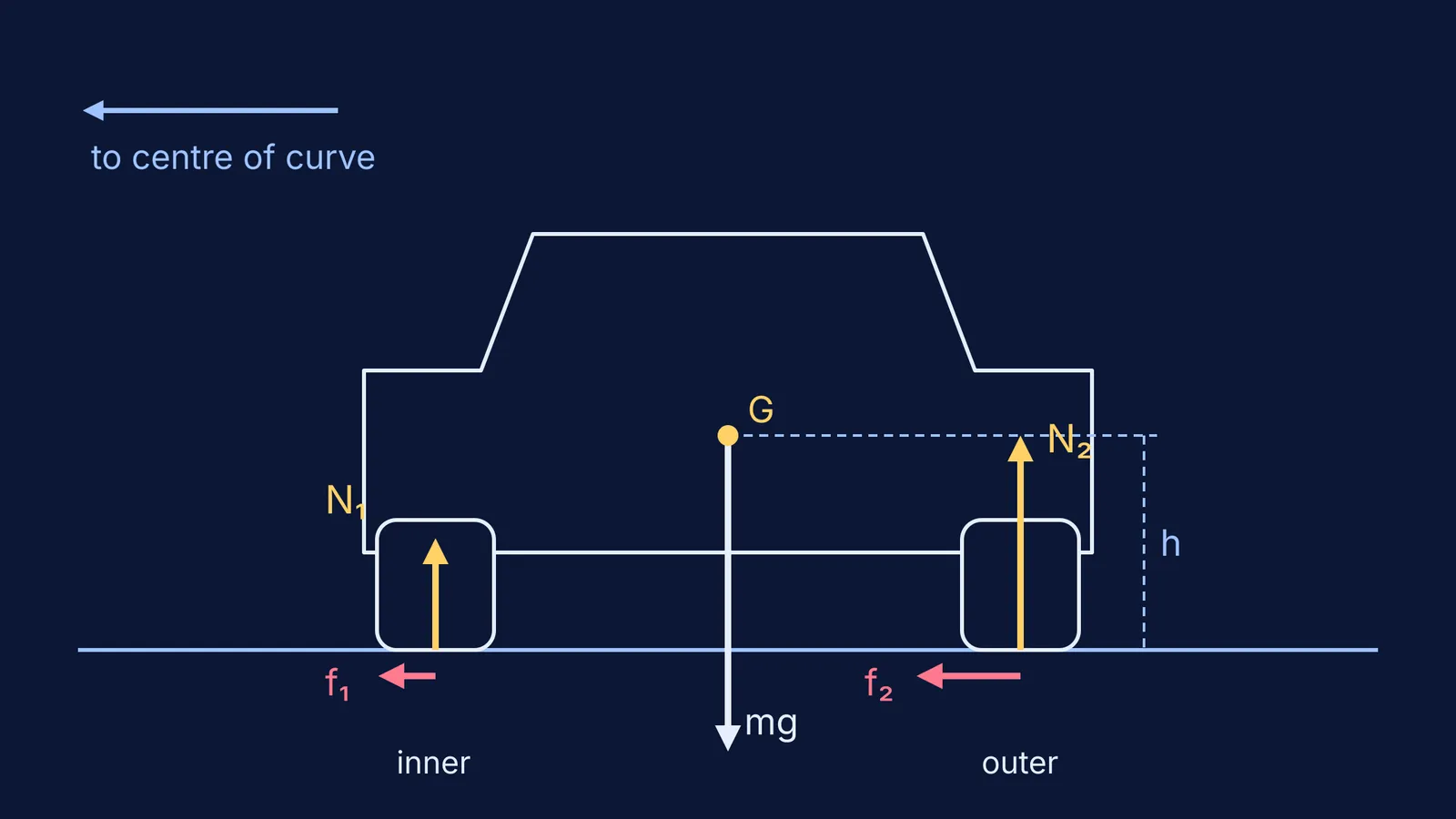
Picture the car from behind as it turns left on a level road, as in the diagram above:
Weight mg, acting down through the centre of mass G, at height h above the road.
Normal reactions N₁ (inner wheels) and N₂ (outer wheels), pointing up.
Static friction f₁ and f₂ at the tyres, pointing towards the centre of the curve.
On a level road, friction is the only horizontal force, so friction is the centripetal force, as OpenStax University Physics explains. Its total must equal F = mv²/r, where m is the mass, v the speed and r the radius of the turn. It is static friction because the tyre patch is not sliding sideways; see why a turning car relies on static, not kinetic, friction.
Why do the outer wheels press harder on a turning car?
Nothing accelerates vertically, so N₁ + N₂ = mg. For the split, take torques about G.
The car is not rolling over, so the net torque about G is zero. Weight passes through G, so it gives none. Friction acts at road level, h below G, and its torque F × h tries to tip the top of the car outward. Only a difference between the normal reactions can cancel it. With the wheels a track width d apart, each side sits d/2 from G, so:
(N₂ − N₁) × d/2 = F × h
Vedantu's worked JEE solution uses the same moment balance, written as R₂ = R₁ + Fh/a with a as half the track width. Since F, h and d are positive, N₂ is always bigger than N₁ on a level curve. Solving both equations:
Outer wheels: N₂ = mg/2 + mv²h/(rd)
Inner wheels: N₁ = mg/2 − mv²h/(rd)
How much load moves? A worked example
Wikipedia's article on weight transfer works through a 0.9g turn with a 550 mm centre-of-mass height and a 1650 mm track: 30% of the car's weight moves across, so the outer wheels carry 60% more load and the inner wheels 60% less.
Illustrative numbers for a small family car: m = 1200 kg, h = 0.55 m, d = 1.5 m, on a curve of r = 50 m at v = 15 m/s (54 km/h), with g = 9.8 m/s².
Centripetal acceleration: v²/r = 225/50 = 4.5 m/s².
Friction needed: F = 1200 × 4.5 = 5400 N.
Half the weight: mg/2 = 1200 × 9.8/2 = 5880 N.
Load transfer: Fh/d = 5400 × 0.55/1.5 = 1980 N.
Outer: N₂ = 5880 + 1980 = 7860 N. Inner: N₁ = 5880 − 1980 = 3900 N.
Check: N₁ + N₂ = 11,760 N = mg. The outer tyres carry about twice the load of the inner ones; the diagram above draws these forces to scale.
When does the inner wheel lift, and why does a car usually skid first?
Set N₁ = 0: the inner wheels lift when v²/r = gd/(2h). Then the load transfer equals half the car's weight, the rollover threshold given in the weight transfer article. The full condition is in when a car topples on a curve.
For our car, gd/(2h) = 9.8 × 1.5/1.1 ≈ 13.4 m/s², about 93 km/h on this curve. Friction could only supply that if μ ≥ 1.36. OpenStax's table of friction coefficients gives a static coefficient of about 1.0 for rubber on dry concrete and 0.5 to 0.7 on wet concrete, so this car slides long before it tips. Even our 54 km/h turn needs μ ≥ 0.46, just below the low end of that wet range.
The rule: it skids when v²/r > μg and tips when v²/r > gd/(2h), whichever comes first. So a car skids first if μ < d/(2h), while a tall, narrow vehicle can tip first. The skid side is worked out in how fast a car can take a circular track before skidding.
How do you answer this in an exam?
Draw the rear view, not the top view. Torques need heights.
Put friction at road level, pointing to the centre.
Write N₁ + N₂ = mg, then take torques about G.
Check the sign: the outer wheel gets the plus. An inner wheel coming out heavier means friction points the wrong way.
Compare μ with d/(2h) to decide skid or tip.
On a banked road, start again: the normal reactions tilt and friction can point up or down the slope.
If the torque step is where your working falls apart, the Fermi Problem Library has worked problems with a step-by-step solver that explains the reasoning rather than printing an answer.


