

On this page
What does an agricultural engineer study?
Agricultural engineering integrates mechanical machine design, civil soil and water management, and bioprocess handling. Under curriculum standards from the Indian Council of Agricultural Research (ICAR), a Bachelor of Technology in Agricultural Engineering spans five core departments: Farm Machinery and Power, Soil and Water Conservation, Irrigation and Drainage, Processing and Food Engineering, and Renewable Energy. Undergraduate programmes culminate in the Student READY (Rural Entrepreneurship Awareness Development Yojana) programme, placing final-year students in manufacturing plants, processing facilities, and watershed projects for hands-on industrial training.
The field is applied physical science and mathematical modelling directed at food security and natural resources. Students analyze engine thermodynamics, structural loads on chassis, open-channel fluid flows, and post-harvest drying kinetics. For families talking about STEM careers beyond engineering and medicine, the discipline unites foundational engineering principles with vital rural and industrial infrastructure.
How do farm machinery and tractor engineering work?
Farm machinery engineering addresses the design, mechanics, and testing of tractors, implements, seeders, and harvesters. According to the Ministry of Agriculture and Farmers Welfare, India has achieved an overall farm mechanisation level of roughly 45% to 47%, with tractor operations widely adopted for tillage while sowing and harvesting represent expanding frontiers. India manufactures between 900,000 and 1,100,000 tractors annually, making it the largest tractor market in the world by volume.
Engineers design power take-off (PTO) drivelines, transmissions, and three-point hydraulic hitches. Developing tractor hydraulic controls relies on Pascal's law in hydraulic machines to regulate implement depth automatically against soil resistance forces. Machines undergo rigorous type-approval testing for drawbar pull and operator safety under Central Motor Vehicles Rules. When analyzing linkage mechanics and fluid power systems, the Fermi Problem Library provides worked problems with a step-by-step solver that explains the reasoning behind each mechanical derivation rather than printing an answer.
Why is precision irrigation central to water engineering?
According to the Food and Agriculture Organization (FAO), agriculture accounts for roughly 70% of freshwater withdrawals globally, and micro-irrigation systems achieve 90% to 95% water application efficiency compared to 40% to 60% for traditional surface flooding, drastically reducing deep percolation and runoff losses.
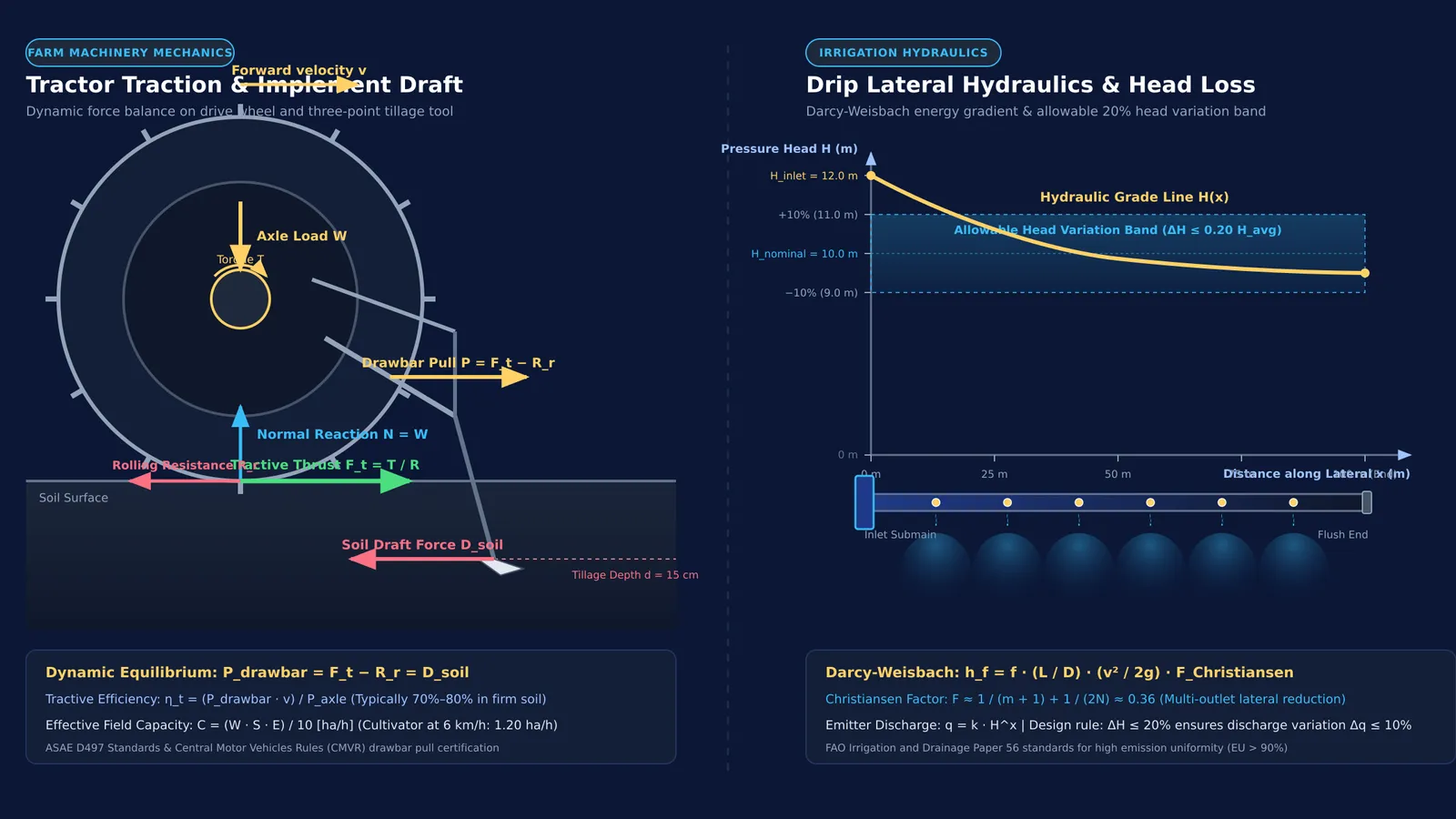
Irrigation engineers evaluate soil-water-plant relationships, size pumps, and design pressurized pipe networks where friction losses must remain controlled to ensure uniform emitter discharge. Sizing distribution manifolds requires avoiding common errors in fluid mechanics and pressure drops when applying the Darcy-Weisbach equation. For visualizing how hydraulic grade lines decline across lateral runs and how water diffuses through soil profiles, the Fermi Simulation Lab offers interactive simulations for ideas that are easier to see than to read.
What roles exist in food processing and public sector recruitment?
Beyond field machinery, agricultural engineers manage post-harvest systems, storage silos, and cold chains. Engineers design drying equipment, sorting systems, and hermetic storage to curb post-harvest losses. Public agencies like the Food Corporation of India (FCI) rely on technical personnel to maintain grain quality and modernize warehouse storage across national reserves.
Public sector career paths for graduates include:
Banking and Finance: The National Bank for Agriculture and Rural Development recruits agricultural engineers as Assistant Managers (Grade A) to evaluate irrigation, warehouse, and agro-processing projects.
State Engineering Services: State commissions appoint graduates as Assistant Engineers (AE) across Agricultural Engineering and Water Resources departments.
Higher Studies and Research: Qualifying through the dedicated Agricultural Engineering paper in GATE 2025 opens postgraduate admissions at institutes like IIT Kharagpur alongside PSU recruitment.
How can you calculate field capacity and irrigation demand?
Under curriculum standards established by the Indian Council of Agricultural Research, graduates apply quantitative engineering formulas to size machinery and irrigation networks:
Tractor field capacity:
Effective field capacity measures working rate in hectares per hour: C = (W × S × E) / 10 where W is implement width in metres, S is tractor speed in km/h, and E is field efficiency as a decimal. For a 2.5-metre cultivator operated at 6.0 km/h with 80% efficiency (0.80): C = (2.5 × 6.0 × 0.80) / 10 = 1.20 ha/h An 8-hour shift covers 9.6 hectares of tillage.
Drip irrigation demand per plant:
Daily water demand per plant is calculated using: V = E₀ × K_c × A × W_p where E₀ is pan evaporation (5.0 mm/day), K_c is the crop factor (0.85), A is tree canopy area (9 m²), and W_p is the wetted fraction (0.40): V = 5.0 × 0.85 × 9 × 0.40 = 15.3 litres/day Engineers use this volume to select emitter discharge rates and plan pumping schedules.


