

On this page
A tractor pulling a log, a stump or a stuck vehicle can rear up and flip over backwards onto the driver. It happens fast. A CDC report on fatalities from improper hitching to farm tractors in New York, 1991–1995 says the tractor flips backward, rotating around its rear axle, and may reach the point of no recovery in 0.75 seconds, often less time than a driver needs to react. In 16 of the 27 rear rollovers it studied, improper hitching was the main cause, and in each of those the chain was tied above the drawbar. The physics behind that finding is one line of rotational equilibrium: take moments about the rear tyres.
Why does a tractor flip backwards when it pulls a load?
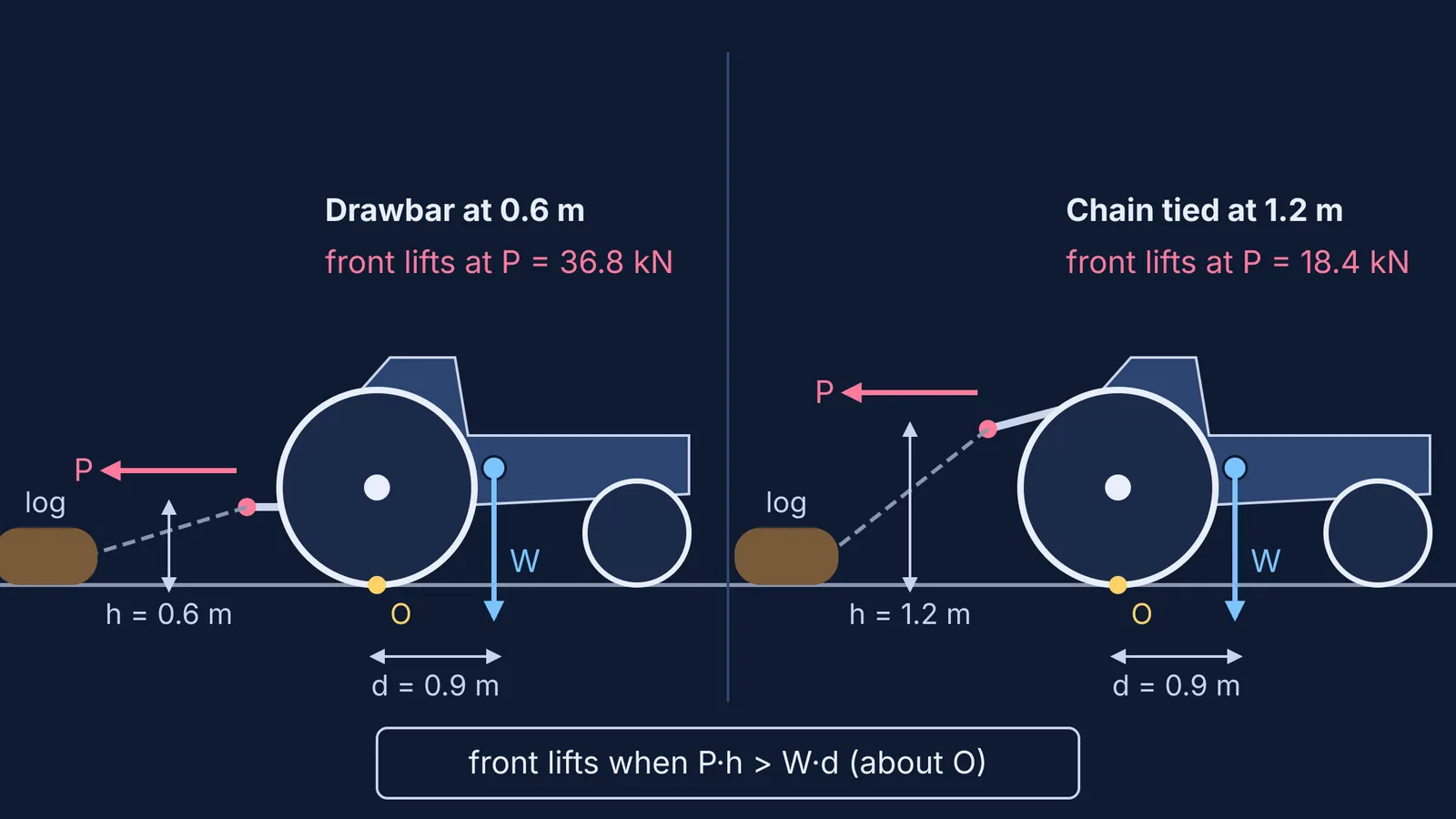
Look at the tractor from the side. Its rear tyres touch the ground at one point, call it O. Two things try to turn the tractor about O.
The weight W acts at the centre of mass, a distance d in front of O. It tries to turn the front down, onto the ground. Its moment is W·d.
The pull P from the chain acts backwards at the hitch, a height h above the ground. It tries to turn the front up. Its moment is P·h.
As P grows, the ground's push on the front wheels shrinks. When P·h equals W·d it is zero, and any more pull lifts the front:
The front lifts when P·h > W·d.
This is the same moment balance used for tower cranes and their counterweights.
How much pull does it take to lift the front?
Here is a worked example. The numbers are illustrative; real tractors vary a lot by model. Take a 2,500 kg tractor with its centre of mass 0.9 m in front of the rear axle and a wheelbase of 2.0 m. Use g = 9.81 m/s².
Weight. W = 2500 × 9.81 = 24,525 N, about 24.5 kN.
Load on the front axle at rest. Take moments about the rear contact: front load × 2.0 = W × 0.9, so the front axle carries 24,525 × 0.9 / 2.0 = 11,036 N, about 11.0 kN. The rear carries the other 13.5 kN.
Restoring moment. W·d = 24,525 × 0.9 = 22,073 N m, about 22.1 kN m.
Chain on a drawbar 0.6 m high. P = W·d / h = 22,073 / 0.6 = 36,788 N, about 36.8 kN.
Chain tied 1.2 m high. P = 22,073 / 1.2 = 18,394 N, about 18.4 kN.
Doubling the hitch height halves the pull needed to lift the front. Units check: N m divided by m gives N.
Why does a high hitch make the front lift before the wheels slip?
A tractor cannot pull with any force it likes. The rear tyres push on the ground through friction, so the pull is limited to about μN, where N is the normal force on the rear tyres. Just as the front lifts, all the weight rests on the rear tyres, so N = W.
So there is a race between two limits, like the contest in toppling or sliding:
The wheels slip when P reaches μW.
The front lifts when P reaches W·d / h.
The front lifts first if W·d / h < μW, that is, if h > d / μ. Take an illustrative μ = 0.8 for good grip. Then d / μ = 0.9 / 0.8 = 1.13 m.
At h = 0.6 m, the wheels slip at 0.8 × 24.5 = 19.6 kN, well before the 36.8 kN needed to lift the front. The tractor just spins its wheels.
At h = 1.2 m, the front lifts at 18.4 kN, before the wheels would slip at 19.6 kN. The tractor rears up instead of spinning.
That matches what the CDC report says: when a load is hitched high or tied directly to the rear axle, less power is required to lift the front end than to move the load or slip the wheels. This simple sum treats the pull as horizontal and steady. A chain angled down to a load adds a downward pull at the hitch, and a sudden clutch release adds a jerk that the steady sum leaves out, so real tractors can tip at lower pulls than these numbers.
What happens if the rear wheels are stuck?
Suppose the rear wheels are jammed in a ditch or deep mud and cannot turn. The engine still pushes a torque τ through the axle onto the wheels. By Newton's third law, the wheels push an equal and opposite torque back on the tractor body. If the wheels cannot turn, the body turns about the rear axle instead, front end up.
The front lifts when τ > W·d. In the example, that is an axle torque of 22.1 kN m. Nothing needs to be hitched at all.
Do front weights help, and what actually protects the driver?
Front weights increase the restoring moment. Add 300 kg of weights 2.6 m in front of the rear axle:
Extra weight = 300 × 9.81 = 2,943 N.
Extra moment = 2,943 × 2.6 = 7,652 N m, so the total restoring moment is 22,073 + 7,652 = 29,724 N m.
With the chain at 0.6 m, the front now lifts at 29,724 / 0.6 = 49,541 N, about 49.5 kN instead of 36.8 kN.
At 1.2 m it lifts at 24.8 kN, while the wheels would slip at 0.8 × (24,525 + 2,943) = 22.0 kN. With the weights on, the wheels slip first.
The physics explains the safety rules, but the rules themselves come from safety authorities. The CDC report recommends choosing the hitching point carefully, not raising or shortening the drawbar, never tying a load directly to the axle, fitting front-end weights and pulling slowly and steadily. The US workplace safety regulator's operating instructions for tractors say "Hitch only to the drawbar and hitch points recommended by tractor manufacturers" and "Operate the tractor smoothly - no jerky turns, starts, or stops".
None of that makes an overturn impossible. The protection for the driver is a rollover protective structure (ROPS), a strong frame over the seat, used with a seat belt. The CDC report calls ROPS used together with safety belts an engineering strategy to protect operators, and the OSHA instructions say "Securely fasten your seat belt if the tractor has a ROPS." The belt keeps the driver inside the space the frame protects.
If you want to check moment problems like these step by step, the Fermi Problem Library has a step-by-step solver that explains the reasoning.
Quick checklist
Take moments about the rear tyres' contact point: the front lifts when P·h > W·d.
Doubling the hitch height halves the pull needed to lift the front: 36.8 kN at 0.6 m, 18.4 kN at 1.2 m in the example.
The front lifts before the wheels slip when h > d / μ.
Stuck rear wheels let the axle torque turn the body: the front lifts when τ > W·d.
Front weights raise the restoring moment: 36.8 kN becomes 49.5 kN in the example.
Rear overturns can pass the point of no recovery in about 0.75 s; ROPS with a fastened seat belt protects the driver.


