

On this page
Every electrolysis problem you solve uses F ≈ 96 485 C mol⁻¹, but you can measure it yourself with two copper strips, a beaker of copper sulphate, an ammeter and a good balance. Pass a steady current for a known time, weigh how much copper lands on the cathode, and Faraday's first law gives you F. Divide by the charge on one electron and you also get Avogadro's number. This is a strong Class 12 practical or project because every step connects to a formula you already use.
What does a copper coulometer measure?
A coulometer is a cell that measures charge by the mass of metal it deposits. With copper electrodes in acidified CuSO₄, the electrode reactions are simple:
Cathode: Cu²⁺(aq) + 2e⁻ → Cu(s)
Anode: Cu(s) → Cu²⁺(aq) + 2e⁻
Copper moves from anode to cathode and the solution stays the same. Why these are the products, and what changes with platinum electrodes, is explained in electrolysis of copper sulphate with copper and platinum electrodes.
Each copper atom needs 2 electrons, so n = 2. Faraday's first law, m = QM / nF, turns round to give:
F = QM / nm
You know Q from the current and the time, M is 63.55 g mol⁻¹, n is 2, and m is what the balance tells you. Theory says F = N_A × e, as shown in why the Faraday constant is about 96 500 C/mol. Here you go the other way and measure it.
How do you set up the experiment?
Solution. About 150 mL of copper sulphate solution (roughly 0.5–1 mol L⁻¹) with a little dilute H₂SO₄ added. The acid stops Cu²⁺ hydrolysing and forming basic copper salts, which would make a loose, greenish deposit.
Electrodes. Two copper strips. Clean the cathode with fine emery paper, rinse it with water, then with propanone, and let it dry in air. Weigh it on a balance reading to 0.0001 g.
Circuit. DC supply, rheostat, ammeter and the cell, all in series. The cathode goes to the negative terminal.
Current density. Keep it to about 10–20 mA per cm² of cathode. At 0.500 A, that means 25–50 cm² of immersed cathode, for example a 5 cm × 4 cm strip counting both faces (40 cm², 12.5 mA cm⁻²). Too high a current gives a dark, powdery deposit that falls off.
Run. Switch on, start the stopwatch, and hold the current steady with the rheostat. Note the ammeter reading every minute.
Finish. Switch off, remove the cathode, rinse it gently with water and then propanone, and let it dry cold. Do not heat it: fresh copper oxidises in a hot oven and gains mass. Weigh it again.
Safety. Copper sulphate is harmful if swallowed and irritates the eyes, so wear goggles and gloves. Propanone is highly flammable; use it away from flames. Use a low-voltage supply.
Worked example: from cathode mass to F and N_A
These figures are illustrative, to show the method, not a real class result.
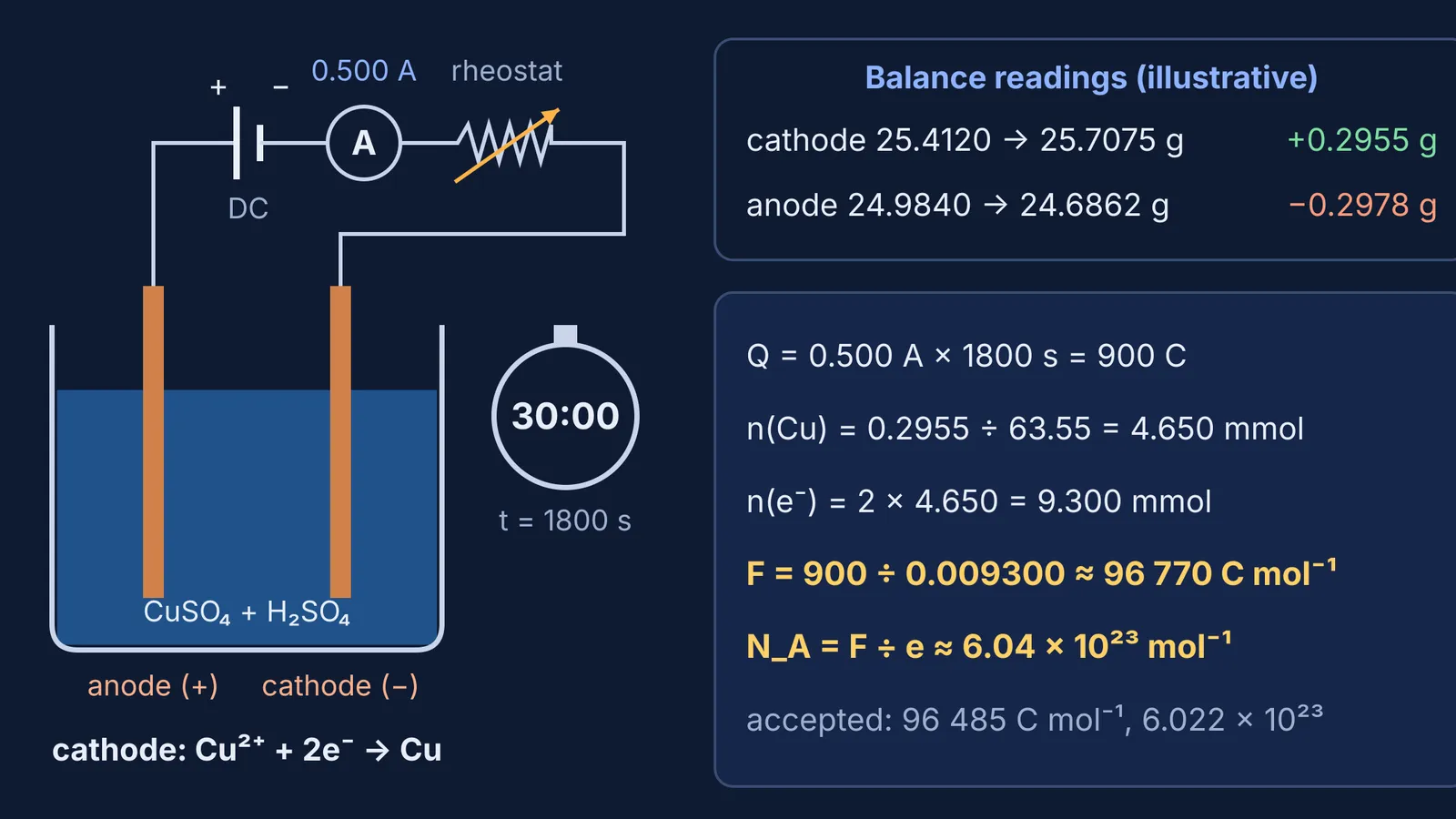
A current of 0.500 A is passed for 30.0 min. The cathode goes from 25.4120 g to 25.7075 g.
Charge. Q = I × t = 0.500 A × 1 800 s = 900 C.
Mass of copper. m = 25.7075 − 25.4120 = 0.2955 g.
Moles of copper. 0.2955 / 63.55 = 4.650 × 10⁻³ mol.
Moles of electrons. Two per Cu: 2 × 4.650 × 10⁻³ = 9.300 × 10⁻³ mol.
Faraday constant. F = charge ÷ moles of electrons = 900 / 9.300 × 10⁻³ = 96 770 C mol⁻¹ (to four significant figures).
Compare. The accepted value is 96 485.33 C mol⁻¹ (NCERT quotes 96 487). Your result is 0.30% high.
Avogadro's number. N_A = F / e = 96 770 / 1.602 × 10⁻¹⁹ = 6.04 × 10²³ mol⁻¹, against the accepted 6.022 × 10²³. Again 0.3% high, as it must be, because e is exact.
Since 2019, e = 1.602 176 634 × 10⁻¹⁹ C and N_A = 6.022 140 76 × 10²³ mol⁻¹ are exact by definition. Your experiment does not change them. It shows that a beaker and a balance can get within a fraction of a per cent of them.
To practise the same chain with other metals and currents, the Fermi Problem Library has a step-by-step solver that explains the reasoning at each stage.
Why use the cathode gain and not the anode loss?
In the same run the anode might go from 24.9840 g to 24.6862 g, a loss of 0.2978 g. That is 0.0023 g more than the cathode gained. Using it gives F = 900 × 63.55 / (2 × 0.2978) = 96 030 C mol⁻¹, about 0.5% low.
The anode loses extra mass because impurities in the copper, and small loose bits of copper, drop off as anode sludge without carrying charge across the cell. Every gram that reaches the cathode, on the other hand, got there by taking two electrons per atom. So the cathode gain is the better measure of charge. The anode loss is still worth recording as a check: the two should agree to within a few milligrams.
Which errors matter most?
Put rough sizes on each error and the answer is clear.
Current drift. F is directly proportional to Q, so a current that is 2% different from what you wrote down gives a 2% error in F. This is usually the largest error. Read the ammeter every minute and use the average.
Ammeter calibration. A school ammeter can be off by a per cent or two. Check it against a better meter if you can.
Balance. Two weighings at ±0.0001 g add up to about ±0.0002 g on 0.2955 g, which is under 0.1%.
Timing. A 2 s error in 1 800 s is about 0.1%.
Lost copper. Powdery deposit that flakes off, or copper rubbed off while rinsing, makes m too small and F too high.
Oxidation. Drying the cathode with heat adds oxygen, makes m too large and F too low.
Side reactions. If the current density is too high, some hydrogen forms at the cathode, less copper is deposited and F comes out high. This is the idea behind current efficiency in electrolysis.
So a well-controlled current matters far more than an expensive balance. A 0.3% error, as in the worked example, is about the size you would expect from a meter and a current that are each slightly off.
Quick checklist
Cathode: Cu²⁺ + 2e⁻ → Cu; n = 2.
F = QM / nm, with Q = I × t in coulombs and seconds.
Add a little dilute H₂SO₄; keep the current density near 10–20 mA cm⁻².
Rinse with water then propanone; dry cold; weigh to 0.0001 g.
Use the cathode gain; record the anode loss as a check.
N_A = F / e; state whether you compare with 96 485 or NCERT's 96 487.
The current is the biggest source of error, not the balance.


