

On this page
An aqueous solution of copper sulphate (CuSO₄) contains four types of ions. The salt splits into copper (Cu²⁺) and sulphate (SO₄²⁻) ions when it dissolves in water, while the water itself provides a small number of hydrogen (H⁺) and hydroxide (OH⁻) ions through its own slight dissociation.
In a typical school laboratory setup, you might connect a battery to two electrodes immersed in a blue copper sulphate solution. When you pass a direct current through the solution, the positive ions (cations) move toward the negative cathode, and the negative ions (anions) move toward the positive anode. But what reacts when they get there depends entirely on the material the electrodes are made of Chemistry LibreTexts/Electrochemistry/Electrolytic_Cells).
What happens in the electrolysis of copper sulphate with copper electrodes?
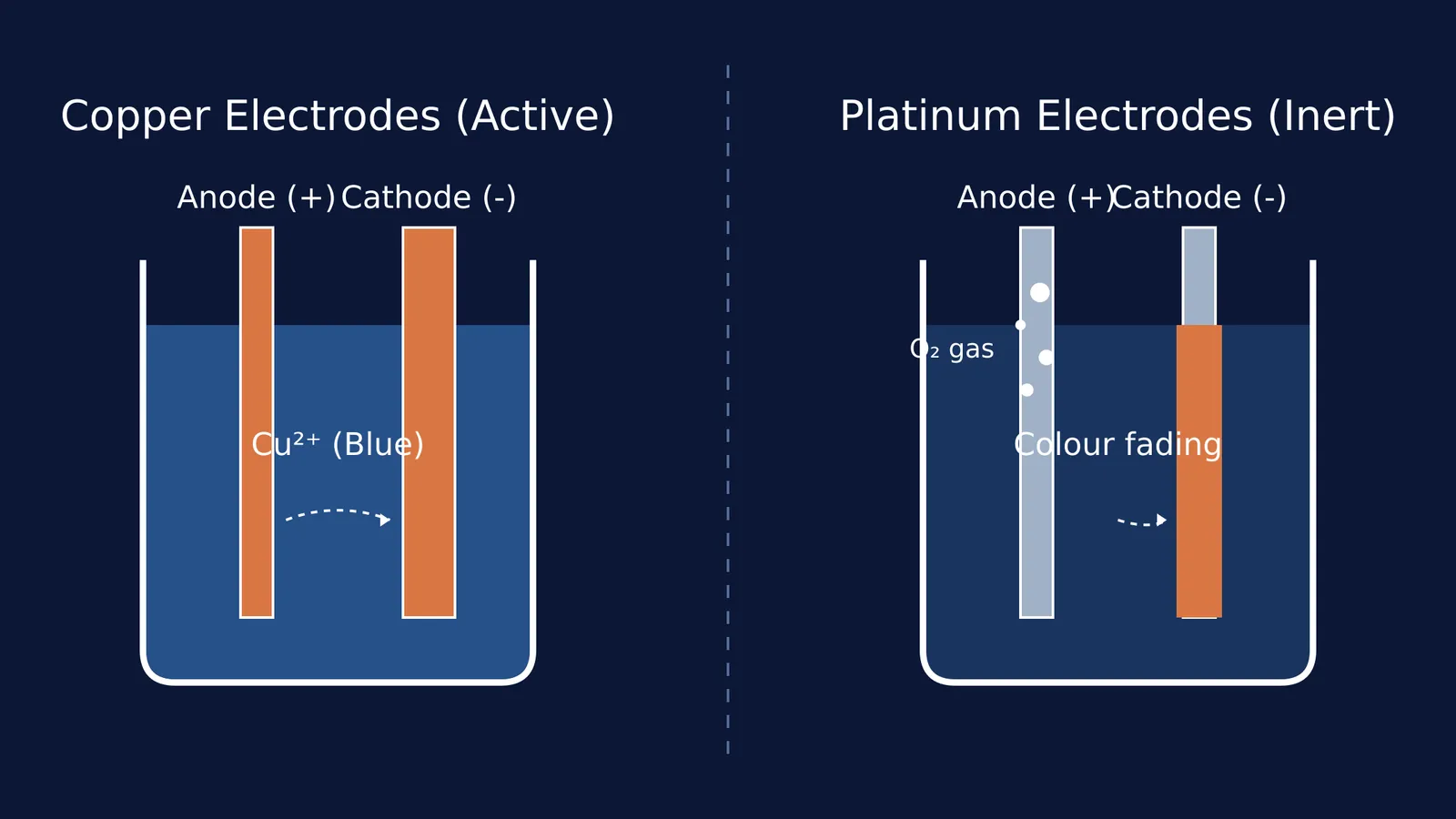
Using copper for both the anode and the cathode gives us a system with "active" electrodes. The anode itself takes part in the chemical reaction.
At the negative cathode, Cu²⁺ ions and H⁺ ions arrive. Copper has a much higher standard reduction potential (+0.34 V) than hydrogen (0.00 V), meaning it is much easier to reduce Chemistry LibreTexts. The Cu²⁺ ions gain electrons and form solid copper metal. Reaction: Cu²⁺(aq) + 2e⁻ → Cu(s)
At the positive anode, SO₄²⁻ and OH⁻ ions arrive. However, neither of these ions reacts. It requires less energy to oxidise the copper atoms in the anode itself than to oxidise either of the anions. The copper anode dissolves into the solution as new Cu²⁺ ions. Reaction: Cu(s) → Cu²⁺(aq) + 2e⁻
The result is a direct transfer of copper from the anode to the cathode. For every Cu²⁺ ion that turns into solid copper at the cathode, a new one enters the solution at the anode. The concentration of Cu²⁺ remains exactly the same, so the blue colour of the solution does not change. This exact process is used on a massive scale for the electrolytic refining of copper in Class 10 to produce ultra-pure metal for electrical wires.
What happens in the electrolysis of copper sulphate with platinum electrodes?
Platinum is an "inert" electrode. It conducts electricity but refuses to participate in the chemical reactions.
At the cathode, the story is exactly the same as before. Cu²⁺ ions are reduced in preference to H⁺ ions, depositing a layer of pinkish-brown copper metal on the platinum surface. (You can explore why copper behaves this way in our guide to the E° values of 3d metals.) Reaction: Cu²⁺(aq) + 2e⁻ → Cu(s)
At the anode, the platinum does not dissolve, so the negative ions must react. Hydroxide ions (OH⁻) have a lower discharge potential than sulphate ions (SO₄²⁻). The OH⁻ ions are oxidised, producing water, oxygen gas and electrons. Reaction: 2H₂O(l) → O₂(g) + 4H⁺(aq) + 4e⁻
You will see bubbles of colourless oxygen gas rising from the anode.
Why does the blue colour of copper sulphate fade with platinum electrodes?
When using platinum electrodes, copper ions are continually removed from the solution at the cathode to form solid metal. Unlike the active copper anode, the inert platinum anode does not replace them.
Because the blue colour of the solution comes entirely from the hydrated Cu²⁺ ions, the liquid grows paler and eventually turns colourless as the copper is depleted. At the same time, the oxidation of water at the anode leaves behind an excess of H⁺ ions. These pair with the unreacted SO₄²⁻ ions, turning the remaining solution into dilute sulphuric acid (H₂SO₄).
How can you predict electrolysis products?
Working out what happens in an electrolytic cell can feel like guesswork, but it follows a strict hierarchy based on standard potentials. Here is a reliable checklist you can use in an exam:
Inspect the anode material first: The anode is the easiest place to slip up. If the anode is made of a reactive metal matching the metal ions in solution (like a copper anode in copper sulphate), the anode itself will oxidise and dissolve. If it is made of an inert substance like platinum or graphite, you move to step two.
Evaluate the anions (for inert anodes): When the anode is inert, the negative ions compete. Simple halide ions like chloride (Cl⁻) and bromide (Br⁻) have low discharge potentials and will oxidise to form halogen gases. Complex oxyanions like sulphate (SO₄²⁻) and nitrate (NO₃⁻) are highly stable and will not discharge; instead, water molecules oxidise to release oxygen gas (O₂).
Evaluate the cations (for the cathode): At the cathode, the rule is simpler. Look at the metal's position in the reactivity series. Metals sitting below hydrogen—such as copper, silver, and gold—are easily reduced and will plate out as solid metal. For reactive metals sitting above hydrogen—like sodium, magnesium, or aluminium—the metal ions remain dissolved in aqueous solutions, and water is reduced to release hydrogen gas (H₂).
If you find keeping track of competing ions tricky, the Fermi Concept Library has every concept in chemistry with its own lesson and its place in the map.


