

On this page
How do you prove that an unknown organic compound contains phosphorus? The standard qualitative test, detailed in the Class 11 NCERT syllabus, is to convert the phosphorus into phosphate and then react it with ammonium molybdate. This produces a bright, canary-yellow precipitate. Here is exactly how the test works, the chemical equations behind it, and how this relates to quantitative estimation.
Why do we heat with an oxidising agent?
Phosphorus in an organic molecule is covalently bonded to carbon and other atoms. To detect it using inorganic reagents, you first have to break these bonds and oxidise the phosphorus into a free phosphate ion (PO₄³⁻).
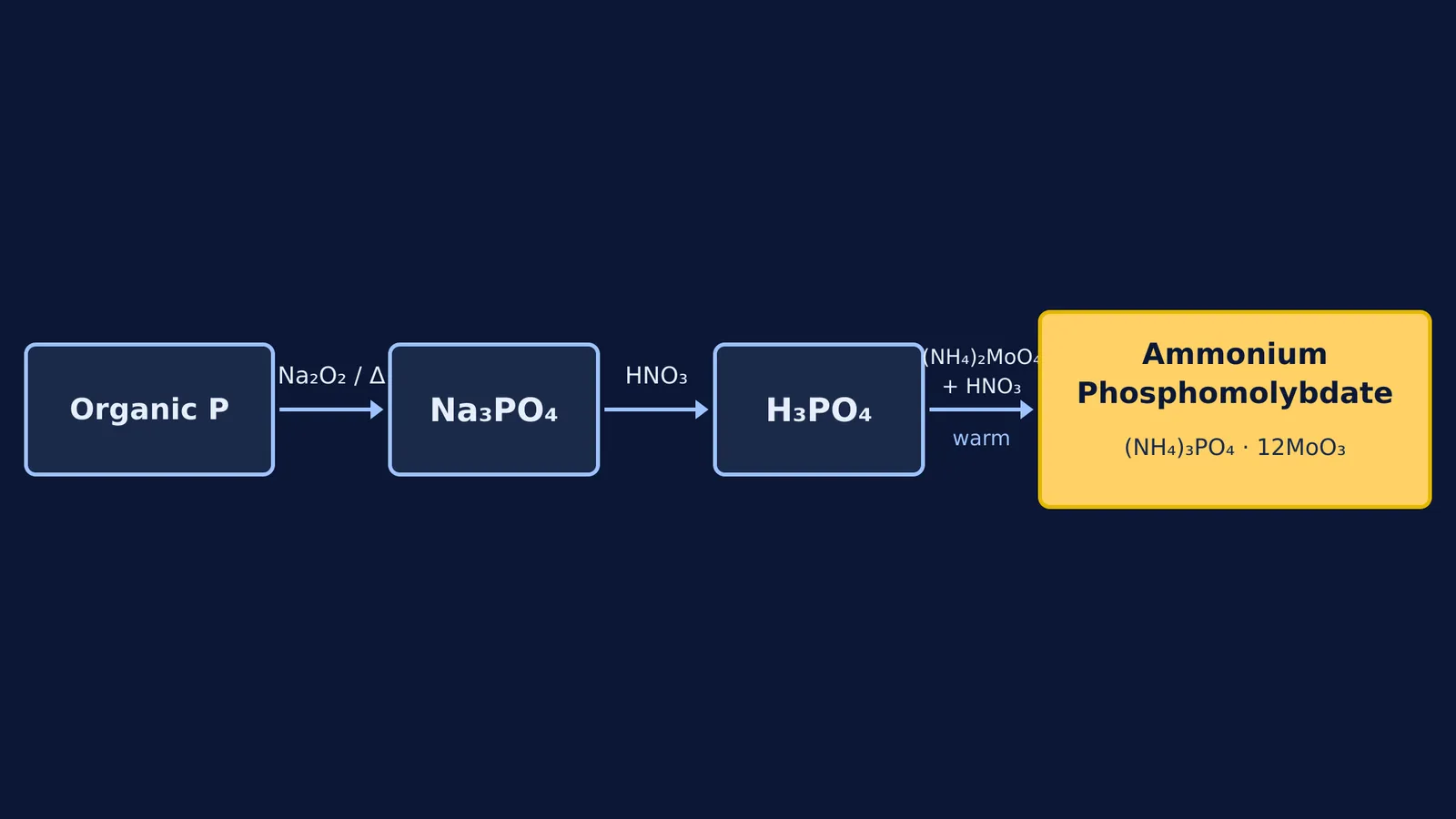
You do this by heating a known mass of the organic compound with a strong oxidising agent, usually sodium peroxide (Na₂O₂) or fuming nitric acid. This fusion process converts the organically bound phosphorus into inorganic sodium phosphate (Na₃PO₄).
Why is the extract acidified with nitric acid?
After oxidation, you boil the fused mass with water and filter it to get an aqueous extract. This extract is then boiled with concentrated nitric acid (HNO₃).
The nitric acid serves two main purposes. First, it neutralises any excess alkali from the fusion. Second, it converts the sodium phosphate into phosphoric acid (H₃PO₄).
Na₃PO₄ + 3HNO₃ → H₃PO₄ + 3NaNO₃
Without this acidification step, the subsequent reaction with the molybdate reagent would fail, as the complex requires an acidic medium.
What forms the yellow precipitate?
Finally, you add ammonium molybdate solution, (NH₄)₂MoO₄, to the acidified mixture and warm it gently.
If phosphorus is present, a canary-yellow precipitate immediately forms. The reaction between phosphoric acid, ammonium molybdate, and nitric acid produces a complex coordination compound known as ammonium phosphomolybdate.
H₃PO₄ + 12(NH₄)₂MoO₄ + 21HNO₃ → (NH₄)₃PO₄ · 12MoO₃ + 21NH₄NO₃ + 12H₂O
This yellow solid, (NH₄)₃PO₄ · 12MoO₃, is the visual proof that phosphorus was in your original organic sample. Similar distinct visual tests include the iodoform test for methyl ketones and the carbylamine test for primary amines.
How does the Carius method estimate phosphorus?
Detecting phosphorus is only half the task; chemists also calculate exactly how much phosphorus was in the sample. This quantitative analysis uses the Carius method.
In the Carius method, you heat a known mass of the organic compound with fuming nitric acid in a sealed glass tube. This produces phosphoric acid. From here, you have two choices for estimation:
The Ammonium Molybdate Method: You precipitate the phosphorus as ammonium phosphomolybdate, exactly as in the detection test. The molar mass of (NH₄)₃PO₄ · 12MoO₃ is 1877 g/mol, and one mole contains exactly 31 g of phosphorus.
The Magnesia Mixture Method: Alternatively, add a magnesia mixture (magnesium chloride, ammonium chloride, and ammonia) to form magnesium ammonium phosphate (MgNH₄PO₄). Ignite this to form magnesium pyrophosphate (Mg₂P₂O₇) and weigh it. Its molar mass is 222 g/mol, and one mole contains 62 g of phosphorus.
A worked example for percentage composition
Let us walk through a typical calculation using the ammonium molybdate method, following the principles from the NCERT method.
Suppose you start with a 0.5 g sample of an unknown organic compound. After heating it with fuming nitric acid in a Carius tube and adding ammonium molybdate, you collect 1.877 g of the yellow ammonium phosphomolybdate precipitate.
Because 1877 g of the precipitate contains 31 g of phosphorus, 1.877 g of it contains exactly 0.031 g of phosphorus. To find the percentage composition, divide the mass of the phosphorus by the original sample's mass and multiply by 100:
Percentage = (0.031 / 0.5) × 100 = 6.2%
This calculation reveals that your original organic compound is 6.2% phosphorus by mass.
A checklist for the practical lab
If you are running this test in a school chemistry lab, use this straightforward framework to ensure you do not miss a step:
Oxidise: Heat the compound with Na₂O₂ to convert phosphorus to the phosphate ion (PO₄³⁻).
Acidify: Boil the extract with concentrated HNO₃ to form H₃PO₄.
Precipitate: Add the (NH₄)₂MoO₄ reagent and warm the mixture gently.
Observe: Look for the immediate formation of the canary-yellow precipitate.
If you forget the exact stoichiometry of the final equation, remember that the core product is (NH₄)₃PO₄ · 12MoO₃.
If you need to connect chemical tests to functional groups and elements, the Fermi Concept Library can map these reactions out for you. Furthermore, Fermi's AI tutor can work out what you already know and teach you the stoichiometry, checking your understanding of the balancing numbers as it goes.


