

On this page
Blue copper sulphate crystals left in a dry room slowly turn pale and crumbly at the surface. On a humid monsoon day the same crystals stay deep blue. Textbooks call the first case efflorescence and explain it in words. JEE goes one step further and asks for a number: below what humidity does blue vitriol start losing water? You can get it from one equilibrium constant and one square root. This post shows how, and how to decide the direction with Q against K.
What equilibrium decides whether CuSO₄·5H₂O loses water?
At room temperature, the first water to leave comes off in a pair:
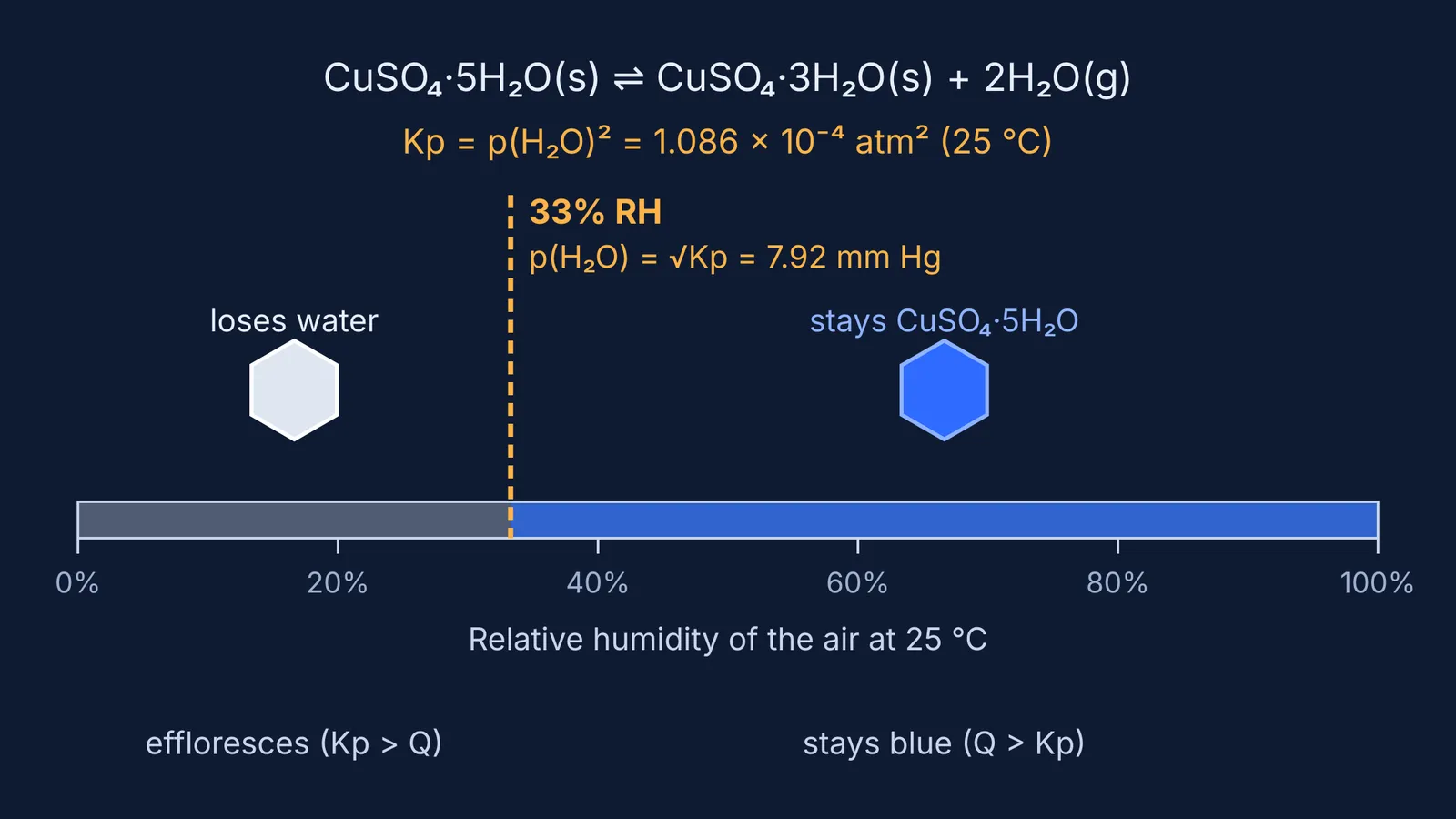
CuSO₄·5H₂O(s) ⇌ CuSO₄·3H₂O(s) + 2H₂O(g)
Check the balance: 5 water molecules on the left, 3 + 2 on the right. Cu, S and the sulphate oxygens are unchanged.
Both hydrates are pure solids, so both drop out of the equilibrium constant. Only the water vapour remains:
Kp = p(H₂O)²
The square comes from the coefficient 2. Why solids drop out, and why some of each solid must be present, is covered in heterogeneous equilibria: why solids and pure liquids drop out of K.
This has a neat consequence. At a fixed temperature, Kp fixes one particular water vapour pressure, √Kp, at which the pentahydrate and trihydrate can sit together. That pressure is called the dissociation pressure (or aqueous tension) of the hydrate. The structural reason the waters leave in pairs, and the higher-temperature steps, are explained in why copper sulphate pentahydrate loses water in stages.
How do you find the humidity at which blue vitriol effloresces?
This is a standard JEE problem. The value Kp = 1.086 × 10⁻⁴ atm² at 25 °C is the one used in the question. Published measurements of this dissociation pressure are close to it but vary slightly between sources, so treat it as problem data.
For CuSO₄·5H₂O(s) ⇌ CuSO₄·3H₂O(s) + 2H₂O(g), Kp = 1.086 × 10⁻⁴ atm² at 25 °C. The vapour pressure of water at 25 °C is 23.8 mm Hg. Find the relative humidity below which the pentahydrate will lose water.
Write Kp. Kp = p(H₂O)², because only the gas appears.
Take the square root once. p(H₂O) = √(1.086 × 10⁻⁴) = 0.0104 atm.
Convert to mm Hg. 0.0104 × 760 = 7.92 mm Hg.
Compare with saturated air. Relative humidity is the water vapour pressure in the air divided by water's own vapour pressure at that temperature. Threshold RH = 7.92 / 23.8 = 0.333, or about 33%.
State the answer. Below about 33% relative humidity at 25 °C, the pentahydrate loses water and becomes the trihydrate. Above it, the pentahydrate is stable.
That is why the crystals stay blue through most of an Indian monsoon, when the humidity is far above 33%. In a laboratory desiccator over P₄O₁₀, the water vapour pressure is close to zero, so the crystals lose water steadily.
How do Q and K tell you the direction at a given humidity?
The threshold is a shortcut. The general method is to compare the reaction quotient Q with Kp, using the actual water vapour pressure of the air.
Example A: a dry room at 20% RH, 25 °C.
p(H₂O) in the air = 0.20 × 23.8 = 4.76 mm Hg = 4.76/760 = 0.00626 atm.
Q = (0.00626)² = 3.9 × 10⁻⁵ atm².
Q < Kp (3.9 × 10⁻⁵ < 1.086 × 10⁻⁴), so the forward reaction is favoured.
The pentahydrate loses water to form the trihydrate. It effloresces.
Example B: a humid room at 50% RH, 25 °C.
p(H₂O) = 0.50 × 23.8 = 11.9 mm Hg = 0.0157 atm.
Q = (0.0157)² = 2.45 × 10⁻⁴ atm².
Q > Kp, so the reverse reaction is favoured.
The pentahydrate does not lose water. If any trihydrate were present, it would take water back from the air and turn into the pentahydrate.
Both examples agree with the 33% threshold, which is what you should expect: the threshold is simply the humidity at which Q = Kp.
If you want more Q against K problems with a solver that shows each step, the Fermi Problem Library has a step-by-step solver that explains the reasoning rather than printing an answer.
Does this number tell you when all the water is lost?
No. The 33% threshold applies only to the pentahydrate-to-trihydrate step. The next step, CuSO₄·3H₂O(s) ⇌ CuSO₄·H₂O(s) + 2H₂O(g), has its own equilibrium constant and a lower dissociation pressure. So a crystal in air somewhat below 33% RH turns into the trihydrate and stops there. It needs much drier air (or heat) to go further. Do not quote one humidity for "losing all its water".
Two other limits are worth knowing:
Equilibrium tells you direction, not speed. A crystal just below the threshold may take days to show a change, because water has to escape from the solid surface. Efflorescence also starts at the surface first.
The number depends on temperature. Both Kp and water's vapour pressure (23.8 mm Hg, about 3.17 kPa, at 25 °C) change with temperature, so the threshold is for 25 °C only.
The word-level comparison of a hydrate's vapour pressure with the air's, for efflorescent, deliquescent and hygroscopic substances, is in how deliquescent, efflorescent and hygroscopic substances differ. This post adds the number behind it.
How do you convert this Kp to Kc?
Use Kp = Kc(RT)^Δn. Count gas moles only: Δn = 2 − 0 = 2. Neither hydrate counts. At 298 K, with R = 0.0821 L atm mol⁻¹ K⁻¹:
RT = 0.0821 × 298 = 24.47 L atm mol⁻¹.
(RT)² = 598.8.
Kc = 1.086 × 10⁻⁴ / 598.8 = 1.8 × 10⁻⁷ mol² L⁻².
What mistakes cost marks on this question?
Writing Kp = p(H₂O). That ignores the coefficient 2 and gives a threshold of 0.083 mm Hg, about 0.35% RH. It would mean the crystals almost never lose water, which is wrong.
Taking a square root twice, or squaring again after taking the root.
Putting the hydrates in Kp. Both are pure solids.
Dividing atm by mm Hg. Convert first.
Reversing the direction. Air drier than the threshold (Q < Kp) means water leaves the crystal.
Quoting one number for every dehydration step. Each step has its own Kp.
Quick checklist
Write CuSO₄·5H₂O(s) ⇌ CuSO₄·3H₂O(s) + 2H₂O(g) and Kp = p(H₂O)².
p(H₂O) = √Kp = 0.0104 atm = 7.92 mm Hg at 25 °C.
Threshold RH = 7.92 / 23.8, about 33%.
Q < Kp: loses water. Q > Kp: stays as the pentahydrate.
The threshold is for this step and this temperature only.
Δn = 2 for converting to Kc.


