On this page
Every order below comes from NCERT Class 12 Biology, Chapter 7 (Reprint 2026-27), listed under Unit 8, Biology and Human Welfare, in the NEET (UG) 2026 syllabus. Eight chains (sections in brackets) come first, then 11 original questions. Diseases appear strictly in NCERT's terms: a study summary, not medical advice.
Which ordered processes does NCERT give in this chapter?
Malaria in two hosts (7.1): sporozoites enter with an infected female *Anopheles* bite → multiply in liver cells → attack red blood cells → a female *Anopheles* bites an infected person → parasites develop and multiply into sporozoites → stored in salivary glands.
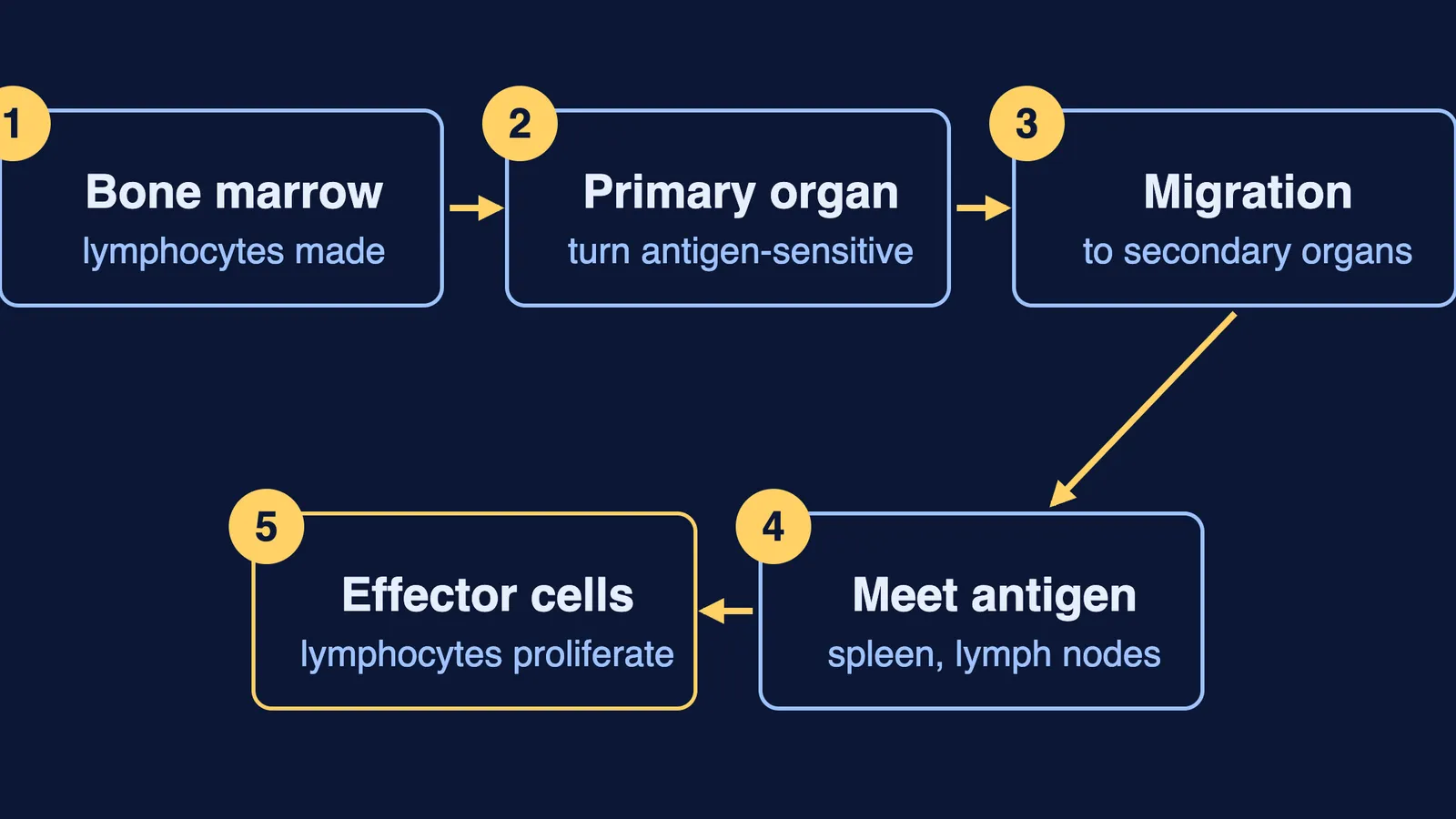
Lymphocytes (7.2.7): produced in bone marrow → turn antigen-sensitive in bone marrow or thymus → migrate to secondary lymphoid organs → meet antigen → proliferate into effector cells.
Vaccination (7.2.4): antigen given → antibodies plus memory B and T cells → quick recognition on real exposure → massive antibody production.
HIV (7.3): enters macrophages → reverse transcriptase makes viral DNA → it joins host DNA → virus made. Simultaneously: enters helper T cells → replicates → progeny released into blood → attack other helper T cells → their number falls.
Metastasis (7.4): contact inhibition lost → continued division → tumour → cells slough off a malignant tumour → blood carries them to distant sites → new tumour where they lodge.
Biopsy (7.4): suspected tissue → thin sections → staining → microscope check by a pathologist.
Pneumonia (7.1): an infected person releases droplets → a healthy person inhales them → bacteria infect the alveoli → alveoli fill with fluid → severe problems in respiration.
Faecal-oral routes (7.1): *Salmonella typhi* enters the small intestine in contaminated food or water → reaches other organs through blood. *Ascaris* eggs leave in faeces → contaminate soil, water and plants → reach a healthy person in contaminated water, vegetables or fruits.
How should you crack an order question?
Pin the step nothing can precede and the one nothing can follow; strike out codes that disagree. Then test one adjacent pair you are sure of, such as "sections before staining".
Can you put these steps in the right order?
Q1. Malaria, from the mosquito's side: A. Sporozoites stored in salivary glands B. Female *Anopheles* bites an infected person C. Parasites multiply into sporozoites D. Parasites enter the mosquito and develop E. Sporozoites injected into a person (1) B, D, A, C, E (2) B, D, C, A, E (3) D, B, C, A, E (4) B, C, D, A, E Answer: (2). Sporozoites must form before storage (7.1).
Q2. Lymphocytes: A. Migrate to spleen and lymph nodes B. Produced in bone marrow C. Proliferate into effector cells D. Turn antigen-sensitive in a primary lymphoid organ E. Meet antigen in a secondary lymphoid organ (1) B, A, D, E, C (2) B, D, E, A, C (3) B, D, A, E, C (4) D, B, A, E, C Answer: (3). Cells mature before they migrate (7.2.7).
Q3. HIV and helper T cells: A. Progeny released into blood B. HIV enters a helper T-lymphocyte C. Helper T count falls progressively D. Progeny attack other helper T cells E. HIV replicates inside the cell (1) B, E, A, D, C (2) B, A, E, D, C (3) E, B, A, D, C (4) B, E, D, A, C Answer: (1). Progeny travel in blood to new helper T cells (7.3).
Q4. Cancer: A. Cells slough off the tumour B. Contact inhibition is lost C. Cells travel through blood to distant sites D. Cells keep dividing into a mass E. A new tumour starts where they lodge (1) B, D, A, C, E (2) D, B, A, C, E (3) B, A, D, C, E (4) B, D, C, A, E Answer: (1). Cells are sloughed off before blood carries them (7.4).
Q5. Biopsy: A. Sections stained B. Suspected tissue taken C. Pathologist examines under a microscope D. Tissue cut into thin sections (1) B, A, D, C (2) D, B, A, C (3) B, D, A, C (4) B, D, C, A Answer: (3). Cut, stain, then examine (7.4).
Q6. Pneumonia: A. Alveoli fill with fluid B. A healthy person inhales droplets C. Severe problems in respiration D. An infected person releases droplets E. Bacteria infect the alveoli (1) D, B, E, A, C (2) B, D, E, A, C (3) D, B, A, E, C (4) D, E, B, A, C Answer: (1). Infection, then fluid, then breathing trouble (7.1).
Which step comes before, after or out of place?
Q7. In ascariasis, what immediately follows eggs leaving in faeces? (1) A healthy person drinks contaminated water (2) Soil, water and plants get contaminated (3) Houseflies carry eggs to food (4) A mosquito bite transfers them Answer: (2). Contamination precedes intake (7.1).
Q8. After entering the small intestine, where does *Salmonella typhi* go next? (1) The alveoli (2) Mosquito salivary glands (3) Other organs, through blood (4) Out as eggs in faeces Answer: (3). Intestine, then blood (7.1).
Q9. A student writes: vaccine given → quick recognition by memory cells → antibodies and memory cells form → real infection → massive antibody production. Which step is misplaced? (1) Antibodies and memory cells form (2) Quick recognition (3) Real infection (4) Massive antibody production Answer: (2). It needs memory cells and real exposure (7.2.4).
Codes for Q10 and Q11: (1) I and II both true (2) Neither true (3) I alone true (4) II alone true
Q10. I: In pneumonia, alveoli fill with fluid before severe breathing problems arise. II: Malignant tumour cells start a new tumour before being sloughed off. Answer: (3). Sloughing and blood transport come first (7.4).
Q11. I: HIV progeny attack other helper T cells before release into blood. II: Lymphocytes turn antigen-sensitive before migrating to secondary lymphoid organs. Answer: (4). Release comes first (7.3); migration follows maturation (7.2.7).
What should you revise after these questions?
Rewrite each missed chain from memory, then check its section. Other formats: the statement and match-the-list questions, the diagram-based questions on malaria, antibodies and HIV and the assertion-reason set.
Which chain keeps slipping? Fermi's AI tutor works out what you already know and builds a plan for the session.