On this page
Riboflavin (vitamin B₂) is one line in the NCERT vitamin table, but its structure holds a neat stereochemistry puzzle. The Bureau of Indian Standards specification for food-grade riboflavin, IS 3827:2008, names it 7,8-dimethyl-10-[(2S,3S,4R)-2,3,4,5-tetrahydroxypentyl]benzo[g]pteridine-2,4-dione. That is three stereocentres in a side chain made from ribitol, which is meso on its own. Here is why, why riboflavin is not a glycoside, and how the standard uses Beer–Lambert.
IS 3827 gives C₁₇H₂₀N₄O₆, M = 376.37 g/mol: a flat isoalloxazine ring (methyls at C-7 and C-8), which gives the yellow colour and fluorescence, plus a five-carbon chain on N-10, –CH₂–CH(OH)–CH(OH)–CH(OH)–CH₂OH.
The standard's other name is 7,8-dimethyl-10-(1′-D-ribityl)isoalloxazine. Ribityl comes from ribitol, the alditol of D-ribose, just as glucose gives sorbitol (see how glucose and fructose are reduced to sorbitol and mannitol). The PubChem record for riboflavin gives the same name and the same (2S,3S,4R) descriptors.
Why is ribitol a meso compound?
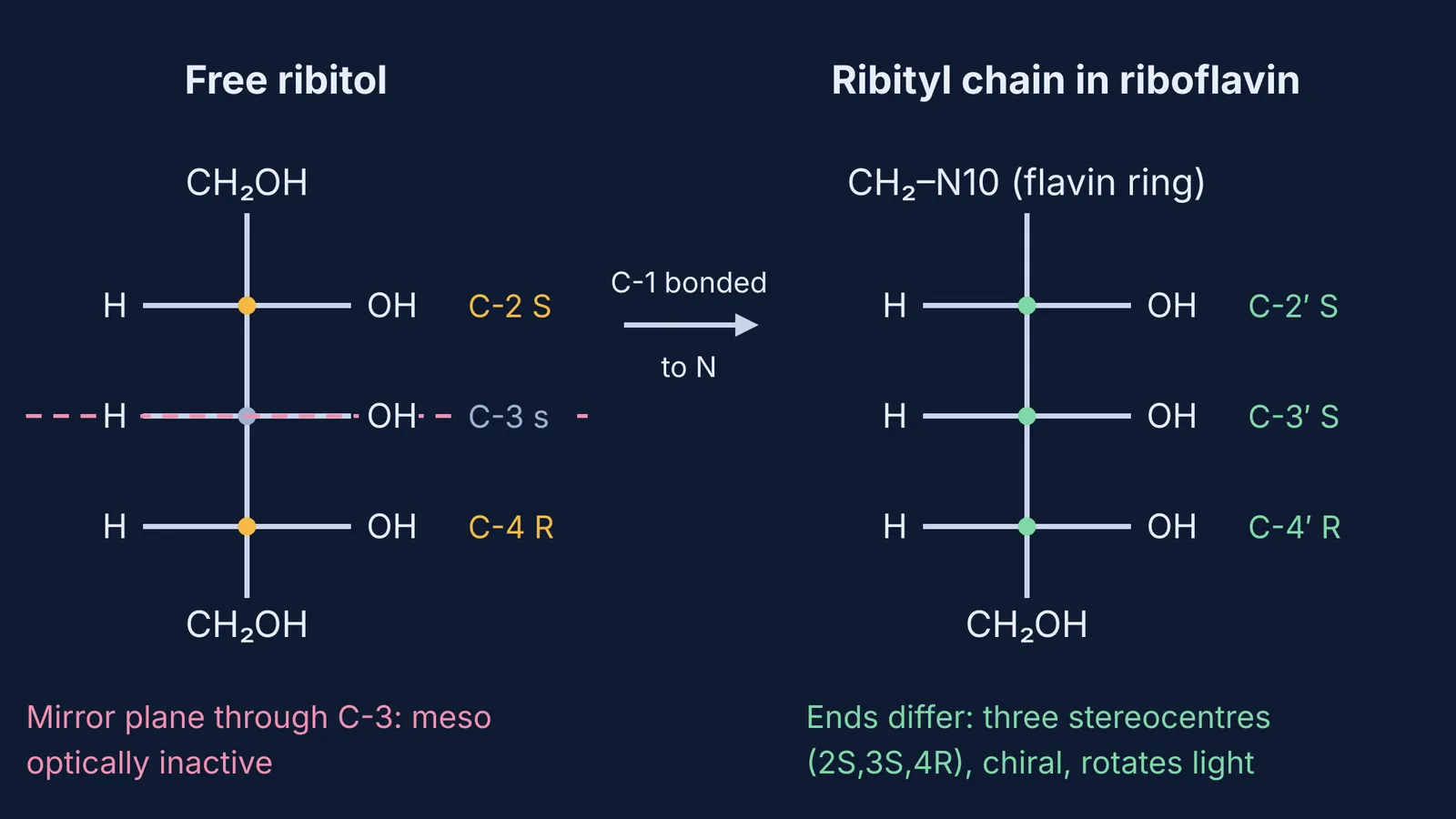
Draw ribitol as a Fischer projection: CH₂OH at both ends, all three OH groups on the right, as in D-ribose. A horizontal plane through C-3 reflects C-2 onto C-4 and the top CH₂OH onto the bottom one. The molecule is its own mirror image, so it is meso and optically inactive.
C-2 and C-4 are stereocentres with opposite labels (S and R), the same pattern as meso-tartaric acid in what a meso compound is, using tartaric acid. C-3 is special: its two branches are mirror images of each other, so it is called pseudoasymmetric (lowercase r or s).
Worked example 1: how many pentitols are there?
Aldopentoses. Three stereocentres give 2³ = 8: D and L ribose, arabinose, xylose and lyxose.
Reduce each one. Both ends become CH₂OH, so the Fischer projection may be turned through 180°. Write the OH sides from C-2 to C-4 as R (right) or L (left).
D-ribose (R, R, R) turned reads L, L, L: its own mirror image. Ribitol is meso.
D-xylose (R, L, R) turned reads L, R, L: again its mirror image. Xylitol is meso.
D-arabinose (L, R, R) turned reads L, L, R, not its mirror image (R, L, L). D-arabinitol is chiral.
D-lyxose (L, L, R) turned reads L, R, R, the D-arabinose pattern: both give the same alditol.
Answer. 8 aldopentoses give only 4 pentitols: ribitol (meso), xylitol (meso) and the D/L pair of arabinitol.
Why does the side chain become chiral when it is bonded to nitrogen?
In riboflavin, C-1′ is CH₂ bonded to N-10 while C-5′ is still CH₂OH. The ends differ, the mirror plane is gone, and the 180° turn is no longer allowed. C-2′, C-3′ and C-4′ each carry four different groups, so all three are true stereocentres. Such a chain has 2³ = 8 stereoisomers (four pairs of enantiomers), and riboflavin is chiral.
So optical rotation works as an identity test. Clause 4.1.2: dissolve 50.0 mg of dried sample in 0.05 N NaOH to 10.0 mL and read the rotation within 30 minutes; the specific rotation must be between 120° and 135°. The scanned copy prints no sign, so only the size is quoted here.
With c = 0.0500 g / 10.0 mL = 0.00500 g/mL, a 1 dm tube shows only α = [α] × l × c = 120 × 1 × 0.00500 = 0.60° to 0.675°.
Why do the labels change from R to S?
D-ribose is (2R,3R,4R). No atom at C-2′, C-3′ or C-4′ moves on the way to riboflavin, yet the name says (2S,3S,4R). Only the priorities changed.
At C-2′, CHO (O, O, H) used to outrank C-3 (O, C, H). Now CH₂N (N, H, H) ranks below C-3′. Two groups swap rank, so R becomes S.
At C-3′, both neighbours are (O, C, H). One step further, the C-4′ side reaches C-5′ (O, H, H) and now beats C-1′ (N, H, H); in ribose the CHO side won. R becomes S.
At C-4′ the ranking is unchanged, so it stays R.
Is riboflavin a glycoside or a nucleoside?
No, despite the "ribo" in the name.
Find the carbon bonded to the ring nitrogen. In both cases it is C-1′.
Count heteroatoms on it. In a nucleoside, C-1′ carries the base N and the ring O: the anomeric carbon of an N-glycoside, with α and β forms. In riboflavin, C-1′ is a CH₂ bonded to N-10 and C-2′ only.
Look for a ring oxygen. A nucleoside has a furanose ring. Riboflavin's chain is open, because the sugar was reduced.
So riboflavin has no acetal-type carbon and no anomers: the ribityl group is an N-alkyl group carrying four OH groups. For the real nucleosides, see nucleoside vs nucleotide, with examples.
How does BIS check riboflavin's purity with the Beer–Lambert law?
E¹%₁cm is the absorbance of a 1 g per 100 mL solution in a 1 cm cell. Annex A uses E¹%₁cm = 328 at 444 nm, working in subdued light in brown glass flasks.
Worked example 2: from absorbance to percent purity
Dilution. Dissolve 65 mg in 500 mL, then dilute 20 mL to 200 mL. Concentration = 65 mg/500 mL × 20/200 = 0.0013 g per 100 mL.
Expected absorbance for pure riboflavin. A = E¹% × c × l = 328 × 0.0013 × 1 = 0.426.
Rearrange. For a sample of W grams, % purity = A × 5000/(328 × W). With A = 0.4264 and W = 0.0650 g this gives 100%.
A real reading. W = 0.0652 g, A = 0.418 gives 97.7%. But Table 1 asks for at least 98% on the dry basis. With 1.2% loss on drying, dry mass = 0.0652 × 0.988 = 0.06442 g, and purity = 98.9%. It passes.
Convert to molar absorptivity. ε = E¹% × M/10 = 328 × 376.37/10 ≈ 1.23 × 10⁴ L mol⁻¹ cm⁻¹.
The scanned Annex A prints an extra factor of 1.367 after this expression. It does not follow from the dilutions (a pure sample would read about 137%), so it is left out here.
What is lumiflavin and why does light matter?
The standard asks for amber containers and limits lumiflavin to 0.025% by mass. Lumiflavin is C₁₃H₁₂N₄O₂, 7,8,10-trimethylisoalloxazine: the same ring, with the ribityl chain replaced by a methyl group. It is a photolysis product of riboflavin.
What is lost. C₁₇H₂₀N₄O₆ − C₁₃H₁₂N₄O₂ = C₄H₈O₄, or 376.37 − 256.27 = 120.10 g/mol.
The limit test. Annex D shakes 25 mg of sample with 10.0 mL of chloroform, in which riboflavin is practically insoluble (the standard's own solubility line). At the limit, 25 mg × 0.025% = 6.25 µg in 10 mL, or 0.625 µg/mL. The TLC reference solution is made to exactly 0.625 µg/mL, so a test spot no larger or brighter than the reference passes.
Exam line: this joins Class 12 Biomolecules (vitamins, alditols), stereochemistry (meso, stereoisomer counts, R/S) and Beer–Lambert numericals. To drill meso counting and R/S in exam format, use Fermi Test Prep for JEE Main and Advanced preparation. For more stereoisomer counts, the Fermi Problem Library has a step-by-step solver that explains the reasoning.
Quick checklist
Free ribitol is meso; bonded to N, its C-2′, C-3′, C-4′ are true stereocentres (2S,3S,4R).
8 aldopentoses give 4 pentitols: ribitol and xylitol (meso), D- and L-arabinitol.
Not a glycoside: C-1′ is a CH₂ with no ring oxygen.
% purity = A × 5000/(328 × W); ε ≈ 1.23 × 10⁴ L mol⁻¹ cm⁻¹.
Lumiflavin: ring + CH₃, limit 0.025%, keep from light.