

On this page
Ask a JEE student what happens when glucose is reduced and most will say "n-hexane, with HI and red phosphorus". That is the structure-proof reaction NCERT gives. A milder reducing agent, NaBH₄ (or H₂ over a nickel catalyst), stops much earlier. It reduces only the C=O group and leaves every OH and every stereocentre untouched. The product is a sugar alcohol, called an alditol. This is JEE Advanced depth, not NCERT, but it is a favourite source of stereochemistry questions because the products can be chiral or meso, and you can decide which just by looking at a Fischer projection.
What does NaBH₄ do to glucose?
Glucose exists in water almost entirely as cyclic hemiacetals (the α and β pyranose forms). Only a tiny fraction is the open-chain aldehyde at any moment. NaBH₄ cannot reduce the ring, because the ring has no C=O. It reduces the open-chain aldehyde. As that small fraction is used up, more ring opens to replace it, so in the end all the glucose is reduced.
The change happens only at C1: the CHO becomes CH₂OH.
With hydrogen: C₆H₁₂O₆ + H₂ → C₆H₁₄O₆
With borohydride in water: 4 C₆H₁₂O₆ + NaBH₄ + 4 H₂O → 4 C₆H₁₄O₆ + NaB(OH)₄
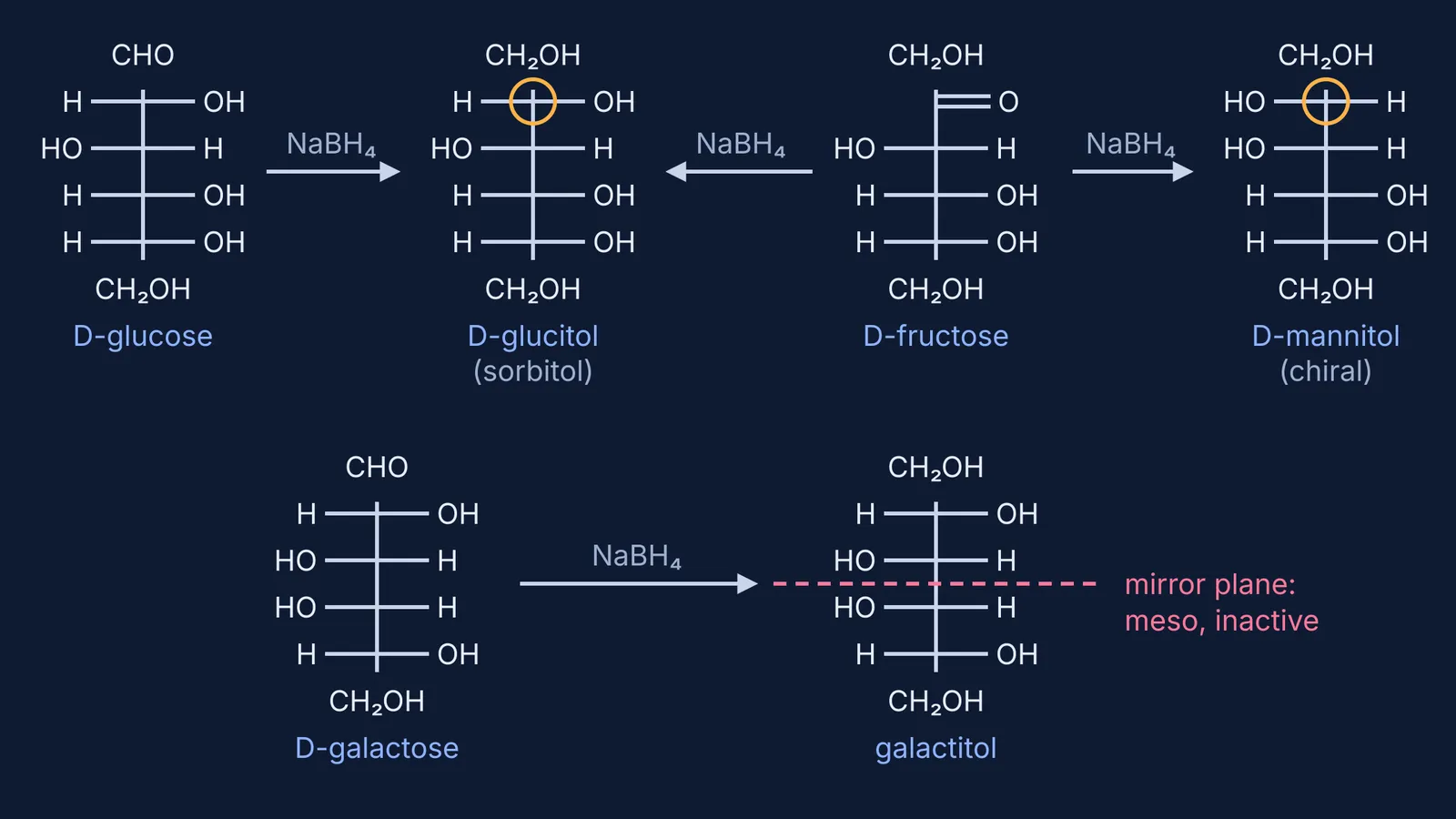
Both equations balance (check the second: 60 H and 28 O on each side). The product from D-glucose is D-glucitol, better known as sorbitol. C2, C3, C4 and C5 keep exactly the configuration they had in glucose. No new stereocentre forms, because C1 was not a stereocentre and the new CH₂OH is not one either. So D-glucose gives one product only.
Why does fructose give two alditols?
D-Fructose is a ketose. Its C=O is at C2, with CH₂OH groups at C1 and C6. C2 is flat (trigonal) in the ketone, so it is not a stereocentre. Reduction adds H to C2 and turns it into CH(OH), which is a stereocentre. Hydride can arrive from either face of the C=O, so you get both configurations at C2:
OH on the right at C2. With C3 to C5 the same as in fructose (left, right, right), this is exactly the pattern of D-glucitol.
OH on the left at C2. The pattern left, left, right, right is D-mannitol, the alditol you also get from D-mannose.
So D-fructose gives a mixture of D-glucitol and D-mannitol, which are C2 epimers. The proportions depend on the reagent and the conditions, so do not assume 1 : 1. This mirrors the Lobry de Bruyn–van Ekenstein rearrangement, where base links glucose, fructose and mannose through the same C2 position. There, an enediol forgets the C2 configuration. Here, the flat ketone does.
Which alditols are chiral, and which one is meso? A worked example
Question. D-Glucose, D-fructose and D-galactose are each reduced with NaBH₄. For each product, count the stereocentres and decide whether it is optically active.
Write each Fischer projection with C1 at the top and record which side the OH is on at C2, C3, C4 and C5 (R = right, L = left; these letters are only positions, not CIP labels).
D-glucose: R, L, R, R
D-galactose: R, L, L, R
D-fructose: C2 is C=O, then L, R, R
Step 1. Reduce. C1 becomes CH₂OH, so both ends of every alditol are now CH₂OH. The two ends are identical, which is what makes symmetry possible.
Step 2. Count stereocentres. In each alditol, C2, C3, C4 and C5 each carry H, OH and two different carbon chains. That is 4 stereocentres in each. C1 and C6 are CH₂ groups, not stereocentres.
Step 3. Look for a mirror plane. A horizontal mirror plane would sit between C3 and C4 and swap C2 with C5 and C3 with C4, without changing left and right. So you need C2 and C5 on the same side, and C3 and C4 on the same side.
D-Glucitol (R, L, R, R): C2 and C5 are both right, but C3 is left and C4 is right. No mirror plane. It is chiral and optically active.
Galactitol (R, L, L, R): C2 and C5 are both right, and C3 and C4 are both left. There is a mirror plane. Galactitol (dulcitol) is meso and optically inactive, even though it was made from optically active D-galactose.
D-Mannitol (L, L, R, R): C2 is left and C5 is right. No mirror plane.
Step 4. Do not stop at "no mirror plane" for mannitol. Turn its Fischer projection by 180° in the plane of the paper, which is allowed. The order of the rows reverses and every OH swaps sides. L, L, R, R reversed is R, R, L, L; swapping sides gives L, L, R, R again. So mannitol has a two-fold rotation axis (C₂ symmetry). A rotation axis does not make a molecule achiral. Only a mirror plane or a centre of symmetry does. D-Mannitol is chiral and optically active, not meso. The meso idea is the same one you meet with tartaric acid, now with four stereocentres.
Answer. D-Glucose gives D-glucitol (4 stereocentres, active). D-Fructose gives D-glucitol and D-mannitol (each 4 stereocentres, both active). D-Galactose gives galactitol (4 stereocentres, meso, inactive).
A quick mass check: 9.0 g of glucose is 9.0 / 180.16 = 0.0500 mol. Complete reduction gives 0.0500 mol of sorbitol (M = 182.17 g/mol), which is about 9.1 g.
Can two different sugars give the same alditol?
Yes. Because both ends of an alditol are CH₂OH, the molecule has no "top" any more. Take L-gulose, whose Fischer projection reads L, L, R, L from C2 to C5. Reduce it, then rotate the projection by 180°. The rows reverse (L, R, L, L) and each OH swaps sides (R, L, R, R). That is D-glucitol. So D-glucose and L-gulose, two different aldoses, give the same alditol.
This also explains a counting result. There are 16 aldohexoses, from four chiral carbons, but only 10 stereoisomeric hexitols: two meso compounds (allitol and galactitol) and four pairs of enantiomers. The symmetric ends merge some of the sixteen.
How is this different from reduction with HI and red phosphorus?
Heating glucose with HI and red phosphorus removes every oxygen and gives n-hexane. That reaction proves the six carbons form an unbranched chain, and it is the one NCERT asks about. The details are in HI and red phosphorus reduction of alcohols, acids and sugars. NaBH₄ and H₂/Ni do something much gentler: one C=O becomes CH–OH, and the stereochemistry is preserved. If a question mentions stereocentres or optical activity of the product, it means the alditol, not hexane.
If you want to practise more epimer and meso questions with the reasoning shown at each step, the Fermi Problem Library has a step-by-step solver that explains the reasoning.
Quick checklist
NaBH₄ or H₂/Ni reduces the open-chain C=O of a sugar to CH₂OH or CH(OH); the ring keeps reopening to supply it.
D-Glucose gives only D-glucitol (sorbitol). D-Mannose gives only D-mannitol.
D-Fructose gives D-glucitol and D-mannitol, because C2 becomes a new stereocentre. Do not assume a 1 : 1 ratio.
Meso test in a Fischer projection: C2 and C5 on the same side, and C3 and C4 on the same side.
Galactitol is meso. D-Glucitol and D-Mannitol are chiral; mannitol has C₂ symmetry, not a mirror plane.
Alditols are JEE Advanced depth; NCERT's glucose reduction is HI/red P to n-hexane.


