

On this page
Hot, concentrated hydriodic acid can strip the oxygen out of an organic molecule and leave a plain alkane. An alcohol becomes an alkane, a carboxylic acid becomes an alkane with the same number of carbons, and glucose becomes n-hexane. Red phosphorus is usually added to the mixture, and many students think it is the reducing agent. It is not the reagent that touches the organic molecule. This post explains what HI does, what red phosphorus does, and how to count the moles of HI each reduction needs.
Why can hot HI remove oxygen from organic compounds?
HI is the strongest reducing agent among the hydrogen halides, because I⁻ gives up its electron easily and is oxidised to I₂. The inorganic side of that, including HI with sulphuric acid, is covered in why HI is a stronger reducing agent than HBr and HCl. In organic chemistry the same property lets HI reduce a C–I bond.
For an alcohol the reaction happens in two stages:
Substitution: R–OH + HI → R–I + H₂O. This step is not a redox reaction. It is the familiar conversion of an alcohol to an alkyl iodide.
Reduction: R–I + HI → R–H + I₂. Here an iodide ion takes the iodine from R–I, carbon gains a hydrogen, and I₂ forms. This is the redox step.
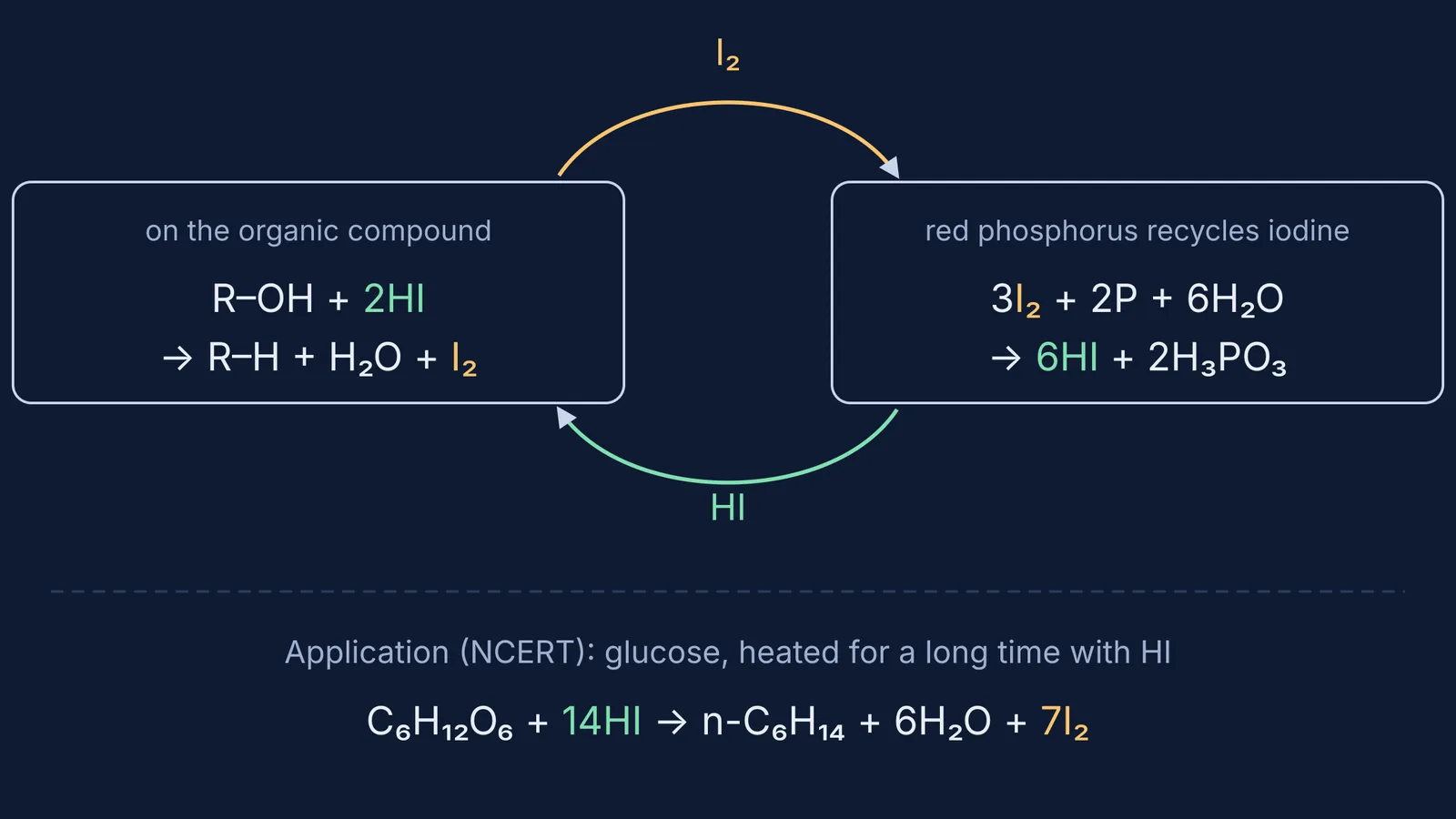
Overall: R–OH + 2HI → R–H + H₂O + I₂.
Without red phosphorus, the reaction with an alcohol mainly stops at the alkyl iodide. Going on to the alkane needs excess HI and prolonged heating.
What does red phosphorus actually do?
Every reduction step makes I₂ and uses up HI. As I₂ builds up, the reaction R–I + HI ⇌ R–H + I₂ is pushed back to the left, and the HI supply runs down. Red phosphorus removes the I₂ and turns it back into HI:
2P + 3I₂ → 2PI₃
PI₃ + 3H₂O → H₃PO₃ + 3HI
Net: 2P + 3I₂ + 6H₂O → 2H₃PO₃ + 6HI
So red phosphorus works as an iodine sink and an HI source. A modest amount of HI can then reduce a lot of the organic compound, because the HI is regenerated again and again.
There is one subtle point worth stating plainly. In the overall change, phosphorus goes from 0 to +3 in H₃PO₃, so phosphorus is where the electrons ultimately come from. But it never reacts with the organic molecule. HI is the reagent that reduces the organic compound; red P keeps the HI supply going. Red phosphorus is used, not white phosphorus, which is far more reactive, toxic and catches fire in air.
How many moles of HI does each group need?
Counting oxygens fails for carbonyl groups. Count C–O bonds instead. Each C–O bond that is replaced by a C–H bond needs 2 electrons, which means 2 HI used and one I₂ formed.
Alcohol, C–OH (1 C–O bond): 2HI. CH₃CH₂OH + 2HI → C₂H₆ + H₂O + I₂.
Ketone or aldehyde, C=O (2 bonds): 4HI. CH₃COCH₃ + 4HI → CH₃CH₂CH₃ + H₂O + 2I₂.
Carboxylic acid, C=O plus C–OH (3 bonds): 6HI. CH₃COOH + 6HI → C₂H₆ + 2H₂O + 3I₂.
You can check each with oxidation states. In acetic acid the COOH carbon is +3; in ethane that carbon is −3. That is a gain of 6 electrons, which is 6HI and 3I₂. Each equation above balances in atoms: for acetic acid there are 2 C, 10 H, 2 O and 6 I on each side.
Notice the pattern for acids: RCOOH → RCH₃. The carboxyl carbon stays in the product as a methyl group, so the carbon count does not change.
Worked example: glucose to n-hexane
NCERT uses this reaction as evidence for glucose's structure: on prolonged heating with HI, glucose gives n-hexane, which shows that its six carbons form a straight chain. NCERT does not mention red phosphorus. Adding red P is standard practice for HI reductions in general, so treat it here as a practical extra, not as part of the NCERT statement.
Question: how many moles of HI are needed to convert one mole of glucose into n-hexane, and how many moles of I₂ form?
Write the open-chain structure. Glucose is CHO–(CHOH)₄–CH₂OH: one aldehyde group and five OH groups.
Count C–O bonds. The aldehyde C=O counts as 2. The five C–OH groups count 1 each. Total: 2 + 5 = 7.
Convert to HI and I₂. 7 C–O bonds × 2HI = 14HI, and 7 I₂ form.
Write the equation. C₆H₁₂O₆ + 14HI → C₆H₁₄ + 6H₂O + 7I₂.
Check atoms. C: 6 = 6. H: 12 + 14 = 26 on the left; 14 + 12 = 26 on the right. O: 6 = 6. I: 14 = 14.
Check electrons. The total oxidation number of the six carbons is 0 in glucose and −14 in hexane, a gain of 14 electrons, matching 14 I⁻ → 7I₂.
Put in masses. 1.80 g of glucose (molar mass 180 g/mol) is 0.0100 mol. Without red P it needs 0.140 mol HI, about 17.9 g. With red P, the I₂ is recycled. The net change becomes 3C₆H₁₂O₆ + 14P + 24H₂O → 3C₆H₁₄ + 14H₃PO₃, so 0.0100 mol glucose uses about 0.0467 mol P, roughly 1.45 g.
Why does the product prove a straight chain? HI removes oxygen but does not rearrange the carbon skeleton under these conditions. If glucose's carbons were branched, you would get a branched hexane such as 2-methylpentane instead of n-hexane. How this fits with glucose's other structural tests is in biomolecules in chemistry: sugars, proteins and DNA.
For more mole-counting problems on redox reagents like this, the Fermi Problem Library has a step-by-step solver that explains the reasoning at each stage.
How is this different from other ways to make alkanes?
Most alkane preparations in your syllabus change the length of the carbon chain. Soda-lime decarboxylation removes one carbon, Kolbe electrolysis joins two chains, and the Wurtz reaction joins two alkyl groups. These are compared in preparing alkanes: Wurtz, Kolbe and decarboxylation.
HI with red P is different: it keeps the carbon skeleton and only removes oxygen (or iodine). So:
Acetic acid gives ethane with HI/red P, but its sodium salt gives methane by soda-lime decarboxylation.
Sodium acetate gives ethane by Kolbe electrolysis too, but there the two methyl groups join and both carboxyl carbons are lost.
Quick checklist
HI reduces; red P recycles I₂ back to HI.
R–OH + 2HI → R–H + H₂O + I₂; without red P and excess HI, alcohols mostly stop at R–I.
Count C–O bonds: 2HI and one I₂ per bond. Alcohol 2HI, carbonyl 4HI, acid 6HI.
RCOOH → RCH₃: the carbon count stays the same.
Glucose + 14HI → n-hexane + 6H₂O + 7I₂, which shows a straight six-carbon chain.
Use red phosphorus, never white.


