

On this page
When comparing the reducing power of hydrogen halides (HF, HCl, HBr and HI), the key factor is how easily the molecule can give up its hydrogen. A stronger reducing agent is one that is more easily oxidised, which in this case means parting with its hydrogen to reduce another chemical species in a reaction.
The reducing power of the hydrogen halides increases steadily as you move down the group in the periodic table. This trend makes hydrogen iodide (HI) the strongest reducing agent of the set, followed by hydrogen bromide (HBr), hydrogen chloride (HCl) and finally hydrogen fluoride (HF), which barely acts as a reducing agent at all.
Why is HI a stronger agent than HBr and HCl?
The reducing power is directly tied to the bond dissociation enthalpy—the energy required to break the covalent H–X bond. As you move from chlorine to iodine in Group 17, the halogen atoms get significantly larger due to the addition of new electron shells. This increasing atomic radius means the orbital overlap between the small hydrogen 1s orbital and the large halogen valence p-orbital becomes progressively less effective.
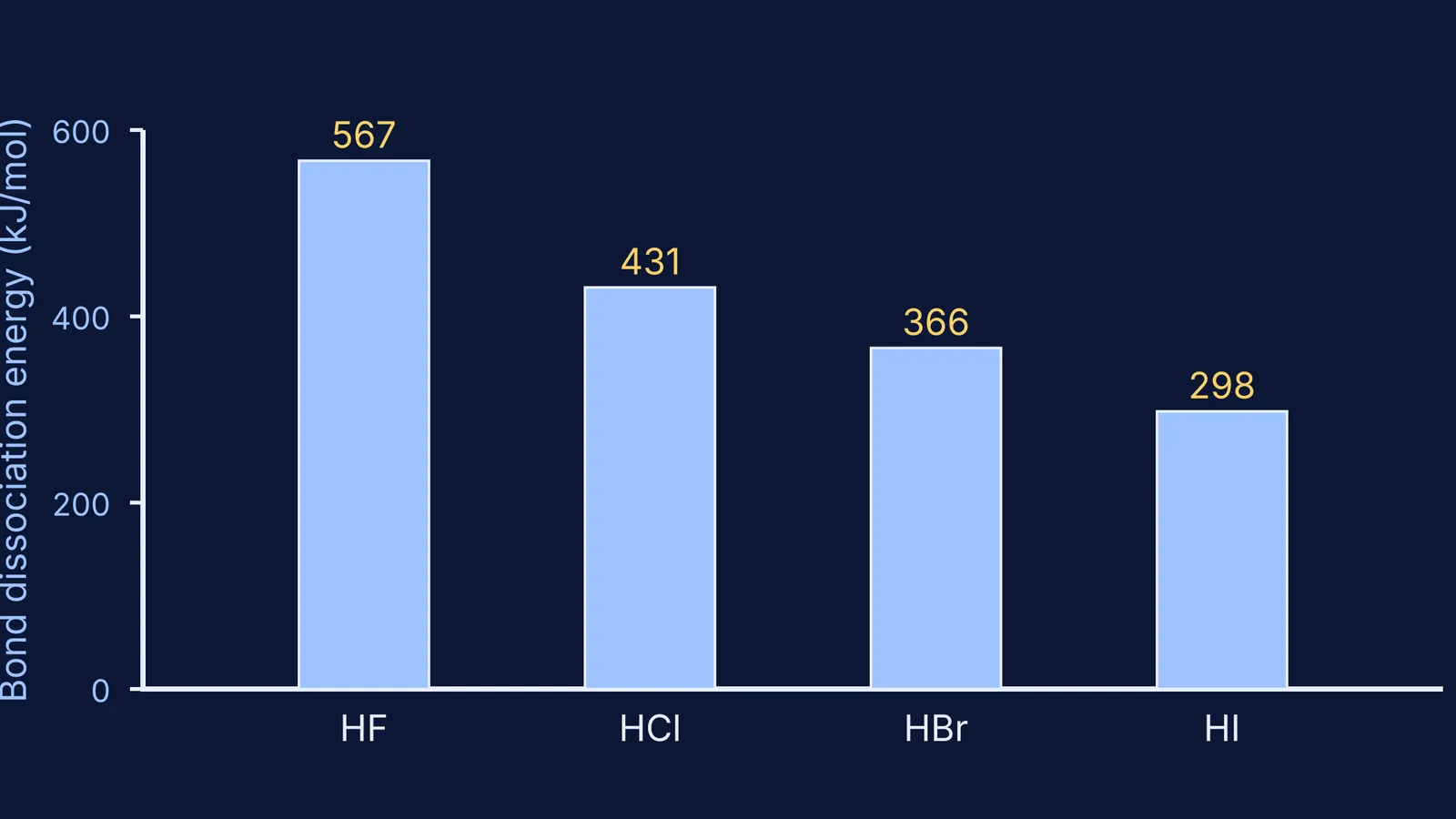
Because of this poor overlap, the bond length increases, and the bond dissociation energy drops steeply. Hydrogen fluoride has a very strong, compact bond requiring 567 kJ/mol to break, while hydrogen chloride is significantly weaker at 431 kJ/mol (Wikipedia). Further down the group, the energy needed for hydrogen bromide drops to 366 kJ/mol, and hydrogen iodide has the weakest bond of all at just 298 kJ/mol (Wikipedia).
Because the H–I bond requires the least energy to break, HI is the most willing to release hydrogen atoms during a reaction. This remarkably low energy barrier makes it the most powerful reducing agent of the series, capable of reducing many compounds that HBr and HCl cannot touch. (For other examples of how atomic size and orbital overlap govern molecule shapes and bonding logic, see our guide to comparing bond angles in NH₃ and PH₃).
Why can concentrated H2SO4 not prepare HBr or HI?
In the laboratory, you can easily prepare hydrogen chloride gas by reacting a solid chloride salt (like sodium chloride, NaCl) with concentrated sulphuric acid (H₂SO₄). The sulphuric acid simply displaces the weaker, more volatile acid from its salt, without any further complications:
NaCl + H₂SO₄ → NaHSO₄ + HCl
You might logically expect the exact same displacement method to work perfectly well for preparing HBr and HI, but it completely fails in practice. Concentrated sulphuric acid (which is manufactured on a massive industrial scale via the Contact process) is a notoriously strong oxidising agent. While hydrogen chloride is too weak a reducing agent to have any chemical effect on the acid, HBr and HI are strong enough to attack and reduce the sulphuric acid itself.
When you try to prepare HBr by adding sulphuric acid to a bromide salt, the H₂SO₄ immediately oxidises the newly formed hydrogen bromide into elemental, reddish-brown bromine gas (Br₂). In return, the sulphuric acid is reduced to sulphur dioxide gas (SO₂) (Wikipedia):
2HBr + H₂SO₄ → Br₂ + SO₂ + 2H₂O
The situation becomes even more extreme when you attempt to isolate HI. Because hydrogen iodide is an even stronger reducing agent than hydrogen bromide, it drives the reduction much further. It strips oxygen from the sulphuric acid and reduces the central sulphur atom all the way from its +6 oxidation state down to a -2 oxidation state, producing hydrogen sulphide (H₂S). The HI is simultaneously oxidised to dense violet iodine vapour (I₂) (Wikipedia):
8HI + H₂SO₄ → 4I₂ + H₂S + 4H₂O
How do you prepare HBr and HI?
To successfully prepare pure HBr or HI gas from their respective alkali salts, you must completely avoid using an oxidising acid. If the acid used can act as an electron acceptor, the hydrogen halide will inevitably be destroyed as fast as it is created.
Instead, a strong but non-oxidising acid such as concentrated phosphoric acid (H₃PO₄) is the standard reagent used in laboratories. Phosphoric acid successfully displaces the hydrogen halide from its salt and provides the necessary acidic environment, but it does not oxidise the resulting gas further:
NaBr + H₃PO₄ → NaH₂PO₄ + HBr
KI + H₃PO₄ → KH₂PO₄ + HI
By switching the reagent, you isolate the pure hydrogen halide gas without any unwanted redox side reactions. (If your synthetic goal is to prepare liquid alkyl iodides and fluorides instead of inorganic gases, displacement reactions are generally avoided; the Finkelstein and Swarts reactions are the standard organic routes).
If you find inorganic chemistry trends and exceptions hard to memorise, it often helps to link them back to core, unchanging principles like atomic size, electronegativity and bonding overlap. The Fermi Concept Library has every concept in physics, chemistry, biology, mathematics and computing, each with its own lesson and its place in the map. This helps you naturally reason your way to the correct answer rather than relying on pure memorisation.


