On this page
Glucose is one of sixteen aldohexoses/25:_Biomolecules-_Carbohydrates/25.04:_Configurations_of_Aldoses) that share the same formula, C6H12O6, and the same open-chain skeleton. They differ only in which way four OH groups point. Once you see where the sixteen comes from, you can count stereoisomers for any sugar, and you stop confusing an enantiomer with an epimer in exams.
Why are there 16 aldohexoses?
An aldohexose is a six-carbon sugar with an aldehyde group at C1. In the open chain, CHO sits at the top, CH2OH at the bottom, and four CH(OH) carbons, C2 to C5, sit in between. Each of those four carbons carries four different groups, so each is a chiral centre.
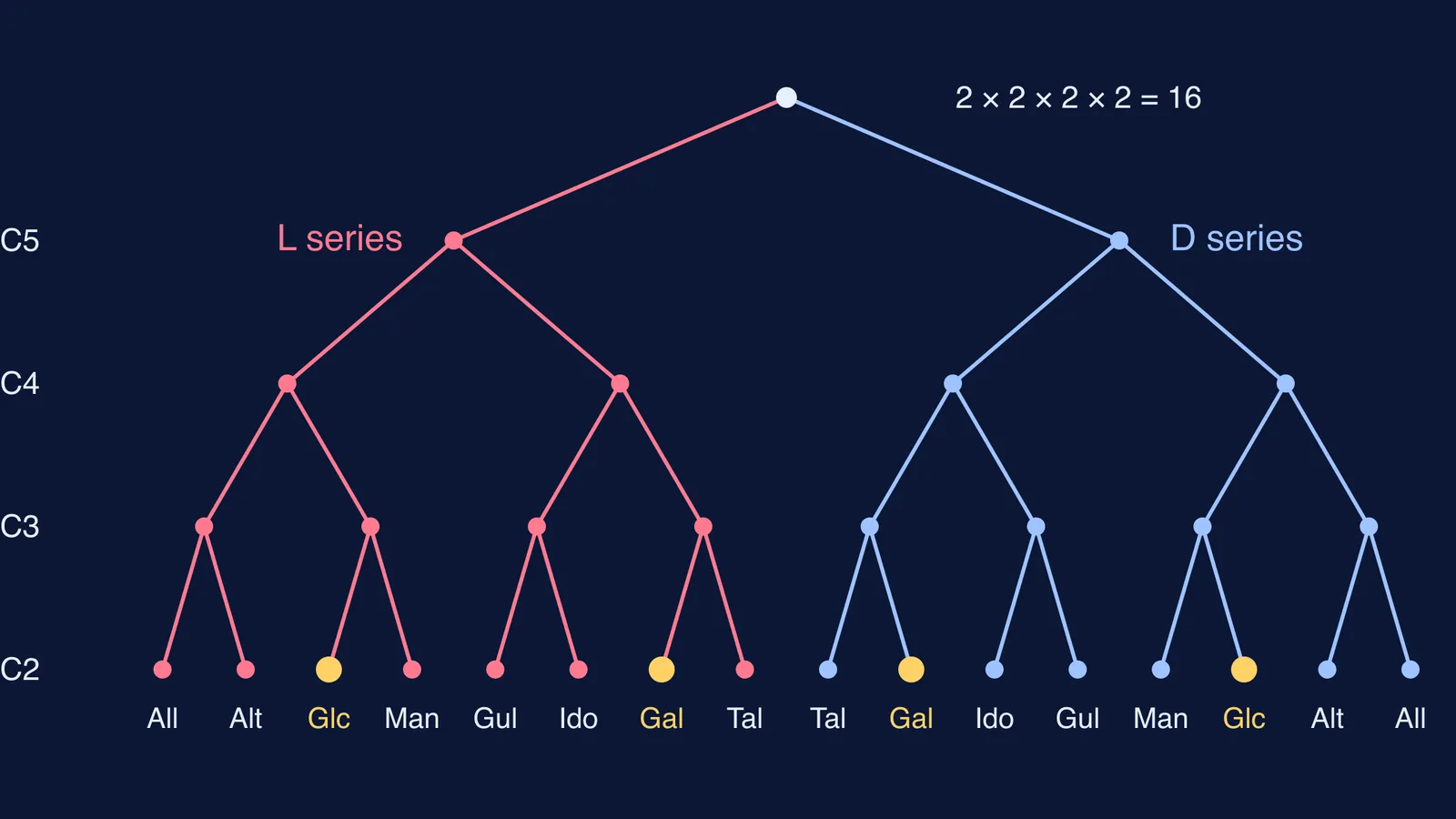
Aldohexoses have four chiral centres, so they have 2^4 = 16 possible stereoisomers (Chemistry LibreTexts, Configurations of Aldoses/25:_Biomolecules-_Carbohydrates/25.04:_Configurations_of_Aldoses)).
The reason for the power of two is simple. In a Fischer projection, the OH on each chiral carbon points either right or left. The four choices are independent, so they multiply: 2 × 2 × 2 × 2. The same source applies the rule down the family: aldotetroses have two chiral centres and four stereoisomers, and aldopentoses have three chiral centres and eight.
Why is the answer not smaller? 2^n is a ceiling. It drops when a molecule has an internal mirror plane, as in meso tartaric acid. An aldohexose cannot have one, because its two ends are different (CHO and CH2OH). So all 16 are genuinely different molecules.
Why are eight of them D and eight L?
The IUPAC rule is that a sugar belongs to the D or L series according to the configuration at its highest-numbered chiral centre: if that OH points right in the Fischer projection, the sugar is D (IUPAC carbohydrate nomenclature, 2-Carb-4). For an aldohexose that carbon is C5.
Half of the 16 arrangements have the C5 OH on the right, so eight are D. The L version of each sugar is drawn by inverting every chiral centre of the D sugar (Chemistry LibreTexts_UConn/12:_Carbohydrates_and_Sugars/12.04:_Configurations_of_Aldoses)). That gives eight mirror-image pairs, and each pair shares one name.
Where do glucose and galactose sit among the 16?
Write each D-aldohexose as a code for the OH at C2, C3 and C4 (R for right, L for left). C5 is always R in the D series. In the standard order used by Chemistry LibreTexts/25:_Biomolecules-_Carbohydrates/25.04:_Configurations_of_Aldoses), the eight are:
D-allose: R R R
D-altrose: L R R
D-glucose: R L R
D-mannose: L L R
D-gulose: R R L
D-idose: L R L
D-galactose: R L L
D-talose: L L L
Read down the columns and you see a pattern: C2 switches every line, C3 every two lines, C4 every four. It is binary counting, which is why there is no ninth D sugar. A classroom mnemonic for the order is "All altruists gladly make gum in gallon tanks".
In D-glucose, every OH is on the right except the one on C3, and D-galactose differs from glucose only at C4 (Chemistry LibreTexts, Important Hexoses/16:_Carbohydrates/16.3:_Important_Hexoses)). Two sugars that differ at exactly one chiral centre are epimers, so glucose and galactose are C4 epimers. If that term is shaky, see epimers vs anomers.
Emil Fischer settled the configuration of glucose in 1891, making an arbitrary choice for D-glucose and building the D family from it (Chemistry LibreTexts_UConn/12:_Carbohydrates_and_Sugars/12.04:_Configurations_of_Aldoses)). He received the 1902 Nobel Prize in Chemistry "in recognition of the extraordinary services he has rendered by his work on sugar and purine syntheses" (Nobel Prize). The full story is in our piece on Emil Fischer and sugar structures.
Is L-glucose just D-glucose with C5 flipped?
No, and this is a common trap. Work it through with the codes for C2, C3, C4 and then C5:
D-glucose is R L R, then R.
Flip only C5: R L R, then L. C5 now points left, so this is an L sugar.
To name an L sugar, mirror it back to its D partner by inverting all four centres: L R L, then R.
L R L is D-idose in the list above, so the molecule from step 2 is L-idose.
L-glucose needs all four flipped: L R L, then L.
The count of 16 is for the open chain. When glucose closes into a ring, C1 becomes the anomeric carbon, with alpha and beta forms (Chemistry LibreTexts on anomers/25:_Biomolecules-_Carbohydrates/25.05:_Cyclic_Structures_of_Monosaccharides_-_Anomers)).
How do you count stereoisomers of any sugar?
Use this five-step check on any open-chain sugar:
Draw the Fischer projection.
Mark every carbon with four different groups.
Write 2^n as the maximum.
Look for an internal mirror plane; if one exists, some forms are meso and the count drops.
Split the rest into D and L by the OH on the highest-numbered chiral carbon.
If you keep flipping the wrong centre, the Fermi Problem Library has worked problems with a step-by-step solver that explains the reasoning rather than printing an answer. If the gap is earlier, at what makes a carbon chiral, the Fermi Concept Library gives each concept its own lesson and its place in the map.