On this page
By 1899 chemists accepted that a carbon atom with four different groups is chiral. Whether nitrogen could do the same was still open. That year William Jackson Pope and Stanley John Peachey, at the Goldsmiths' Institute in New Cross, split a quaternary ammonium iodide into two forms with equal and opposite rotations. It was the first convincing case of an optically active compound whose only stereocentre is nitrogen.
The paper is W. J. Pope and S. J. Peachey, "Asymmetric Optically Active Nitrogen Compounds. Dextro- and Laevo-α-benzylphenylallylmethylammonium Iodides and Bromides", J. Chem. Soc. Trans. 75 (1899) 1127–1131 (DOI 10.1039/CT8997501127; scan on the Internet Archive). All readings and quotes below come from that scan, checked against the page images.
Was anyone first before Pope and Peachey?
There was one earlier claim. In 1891 Le Bel reported that when the mould Penicillium glaucum was grown in a solution of isobutylpropylethylmethylammonium chloride, the liquid gained a rotation of −0°25′ or −0°30′, that is, about −0.4° to −0.5°. Pope and Peachey called this "the only direct evidence", but noted "the fugitive nature of the optical activity" and the failure of Marckwald and von Droste-Huelshoff to repeat it in 1899. In a footnote they add that Le Bel had replied and said he had confirmed his results.
Others had tried the standard method, using an optically active acid to separate the two forms. Marckwald and von Droste-Huelshoff used tartaric, camphoric and mandelic acids on Le Bel's base. Wedekind used tartaric and camphoric acids on the very compound Pope and Peachey chose. "In no case, however, was an optically active base obtained." So the fair wording is "first convincing resolution", not "first claim".
Why had the earlier attempts failed?
Pope and Peachey thought the problem was water. In their words, "tetralkylammonium salts are decomposed by water and converted into tertiary base and alcohol". So they worked in acetone mixed with ethyl acetate, adding only a few drops of water when needed.
A modern reading, which is ours and not the paper's: a tertiary amine has a lone pair and inverts very fast, so any route through the free amine loses the nitrogen's handedness.
How did camphorsulphonic acid separate the two forms?
The cation is C₆H₅CH₂–N⁺(C₆H₅)(CH₂CH=CH₂)(CH₃): benzyl, phenyl, allyl and methyl on one nitrogen. Count the atoms: C 7 + 6 + 3 + 1 = 17, H 7 + 5 + 5 + 3 = 20, so the iodide is C₁₇H₂₀NI.
Swap the anion. They boiled the inactive iodide with the silver salt of Reychler's dextro-camphorsulphonic acid. Silver iodide precipitates: [C₁₇H₂₀N]⁺I⁻ + Ag⁺[C₁₀H₁₅O₄S]⁻ → [C₁₇H₂₀N]⁺[C₁₀H₁₅O₄S]⁻ + AgI.
Now there are diastereomers. The solution holds (+)-cation with (+)-anion and (−)-cation with (+)-anion. These are not mirror images, so they have different solubilities.
Crystallise. From boiling acetone, the less soluble (+,+) salt came out as colourless, diamond-shaped plates melting at 169–170 °C. The (−,+) salt stayed in the mother liquor.
Swap back. Potassium iodide in water gave the active iodide as a white precipitate: [C₁₇H₂₀N]⁺[C₁₀H₁₅O₄S]⁻ + KI → [C₁₇H₂₀N]⁺I⁻ + K⁺[C₁₀H₁₅O₄S]⁻. Potassium bromide gave the bromide.
The general method is in racemic mixture and resolution.
How do you get [α] and [M] from their readings?
Use [α] = α ÷ (l × c), with l in dm and c in g/mL, and [M] = [α] × M ÷ 100. All tubes were 200 mm, so l = 2 dm. Molar masses below use modern atomic masses.
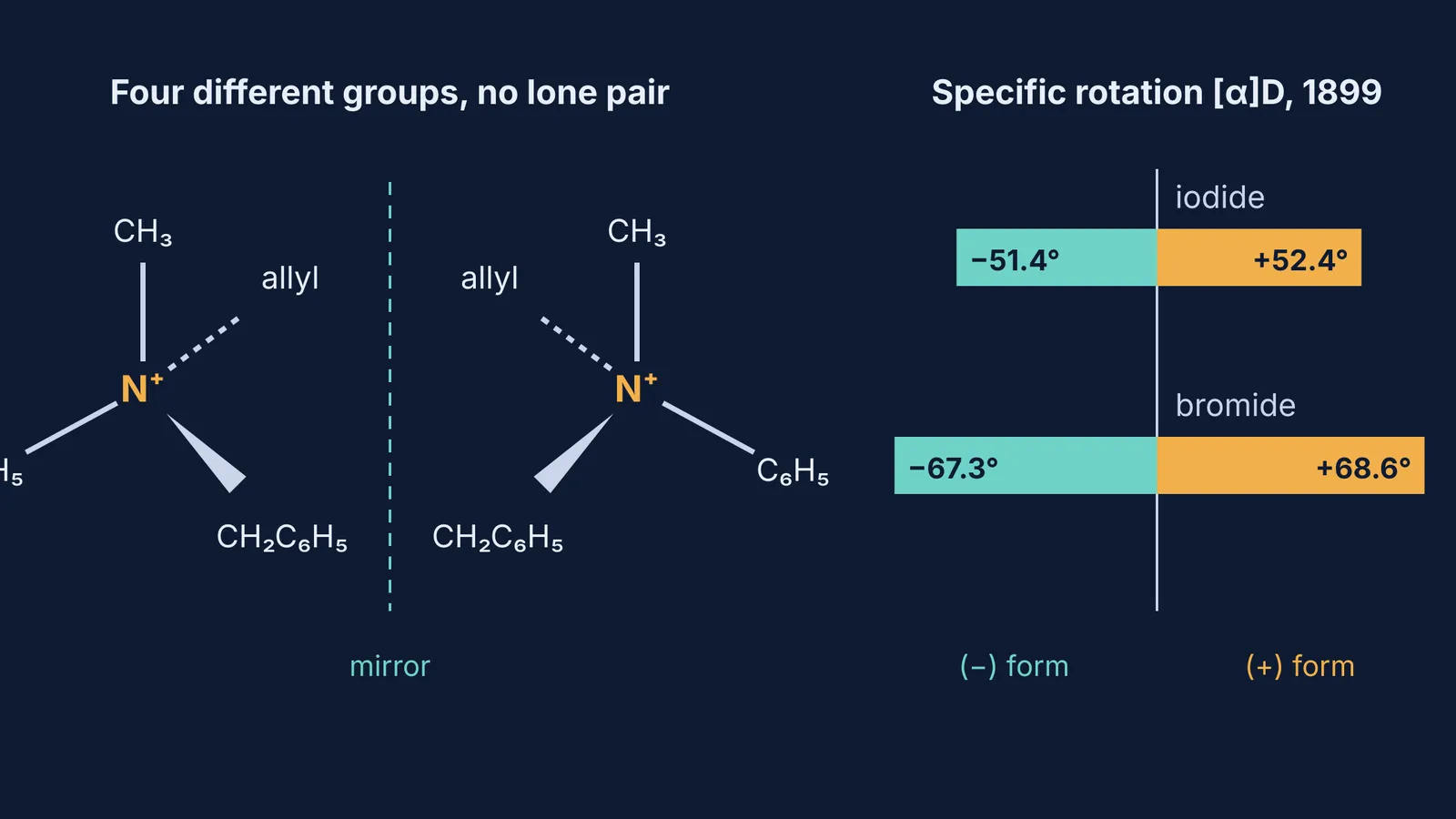
(+)-iodide. 0.1445 g in 15 mL of acetone–methanol, α = +1.01°. c = 0.1445 ÷ 15 = 0.009633 g/mL. [α] = 1.01 ÷ (2 × 0.009633) = +52.4° (paper +52.5°). With M = 365.3, [M] = 52.4 × 3.653 = +191 (paper +192).
(−)-iodide. 0.3105 g in 15 mL, α = −2.13°. c = 0.02070 g/mL. [α] = −2.13 ÷ 0.0414 = −51.4°. Equal and opposite to within 2%, which is the test for enantiomers.
Bromides. (+): 0.1454 g in 15 mL of ethanol, α = +1.33°, gives +68.6°, and with M = 318.3, [M] = +218. (−): 0.2240 g in 15 mL, α = −2.01°, gives −67.3°.
The diastereomeric salt. 0.5256 g in 25 mL of water, α = +1.87°. [α] = +44.5° (paper +44.4°). With M = 469.6 for C₂₇H₃₅NO₄S, [M] = +209 (paper +208).
Split off the anion. In a paper earlier in the same volume they had found [M] = +51.7° for camphorsulphonate salts of inactive bases. So the cation contributes about 209 − 52 = +157. They wrote "about +150°".
Check the other salt. The (−,+) salt gave [α] = −18.6° and [M] = −87. If pure, it should be about −150 + 52 ≈ −98. They wrote "about −100" and said their sample "still contained some of the salt of the dextro-base". From −87 = −100(1 − y) + 208y, y ≈ 0.04, so about 4% of the wrong salt. That estimate is ours.
Percent iodine. 0.2561 g of iodide gave 0.1640 g AgI. I = 0.1640 × 126.90 ÷ 234.77 = 0.0886 g, which is 34.61%. Calculated for C₁₇H₂₀NI: 34.74%.
The cation's [M] comes out near +150 in water, +191 in acetone–methanol and +218 in ethanol. Rotation depends on the solvent, so compare values only under the same conditions. The authors also called their figures "only provisional".
Why does a quaternary nitrogen with four different groups stay chiral?
In the cation, nitrogen is sp³ and tetrahedral, and its four groups (benzyl, phenyl, allyl, methyl) are all different. There is no plane of symmetry, so the ion and its mirror image cannot be superimposed, just as for a carbon stereocentre.
A tertiary amine with three different groups looks chiral too, with the lone pair as the fourth "group". But the lone pair lets the nitrogen flip through a flat shape, swapping one form for the other far too fast to separate. In the quaternary ion the lone pair is used in the fourth N–C bond, so there is nothing to flip through without breaking a bond. The barrier numbers are in why chiral amines can't be resolved but quaternary salts can.
The paper says "the five substituting groups are different". That is 1899 language, in which nitrogen was counted as pentavalent and the halide as the fifth group. Today you would say four different carbon groups on N⁺, with iodide as the counter-ion.
What did they learn about the inactive iodide?
A warm alcoholic solution of (+)-iodide mixed with the inactive iodide read +0.25°. On standing, crystals formed and the solution became inactive, "all the dextrorotatory iodide having been deposited." They concluded that the inactive iodide was not a racemic compound but a mixture of separate (+) and (−) crystals. Today this is called a conglomerate. They also found that crystal measurements published earlier for the inactive iodide matched their active crystals.
For exam-focused practice on stereochemistry, Fermi Test Prep offers JEE Main and Advanced preparation with an AI tutor. For more polarimetry calculations, the Fermi Problem Library has a step-by-step solver that explains the reasoning.
Quick checklist
1899: Pope and Peachey resolved benzylphenylallylmethylammonium iodide.
Le Bel's 1891 claim came first but could not be repeated reliably.
They kept water out and used silver d-camphorsulphonate to make diastereomeric salts.
Iodides: +52.4° and −51.4°. Bromides: +68.6° and −67.3°.
[α] = α ÷ (l × c); [M] = [α] × M ÷ 100.
Four different groups and no lone pair: the nitrogen cannot invert, so the ion stays chiral.