On this page
Erythrosine is a cherry-red synthetic food colour. Its Indian Standard, IS 1697:1994, names it as the disodium (or dipotassium) salt of 2′,4′,5′,7′-tetraiodofluorescein, C₂₀H₆O₅I₄Na₂, with a molar mass of 879.87 for the disodium salt. Read that name with Class 12 eyes and you find two reactions you already know: the phthalein dye test that turns resorcinol into fluorescein, and the ortho/para halogenation of a phenol. Here is the chemistry, with every BIS number checked.
What does IS 1697 say erythrosine is?
The foreword lists the synonyms FD & C Red No. 3 and C.I. Food Red 14, Colour Index No. 45430, and the class xanthene: three fused rings with an oxygen bridge in the middle one. It says the standard belongs to the series of Indian Standards for synthetic food colours permitted under the Prevention of Food Adulteration Rules, 1955, and quotes those rules: food colours, except saffron and curcumin, are sold only under the BIS Certification Mark. The standard was first issued in 1960, revised in 1974 and again in 1994, and reaffirmed in 2008. Amendment No. 1 (September 2016) lowered the lead limit from 10 to 2 mg/kg.
Where do the four iodines go, and why there?
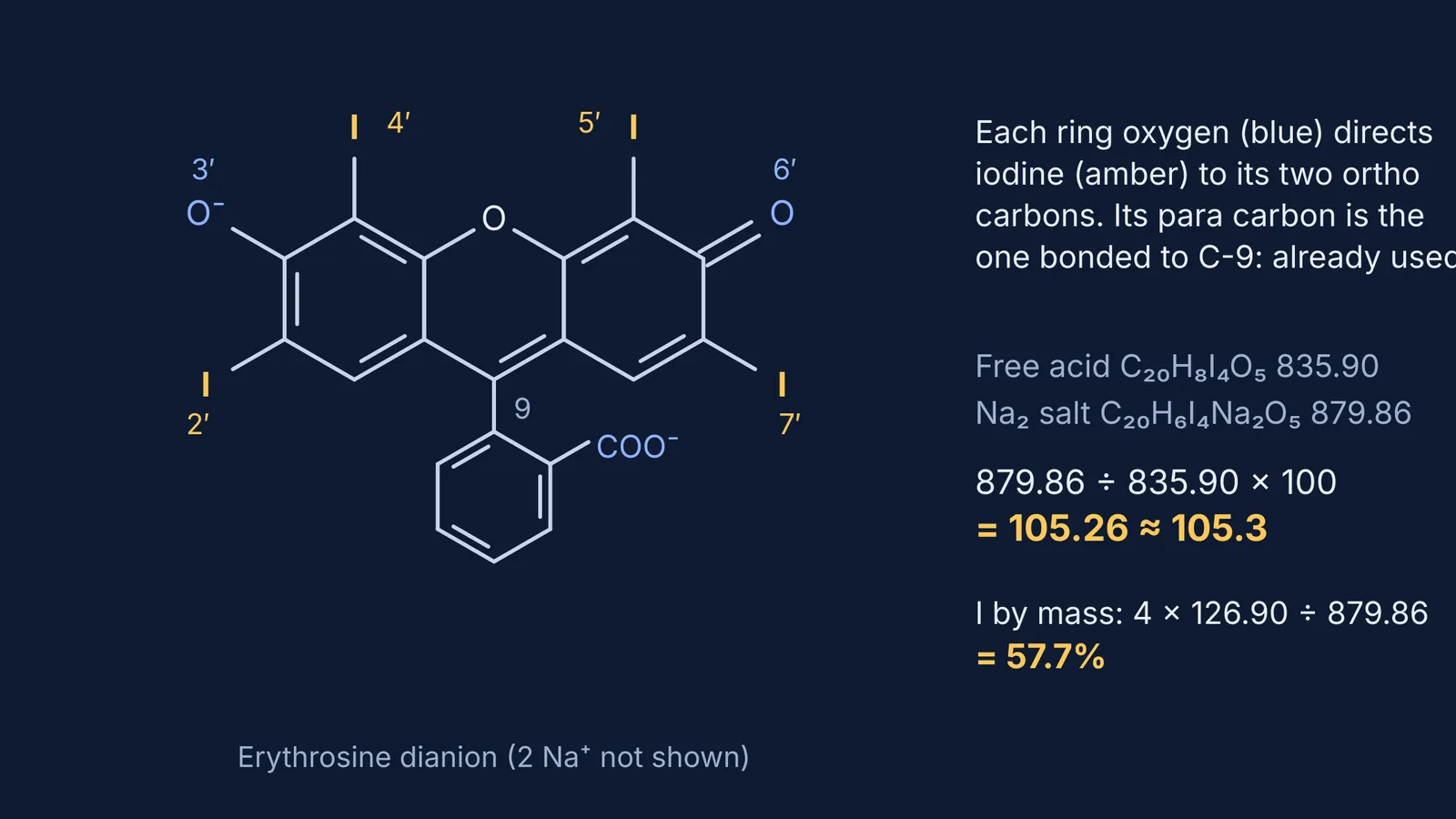
Fluorescein is what resorcinol gives in the phthalein dye test for phenols. Phthalic anhydride joins two resorcinol rings to one central carbon (C-9), and the rings close into the xanthene skeleton. Each outer ring keeps one phenolic oxygen, at 3′ and 6′.
Now look at the ring that carries the 3′ oxygen:
Its two ortho positions are 2′ and 4′. Both carry H in fluorescein.
Its para position is the carbon bonded to C-9. That bond already fills it.
The other ring hydrogen, at 1′, is meta to the oxygen.
So the only free positions that the oxygen activates are 2′ and 4′. The mirror-image ring gives 5′ and 7′, ortho to the 6′ oxygen. That is exactly BIS's 2′,4′,5′,7′. PubChem's record for erythrosine (free acid, CID 3259) agrees: its structure puts each iodine on a carbon next to a C–OH, and leaves H at 1′ and 8′.
It is the rule behind the bromination of phenol to 2,4,6-tribromophenol: an –OH (or –O⁻) activates its ortho and para positions. Phenol has three free and takes three bromines; each fluorescein ring has two free, so four iodines in all.
The overall stoichiometry, written for the free acid, balances:
C₂₀H₁₂O₅ + 4I₂ → C₂₀H₈I₄O₅ + 4HI
Each iodine replaces one hydrogen and adds 126.904 − 1.008 = 125.896 g/mol. So 332.31 (fluorescein) + 4 × 125.896 = 835.90 g/mol, the molar mass PubChem lists for the free acid.
What do the impurity limits say about how it is made?
Table 1 sets total dye at 87% minimum, inorganic iodide (as NaI) at 0.1% maximum, other subsidiary colours at 4%, fluorescein at 20 mg/kg, and lead at 2 mg/kg (as amended). It also names two organic impurities, each at most 0.2%. They are the building blocks, iodinated:
Tri-iodoresorcinol. Free resorcinol has three positions that are ortho or para to its –OH groups (2, 4 and 6), so iodine fills all three.
2-(2,4-dihydroxy-3,5-di-iodobenzoyl)benzoic acid. This is phthalic anhydride joined to one resorcinol: the half-made dye. Its iodines at 3 and 5 again sit ortho or para to the two –OH groups.
The 20 mg/kg fluorescein limit (0.002%) catches dye that never took up iodine. BIS checks it by thin-layer chromatography under UV light, comparing the fluorescence of the sample spot with a standard. BIS does not describe the manufacturing route.
How does BIS's 105.3 factor work?
The nitric acid method (Annex A-2) dissolves 1.000 g of dye in 250 mL of water and adds 8.0 mL of 1.5 N nitric acid. A strong acid displaces the weak one, and the neutral free acid, which does not dissolve in water, comes out:
C₂₀H₆I₄O₅Na₂ + 2HNO₃ → C₂₀H₈I₄O₅ + 2NaNO₃
The precipitate is filtered on a weighed sintered-glass crucible, washed with 0.5% nitric acid until the washings give no turbidity with silver nitrate, dried at 135 ± 5 °C and weighed. BIS's formula is total dye % = mass of residue × 105.3 / mass of sample.
Where does 105.3 come from? You weigh the acid, but you want the salt. One mole of salt gives one mole of acid, so:
M(salt), C₂₀H₆I₄Na₂O₅ = 879.86 g/mol
M(acid), C₂₀H₈I₄O₅ = 835.90 g/mol
Factor = 879.86 / 835.90 × 100 = 105.26 ≈ 105.3
Worked example: total dye and iodine content
A 1.000 g sample gives 0.8460 g of dried free acid.
Salt that this acid came from: 0.8460 × 879.86/835.90 = 0.8905 g.
Total dye = 0.8460 × 105.3 / 1.000 = 89.1%, above the 87% minimum.
Iodine in the pure salt: 4 × 126.904 / 879.86 × 100 = 57.7% by mass. In the free acid it is 4 × 126.904 / 835.90 × 100 = 60.7%.
How does the spectrophotometric method use E¹%?
In a dispute, BIS takes the spectrophotometric method as the reference. About 125 mg of dye is dissolved in 0.1 N NaOH, made up to 250 mL and diluted to about 0.5 mg per 100 mL. The absorbance (optical density, OD) is read at 527 nm in a 10.0 mm cell. Then:
Total dye % = OD × 100 / (M × 1080)
Here M is the dry mass of sample in grams per 100 mL of the final solution, and 1080 is E¹%₁cm: the absorbance a 1 g per 100 mL solution would give in a 1 cm cell.
Try it. You weigh 125.0 mg, and a separate portion loses 8.0% on drying at 105 °C, so the dry mass is 115.0 mg in 250 mL. A 1 in 100 dilution gives 0.460 mg, or 0.000460 g, per 100 mL. If OD = 0.445, dye = 0.445 × 100 / (0.000460 × 1080) = 89.6%. Pure dye would read 0.000460 × 1080 = 0.497.
To turn E¹%₁cm into molar absorptivity, multiply by M/10: 1080 × 879.86/10 ≈ 9.5 × 10⁴ L mol⁻¹ cm⁻¹. That is our conversion, not a BIS number, and it holds only in 0.1 N NaOH, where the dye is the dianion.
The iodide test (Annex B) reuses the acid trick: nitric acid precipitates the dye, and the filtrate is titrated potentiometrically with 0.1 N AgNO₃ (Ag⁺ + I⁻ → AgI). BIS's 1 mL = 0.0150 g NaI is 0.1 mmol × 149.89 g/mol, so for a 3 g sample the 0.1% limit is a titre of only 0.20 mL.
Erythrosine has no azo group, so it is not assayed like the azo colours in our post on titanous chloride titration of azo food colours.
Where does this sit in the syllabus?
Class 12, Alcohols, Phenols and Ethers: electrophilic substitution of phenol, ortho/para direction, bromination of phenol, and the phthalein dye test in the practical manual.
Class 11, Some Basic Concepts: mass percent and mole-ratio (gravimetric) factors.
If ortho/para direction still feels like a rule to memorise, the Concept Library walks through why –OH activates those positions. For more mole-ratio and percentage-purity sums, the Fermi Problem Library has a step-by-step solver that explains the reasoning.
Quick checklist
Fluorescein's oxygens are at 3′ and 6′; iodines go ortho to them, at 2′, 4′, 5′ and 7′.
The para position is the carbon bonded to C-9, so it is already taken.
C₂₀H₁₂O₅ + 4I₂ → C₂₀H₈I₄O₅ + 4HI; each I adds 125.90 g/mol.
105.3 = M(disodium salt)/M(free acid) × 100; it does not fit the potassium salt.
E¹%₁cm = 1080 applies at 527 nm in 0.1 N NaOH only.