

On this page
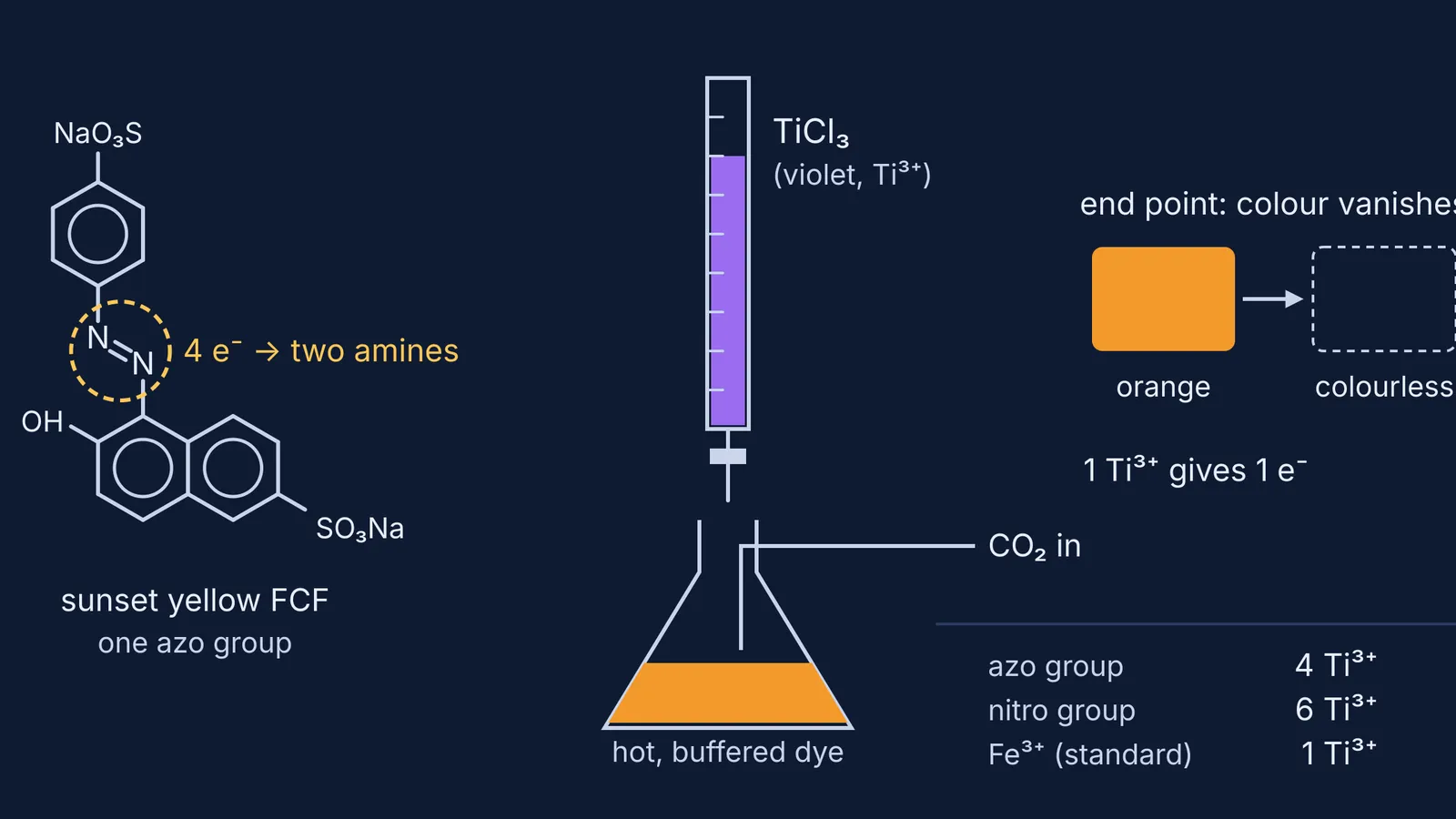
A food colour sold as "sunset yellow" is never 100% dye. The powder also holds salt, sodium sulphate, moisture and small amounts of related colours. So how does a laboratory find out how much real dye is inside? One classic answer is to count the azo groups, and the counting tool is a violet solution of titanous chloride, TiCl₃. Each azo group takes exactly four electrons, each Ti³⁺ gives exactly one, so the burette reading turns straight into moles of dye.
How can a titration count functional groups?
A redox titration counts electrons. If every molecule of a compound accepts a fixed number of electrons, then the electrons delivered by the titrant tell you the number of molecules. It is the n-factor idea from KMnO₄ titrations, applied to an organic group.
Titanous ion is a convenient electron donor. Ti³⁺ is a 3d¹ ion, which is why its solution is violet (a colour listed in the NCERT d-block chapter). In acid it is oxidised to the colourless titanium(IV) state, written as TiO²⁺:
Ti³⁺ + H₂O → TiO²⁺ + 2H⁺ + e⁻
The standard potential of the TiO²⁺/Ti³⁺ couple is only about +0.1 V in 1 M acid (approximate; tables differ a little). That low value is what makes Ti³⁺ a strong enough reducing agent to cut an N=N bond, and its n-factor is 1, so molarity and normality are the same number.
The method goes back to the early 1900s, when the Manchester chemist Edmund Knecht worked out titanous chloride methods for analysing dyes. It is still the reference method for azo food colours today.
How many electrons does an azo group or a nitro group take?
Write each reduction as a half-reaction, then balance with H⁺ and e⁻.
Azo group: Ar–N=N–Ar′ + 4H⁺ + 4e⁻ → Ar–NH₂ + Ar′–NH₂. The N=N link is cut and each nitrogen ends up as an amine. So 1 azo group = 4 Ti³⁺.
Nitro group: Ar–NO₂ + 6H⁺ + 6e⁻ → Ar–NH₂ + 2H₂O. Nitrogen goes from +3 to −3. So 1 nitro group = 6 Ti³⁺.
Iron(III), used as the standard: Fe³⁺ + e⁻ → Fe²⁺. So 1 Fe³⁺ = 1 Ti³⁺.
Adding the titanium half-reaction gives full balanced equations. For an azo dye: Ar–N=N–Ar′ + 4Ti³⁺ + 4H₂O → ArNH₂ + Ar′NH₂ + 4TiO²⁺ + 4H⁺ (charge +12 on both sides). For nitrobenzene: C₆H₅NO₂ + 6Ti³⁺ + 4H₂O → C₆H₅NH₂ + 6TiO²⁺ + 6H⁺ (charge +18 on both sides).
The azo dye is made by diazotisation and coupling, the same steps as in the azo dye test for aromatic primary amines. The titration runs that story backwards and gives back two amines. The nitro reduction is the full six-electron route to aniline; the partial products you get in other media are in reduction of nitrobenzene in neutral and alkaline media.
Why does the dye titration need no indicator?
The dye is its own indicator. An azo colour is coloured because the –N=N– link joins two aromatic rings into one long conjugated system. Once the link is cut, the two amines are colourless. So the orange solution fades as TiCl₃ is added, and the end point is the moment the last trace of colour disappears.
Two details matter. The titration is done in hot solution with a buffer salt (sodium citrate or tartrate), because the reduction is slow in the cold. And air is kept out with a stream of carbon dioxide, because oxygen oxidises Ti³⁺ quickly and would use up titrant.
How is food colour purity worked out from the burette reading?
The international specification from JECFA (the joint FAO/WHO expert committee on food additives) for sunset yellow FCF requires not less than 85% total colouring matters, calculated as the sodium salt, and the older JECFA text gives the titanous chloride factor used below. India's BIS food-grade standard for sunset yellow was revised to follow the JECFA specification. FSSAI's food additive rules list which synthetic colours are permitted in which foods and in what maximum amounts; tartrazine and sunset yellow FCF are both on that list.
Worked example. Sunset yellow FCF is a disodium salt, C₁₆H₁₀N₂Na₂O₇S₂, molar mass about 452.4 g/mol, with one azo group.
Sample. 0.500 g of colour is dissolved and made up to 250 mL. A 50.0 mL aliquot holds 0.500 × 50.0/250 = 0.1000 g = 100.0 mg of sample.
Titrant used. The aliquot needs 7.80 mL of 0.100 M TiCl₃. Moles of Ti³⁺ = 7.80 × 0.100 = 0.780 mmol.
Moles of dye. One azo group takes 4 Ti³⁺, so dye = 0.780/4 = 0.195 mmol.
Mass of dye. 0.195 mmol × 452.4 mg/mmol = 88.2 mg.
Purity. 88.2/100.0 × 100 = 88.2% total colouring matter. This passes the 85% minimum.
The shortcut is a factor: 1 mL of 0.1 M TiCl₃ = 0.1 mmol Ti³⁺ = 0.025 mmol dye = 452.4 × 0.025 = 11.31 mg sunset yellow. For tartrazine (trisodium salt, about 534.4 g/mol, also one azo group) the same logic gives 13.36 mg per mL.
How do you titrate a nitro compound that has no colour?
A nitro compound gives no colour change, so you use a back titration. Add a known excess of TiCl₃, let it reduce the nitro group fully, then titrate the leftover Ti³⁺ with standard Fe³⁺ (ferric alum) using thiocyanate. While Ti³⁺ remains, each Fe³⁺ added is reduced at once to Fe²⁺. When the Ti³⁺ runs out, the next drop of Fe³⁺ meets SCN⁻ and the blood-red complex appears. This is the same red complex you meet in the ferric thiocyanate equilibrium practical, used here as an end-point signal.
Sample. 0.1231 g nitrobenzene (molar mass 123.1 g/mol) = 1.000 mmol.
Ti³⁺ added. 75.0 mL of 0.100 M = 7.50 mmol.
Ti³⁺ left over. It needs 15.0 mL of 0.100 M Fe³⁺ = 1.50 mmol, so 1.50 mmol Ti³⁺ was unused.
Ti³⁺ used. 7.50 − 1.50 = 6.00 mmol for 1.000 mmol nitrobenzene: exactly 6 per nitro group.
Why must titanous chloride be standardised and kept under gas?
Air oxidises Ti³⁺ to Ti(IV), so the solution weakens on standing. It is stored under hydrogen or carbon dioxide, and a fading violet colour in the bottle is a warning sign. You standardise it shortly before use against iron(III). For example, if 25.0 mL of 0.0500 M Fe³⁺ (1.25 mmol) needs 12.40 mL of TiCl₃ to reach the point where the red thiocyanate colour just vanishes, the TiCl₃ is 1.25/12.40 = 0.1008 M.
The 4-electron count applies only to azo dyes. Permitted colours such as indigo carmine and brilliant blue FCF have no azo group and reduce differently. The reagents are corrosive and air-sensitive, so this is a laboratory method, not something to try on sweets at home. For more redox titration problems with the electron counting laid out, the Fermi Problem Library has a step-by-step solver that explains the reasoning.
Quick checklist
Ti³⁺ is violet (d¹) and gives 1 electron; its n-factor is 1.
Azo group: 4 electrons, so 1 azo = 4 Ti³⁺.
Nitro group to amine: 6 electrons, so 1 nitro = 6 Ti³⁺.
Azo dyes are self-indicating: colour vanishes at the end point.
Nitro compounds: add excess TiCl₃, back titrate with Fe³⁺ and SCN⁻.
1 mL of 0.1 M TiCl₃ = 11.31 mg sunset yellow FCF.
Work under CO₂, hot and buffered; standardise TiCl₃ against Fe³⁺ often.


