

On this page
The reduction of nitrobenzene is a classic organic chemistry reaction because the final product changes dramatically when you alter the pH of the reaction mixture. While students often memorise the acidic reduction to aniline, questions in competitive exams frequently test the neutral and alkaline pathways.
This article walks you through the reagents and intermediate products formed when nitrobenzene is reduced in neutral and alkaline media, and how these differ from the standard acidic route.
What is the product of nitrobenzene reduction in acidic medium?
Before looking at neutral and alkaline conditions, it is helpful to establish the baseline. The complete reduction of nitrobenzene in an acidic medium, such as with iron and hydrochloric acid, yields aniline (Wikipedia). Aniline is one of the most important organic compounds because it acts as the starting material for many dyes and pharmaceuticals.
Reagents: Common reagents include iron and hydrochloric acid (Fe/HCl), or tin(II) chloride (SnCl2).
Reaction: C6H5NO2 + 6[H] → C6H5NH2 + 2H2O (using Fe/HCl)
The reduction proceeds through intermediates, but these cannot be isolated because the strong acid rapidly pushes the reduction all the way to the amine. You can read more about this specific pathway in our guide to reducing nitrobenzene to aniline.
What happens during reduction in a neutral medium?
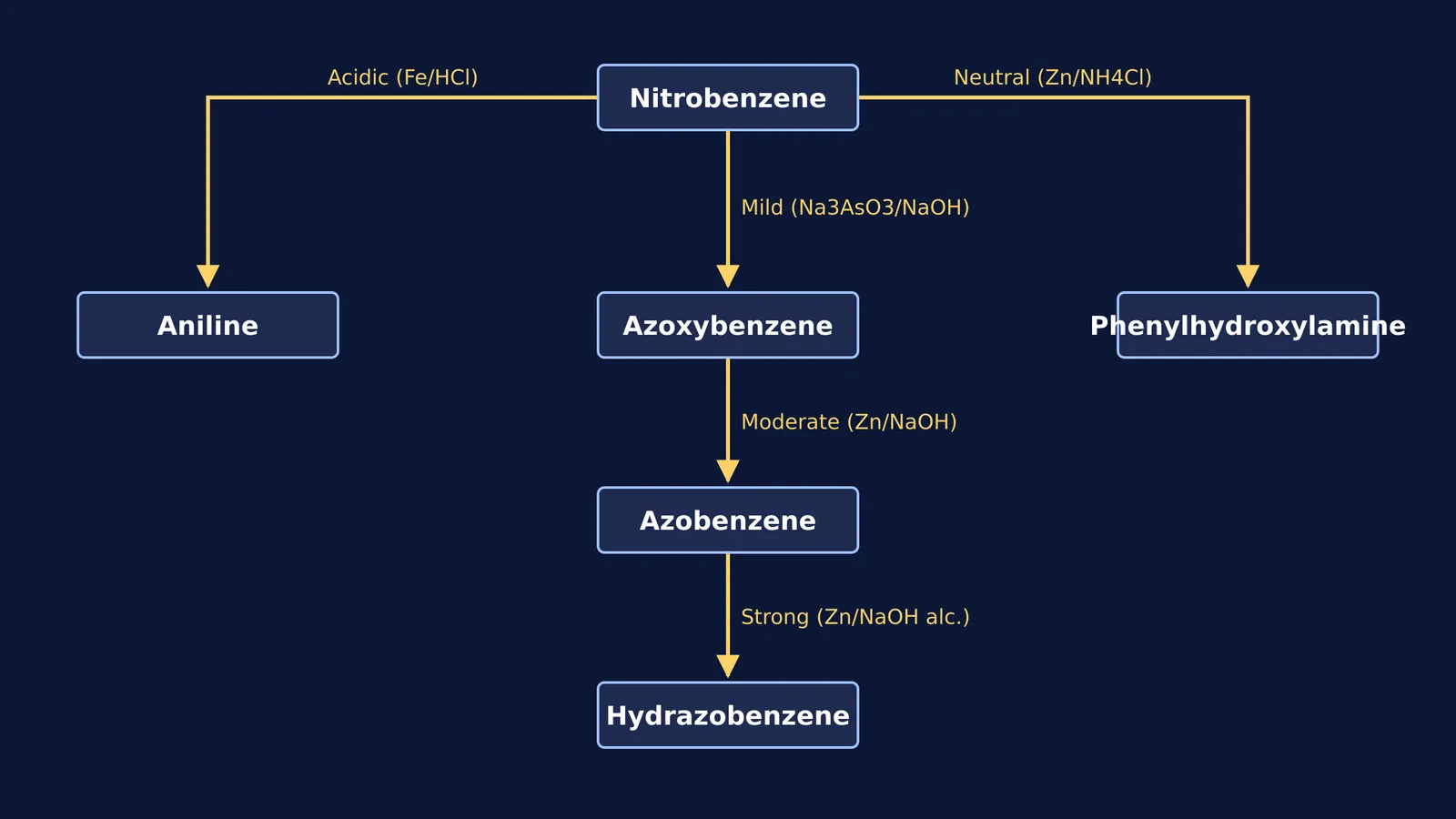
In a neutral medium, the reduction power is milder. The reaction stops at an intermediate stage, allowing you to isolate phenylhydroxylamine (C6H5NHOH).
Reagents: The standard reagent for this conversion is zinc dust in aqueous ammonium chloride (Zn/NH4Cl) (Wikipedia).
Reaction: C6H5NO2 + 4[H] → C6H5NHOH + H2O (using Zn/NH4Cl)
Because the medium is neutral, the sensitive phenylhydroxylamine intermediate is stable enough to be collected rather than being reduced further. It appears as a pale yellow solid that is prone to oxidation in air. If you are struggling to remember these triggers, you can check the Fermi Concept Library to find a lesson for every concept in chemistry and see its place in the map.
How do alkaline conditions change the product?
In alkaline conditions, the intermediate products—nitrosobenzene and phenylhydroxylamine—undergo bimolecular condensation (Wikipedia). This means two aromatic rings join together through their nitrogen atoms, forming a series of "coupled" products depending on how strong the reducing agent is.
The bimolecular products are formed because the reaction in an alkaline medium creates two reactive intermediates at the same time. These two molecules condense together (lose water) to form azoxybenzene first. Further reduction strips away the remaining oxygen to give azobenzene, and even further reduction adds hydrogen to the nitrogen-nitrogen double bond to give hydrazobenzene. In exams, knowing that condensation is the key step helps explain why these molecules all have two aromatic rings.
1. Mild Alkaline Reduction: Azoxybenzene
When a mild alkaline reducing agent is used, such as sodium arsenite (Na3AsO3) in sodium hydroxide (NaOH), the product is azoxybenzene (Wikipedia).
Reaction: 2 C6H5NO2 + 6[H] → C6H5-N=N(O)-C6H5 + 3H2O (using Na3AsO3/NaOH)
2. Moderate Alkaline Reduction: Azobenzene
If a slightly stronger reducing agent is applied, like zinc dust in the presence of a base, the oxygen is completely removed to form azobenzene (Wikipedia).
Reaction: 2 C6H5NO2 + 8[H] → C6H5-N=N-C6H5 + 4H2O (using Zn/NaOH)
3. Strong Alkaline Reduction: Hydrazobenzene
When heated with zinc dust and sodium hydroxide in an alcoholic solution, the reduction goes one step further to yield hydrazobenzene (Wikipedia).
Reaction: 2 C6H5NO2 + 10[H] → C6H5-NH-NH-C6H5 + 4H2O (using Zn/NaOH alc.)
If you are studying these reaction mechanisms for competitive exams, identifying the exact solvent and reagent combination is crucial. A simple switch from aqueous to alcoholic base changes the final isolated compound.
How can you predict the product?
To avoid confusion during an exam, you can categorise the reduction of nitrobenzene strictly by the number of nitrogen atoms in the main product:
Monomolecular products (one benzene ring per nitrogen): Formed in acidic and neutral media. Acidic gives aniline; neutral gives phenylhydroxylamine.
Bimolecular products (two benzene rings linked by nitrogen): Formed in alkaline media. The sequence goes from azoxybenzene to azobenzene and then to hydrazobenzene as the reducing strength increases.
When you map these out visually, the pattern becomes clear. If you find yourself forgetting which reagent does what, try recreating the reaction tree on a blank sheet of paper until the pathways are locked in. Start by placing nitrobenzene in the centre, then draw three arrows pointing outwards to represent acidic, neutral, and alkaline conditions. Label the arrows with the specific reagents and write the final products at the ends. Practising this visual recall technique is often more effective than simply reading the reactions from a textbook. You can also explore similar pH-dependent reactions in our overview of Tollens' and Fehling's tests.


