On this page
If your Class 12 practical asks you to confirm a phenolic –OH group, the phthalein dye test gives a colour that is hard to miss. With phenol, the product is phenolphthalein, the same indicator you use in titrations.
What is the phthalein dye test for phenol?
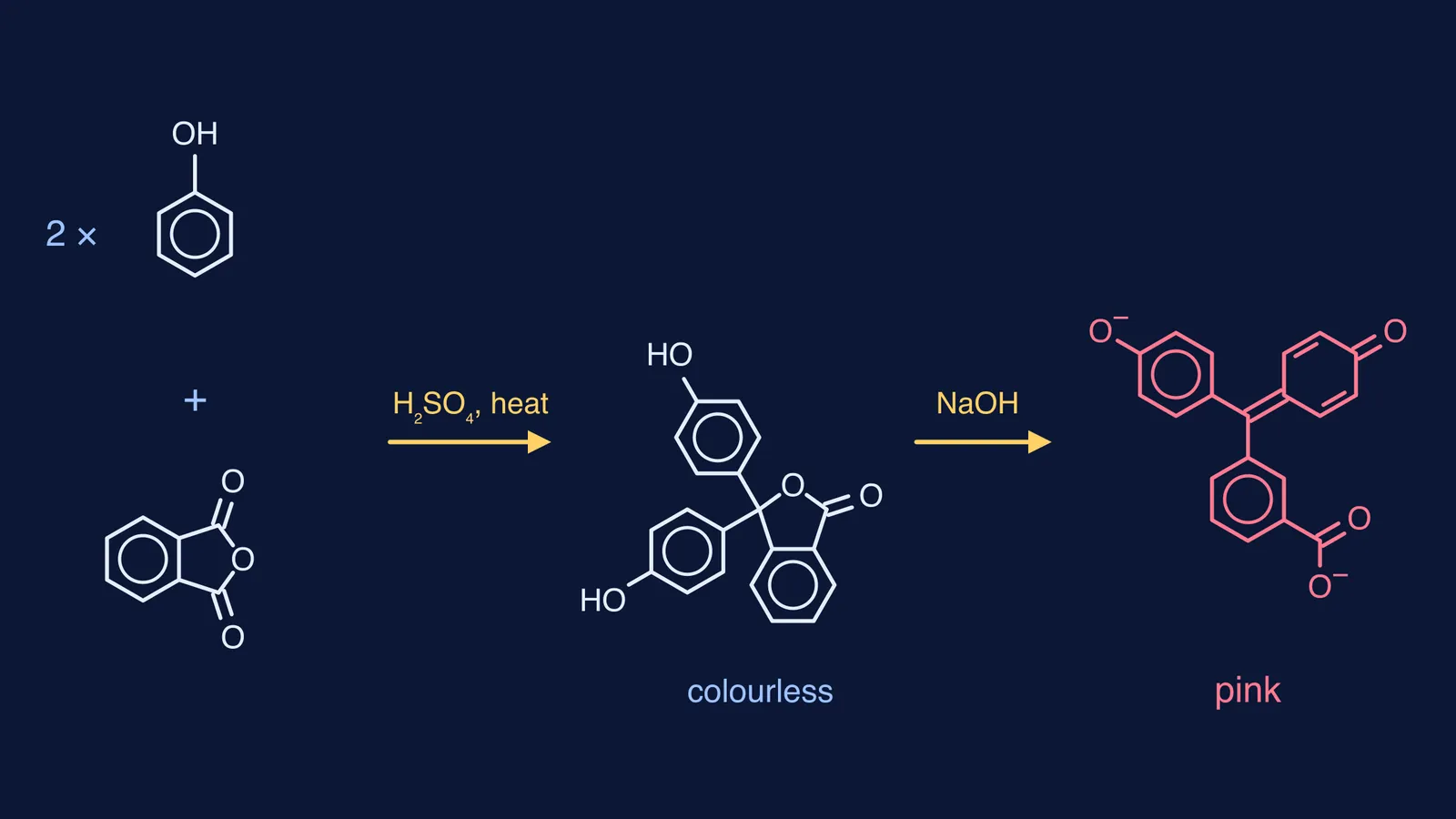
The phthalein dye test is a functional-group test in which a phenol is heated with phthalic anhydride and concentrated sulphuric acid, and the product is poured into sodium hydroxide to see whether a colour appears, as described in the NCERT Class 12 chemistry laboratory manual, Unit 8. With phenol itself the product is phenolphthalein, which gives a dark pink colour with NaOH solution.
Adolf von Baeyer first made phenolphthalein in 1871 by combining phenol and phthalic anhydride in the presence of sulfuric acid or zinc chloride, according to the Royal Society of Chemistry's Education in Chemistry. The NCERT structure shows two phenol rings joined to one carbon from the anhydride, each through the ring carbon opposite (para to) its –OH group.
How do you do the phthalein dye test, step by step?
These are the steps given in the NCERT lab manual:
Take 0.1 g of the organic compound and 0.1 g of phthalic anhydride in a clean, dry test tube.
Add 1–2 drops of concentrated sulphuric acid.
Heat the test tube for about 1 minute in an oil bath.
Cool it, then pour the mixture carefully into a beaker containing 15 mL of dilute sodium hydroxide solution.
Look for pink, blue, green or red. Any of these indicates a phenolic –OH group.
Why does phenolphthalein turn pink in NaOH?
Phenolphthalein is colourless in acidic or near-neutral solution (pH 0 to 8.3) and pinky-fuchsia between pH 8.3 and 10, according to the University of Bristol's Molecule of the Month page. The same page explains that losing protons in base changes the molecule's electronic structure, and so changes the wavelength of light it absorbs.
The structures in the NCERT manual show the change. In acid, phenolphthalein holds a closed five-membered lactone ring and is colourless. In NaOH, that ring opens to a carboxylate, the phenol groups lose their protons, and one ring becomes a quinoid ring joined to the central carbon by a double bond. That is the pink form, the same one you watch appear at the end point of an NaOH and HCl titration with phenolphthalein.
What colours do other phenols give in the phthalein test?
Table 8.1 of the NCERT lab manual lists:
o-cresol: red
m-cresol: bluish-purple
p-cresol: no colour
catechol: usually blue, and takes longer to appear
resorcinol: the green fluorescent colour of fluorescein
The NCERT structures suggest why p-cresol fails. Each phenol ring bonds through the carbon para to its –OH, and in p-cresol a methyl group already sits there.
How do you tell o-, m- and p-cresol apart?
Suppose three unlabelled bottles hold o-, m- and p-cresol. How do you sort them?
Run the ferric chloride test first. NCERT says o-, m- and p-cresol all give a violet or blue colour, so it confirms they are phenols but cannot separate them. (Our guide to the neutral ferric chloride test for phenol covers how to prepare the reagent.)
Run the phthalein dye test on each bottle. Red means o-cresol; bluish-purple means m-cresol; no colour means p-cresol.
Run phenol alongside as a positive control. If phenol turns pink but one bottle stays colourless, the test worked and that bottle is p-cresol, not a failed heating.
A blank tube means something only when you know the test worked. For more problems that ask you to choose and order tests like this, the Fermi Problem Library has worked problems with a step-by-step solver that explains the reasoning rather than printing an answer.
What should you write in your practical record?
Keep observation and inference separate:
Experiment: Phthalein dye test.
Observation: A pink colour appeared when the reaction mixture was poured into dilute NaOH.
Inference: Phenolic –OH group is present.
Three viva questions you can answer from the manual:
Why is it called the phthalein dye test? The phenol condenses with phthalic anhydride to form a phthalein dye; phenol gives phenolphthalein.
Why can the colour vanish? A large excess of NaOH turns the pink form colourless.
Why does phenol dissolve in NaOH but not in sodium hydrogencarbonate? NCERT explains that phenols are weakly acidic, not acidic enough to dissolve in sodium hydrogencarbonate solution.
For the full set of phenol tests side by side, see how to distinguish ethanol and phenol with three chemical tests. If the jump from lactone ring to pink colour still feels fuzzy, the Fermi Concept Library covers every concept in chemistry, each with its own lesson and its place in the map.