

On this page
Ethanol and phenol both carry an –OH group, so on paper they look like cousins. In a test tube they behave very differently, which is why "distinguish between ethanol and phenol" is a standard Class 12 organic chemistry question. Three tests do the job: neutral iron(III) chloride, bromine water and the iodoform test. Each one works for a reason you can explain in a line.
Why do ethanol and phenol give different results?
In ethanol the –OH sits on an ordinary saturated carbon. In phenol it sits directly on a benzene ring, and that changes two things.
The ring becomes much more reactive. The oxygen's lone pair overlaps with the ring's delocalised electrons, which makes the ring more attractive to electrophiles, as Chemguide's page on the ring reactions of phenol explains.
Phenol becomes weakly acidic. It reacts with sodium hydroxide solution to give sodium phenoxide, while alcohols are so weakly acidic that their acidity can be virtually ignored for normal lab purposes, according to Chemguide on the acidity of phenol.
Ethanol has something phenol lacks: a CH3CH(OH)– group. That group is exactly what the iodoform test looks for.
How does the neutral FeCl3 test tell phenol from ethanol?
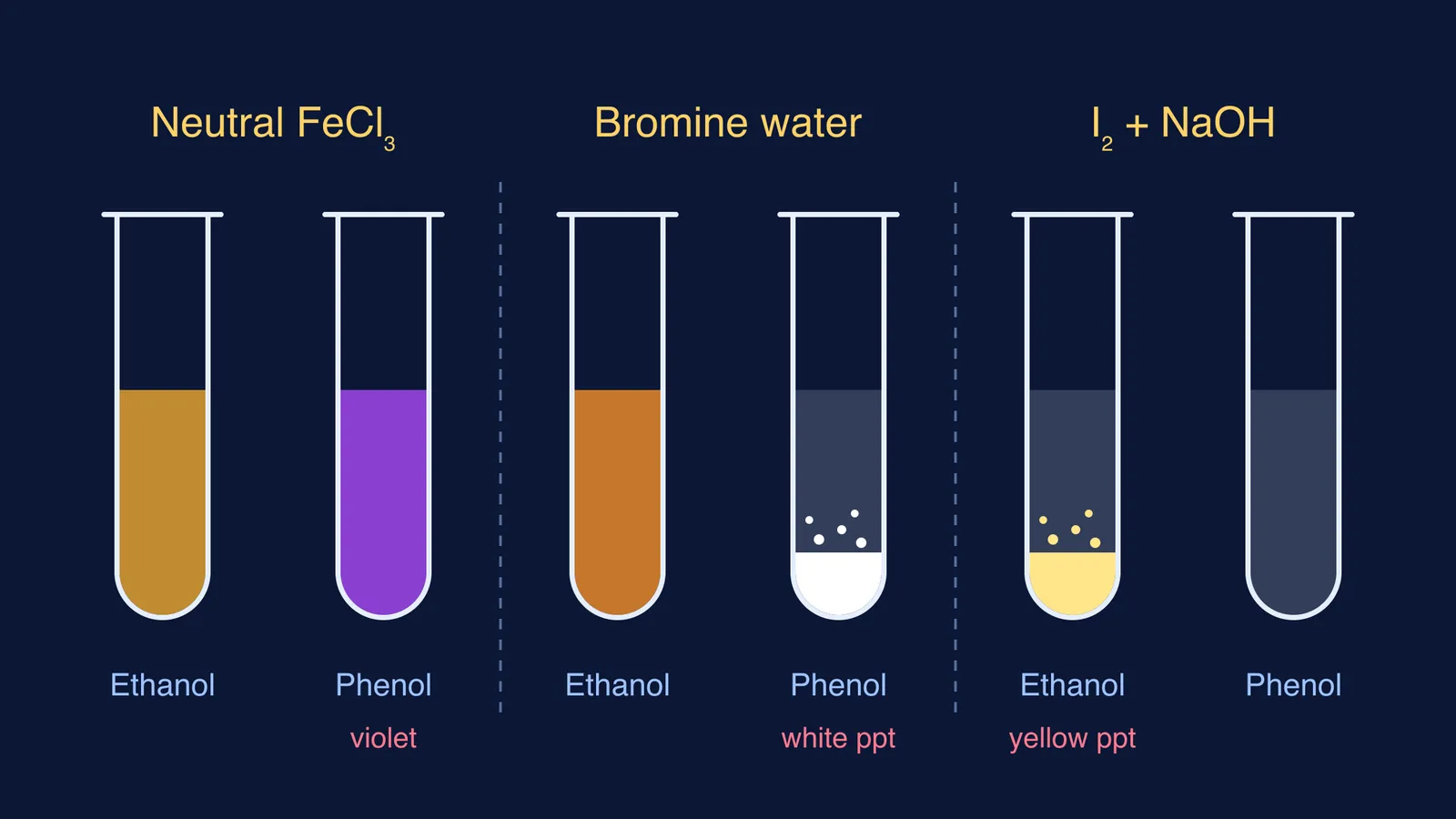
Add a few drops of neutral iron(III) chloride solution to each sample. Phenol gives an intense violet-purple colour: Chemguide's page on other reactions of phenol describes adding a crystal of phenol to iron(III) chloride solution and getting an intense violet-purple solution. Ethanol gives no violet colour.
The word "neutral" is part of the reagent's name in textbook answers, so write it. How to prepare the reagent, and what can give a false result, is covered in our guide to the neutral ferric chloride test for phenol.
What does bromine water do to phenol but not ethanol?
Shake each sample with bromine water; no heating is needed. With phenol, the bromine water is decolourised and a white precipitate of 2,4,6-tribromophenol forms, in the cold and without a catalyst, as Chemguide's ring reactions page describes. The three bromine atoms go onto the ring at positions 2, 4 and 6: the two ortho positions and the para position relative to the –OH.
Ethanol has no ring for bromine to substitute, so the orange colour of the bromine water stays.
Is the iodoform test positive for ethanol or phenol?
Ethanol. Add iodine solution to the sample, followed by just enough sodium hydroxide solution to remove the colour of the iodine (potassium iodide followed by sodium chlorate(I) works the same way). A positive result is a very pale yellow precipitate of triiodomethane, CHI3, which also has a faint "medical" smell, according to LibreTexts on the triiodomethane (iodoform) reaction.
The reaction needs a CH3CH(OH)– group, and the same LibreTexts page notes that ethanol is the only primary alcohol to give it. Phenol has no such group, so it does not form iodoform.
How should you write the answer in an exam?
A clear answer names the reagent, gives the observation for both compounds and, where it can, names the product. Here is a model answer you can adapt.
Add neutral FeCl3 solution. Phenol: violet colour. Ethanol: no violet colour.
Add bromine water. Phenol: decolourises it and gives a white precipitate of 2,4,6-tribromophenol. Ethanol: no change.
Add I2 and NaOH (iodoform test). Ethanol: pale yellow precipitate of CHI3. Phenol: no iodoform formed.
If a question asks for one test, one is enough. The FeCl3 and iodoform tests make a neat pair, because each gives a positive result for a different compound. Write both observations anyway, including "no change".
Before you move on, run this quick check:
Did you write "neutral" FeCl3 and "bromine water", not just "FeCl3" or "bromine"?
Did you give an observation for each compound?
Did you name the precipitate: 2,4,6-tribromophenol or iodoform?
If the question asks why, did you mention the activated ring or the CH3CH(OH)– group?
If organic tests keep blurring together, the Fermi Concept Library has every concept in chemistry, each with its own lesson and its place in the map, so you can see why an –OH on a ring changes the chemistry. For practice, the Fermi Problem Library has worked problems with a step-by-step solver that explains the reasoning rather than printing an answer.
Next, apply the same idea to alcohols alone with the Lucas test for primary, secondary and tertiary alcohols, or try the carbonyl version in how to distinguish benzaldehyde and acetophenone.


