

On this page
The ferric chloride (FeCl₃) test is a staple of organic chemistry practicals for identifying the phenolic -OH group. When you add a few drops of the reagent to a phenol solution, it flashes a brilliant red, blue, green, or purple colour. However, if the solution is poured straight from the stock bottle, the test often fails.
Here is the chemistry behind the colours, how to neutralise the reagent properly, and how to tell a true phenol from a false positive.
Why does phenol give a coloured complex with ferric chloride?
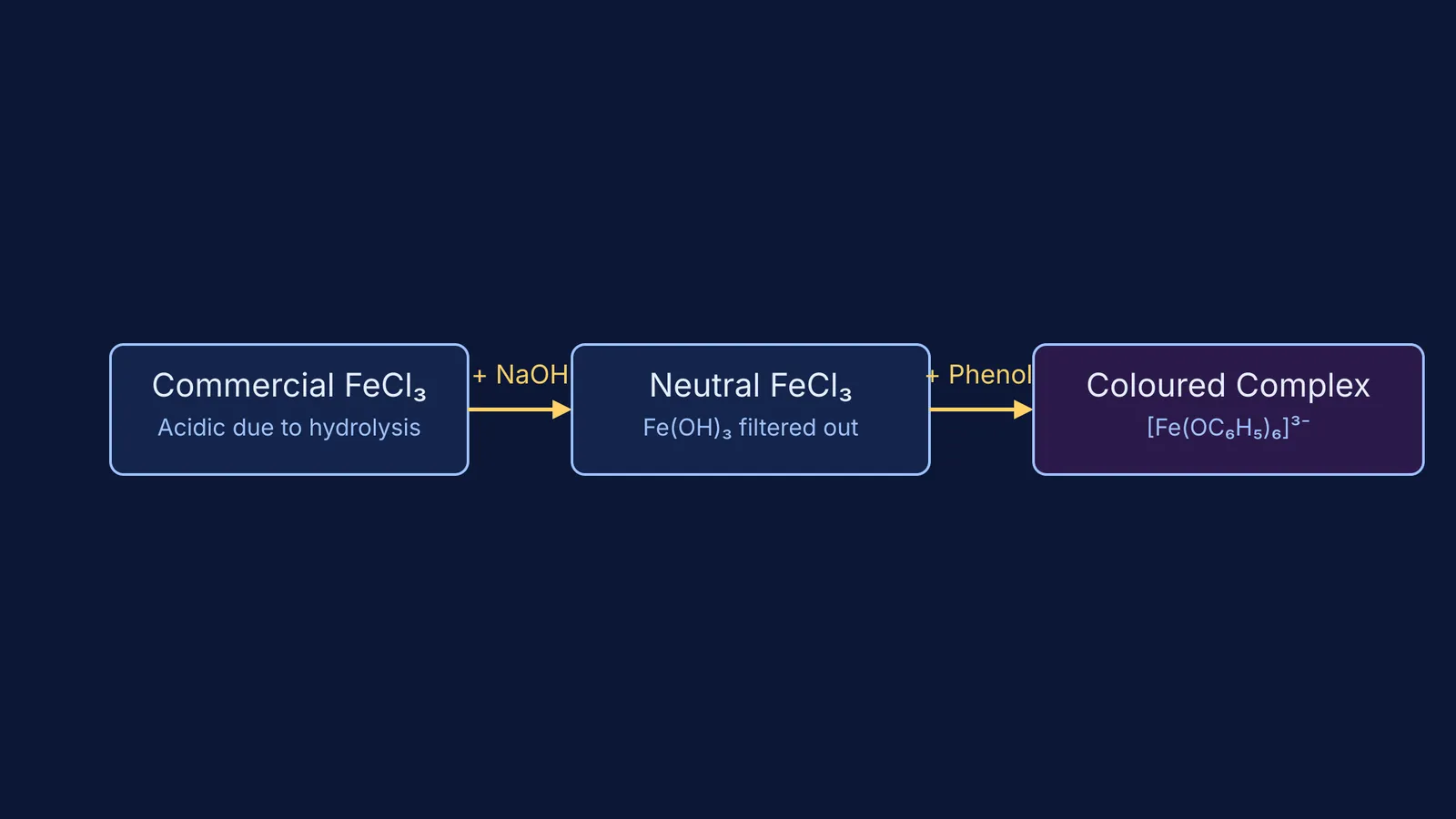
When phenol (C₆H₅OH) reacts with FeCl₃, the iron ion bonds directly with the oxygen of the phenoxide ions. This forms a water-soluble coordination complex, hexaphenoxoferrate(III), according to the equation:
6 C₆H₅OH + Fe³⁺ → [Fe(OC₆H₅)₆]³⁻ + 6 H⁺
The exact colour of the final solution depends heavily on the specific phenol used. The reaction can produce a red, blue, green, or purple coloration (Wikipedia). These intense colours do not come from the iron's d-d electron transitions alone; they are caused by ligand-to-metal charge transfer. In this process, electrons shift from the electron-rich phenoxide ligand toward the central iron atom, absorbing specific wavelengths of light in the visible spectrum. The absorption leaves the remaining complementary colours to be transmitted to our eyes. If you are struggling to map out how electrons shift and why transition metal complexes show such vivid colours, the Fermi Concept Library breaks down coordination chemistry and orbital theories step by step.
How to prepare neutral ferric chloride reagent?
You cannot use standard commercial FeCl₃ directly because it is highly acidic. In water, it hydrolyses to form ferric hydroxide and hydrochloric acid. If the testing environment is already saturated with H⁺ ions, the equilibrium of the complex-forming reaction gets pushed strongly to the left, preventing the colour from ever appearing.
To make the reagent neutral, you must deliberately remove this excess acid.
Dissolve a small amount of solid FeCl₃ in de-ionised water, creating a yellow or orange solution.
Add dilute sodium hydroxide (NaOH) drop by drop while stirring constantly.
Stop adding the base the moment a permanent brown precipitate of Fe(OH)₃ appears. This tells you the free acid has been consumed.
Filter out the brown solid. The clear filtrate that drips through is your neutral ferric chloride reagent.
Which compounds give false results?
The ferric chloride test is sensitive, but it is not perfectly exclusive to phenols.
Compounds that contain an enol form, hydroxamic acids, oximes, and sulfinic acids will also react with the iron to give coloured complexes (Wikipedia). Enols are organic compounds that contain a hydroxyl group adjacent to a carbon-carbon double bond. If you are given an unknown sample, an enol can easily masquerade as a phenol in this test because the functional group shares the same capacity to coordinate with the iron center.
A checklist for practical exams
Practical errors usually stem from how the reagent is handled or stored. Before you conclude your qualitative analysis, run through this checklist of common constraints:
Did you neutralise it freshly? Neutral FeCl₃ degrades over time as iron slowly precipitates out of the solution in the form of oxides and hydroxides. You should always prepare it on the day of the test.
Did you add too much base? If you drown the initial FeCl₃ solution in sodium hydroxide, all the iron drops out as a heavy Fe(OH)₃ precipitate. You will have a colourless filtrate with no Fe³⁺ left to react with your phenol.
Is your organic sample water-soluble? Many bulky or substituted phenols will not dissolve in pure water. If your sample floats on top of the reagent, they cannot react. You may need to dissolve your organic compound in a water-ethanol mixture or dichloromethane with a small amount of pyridine first, and then add the aqueous FeCl₃ drops.
Have you cross-checked the result? Because enols give similar colours, you must confirm a suspected phenol with a secondary test, such as the bromine water test, which yields a white precipitate of 2,4,6-tribromophenol. Just as you use Tollens' and Fehling's tests to verify aldehydes, pair the ferric chloride test with bromination to lock down phenols. You can read more about how this secondary confirmation works in our guide to the bromination of phenol. Working out which sequence of qualitative tests to use for an unknown mixture is a common hurdle in JEE Advanced; you can practice these logic chains in the Fermi Problem Library.


