

On this page
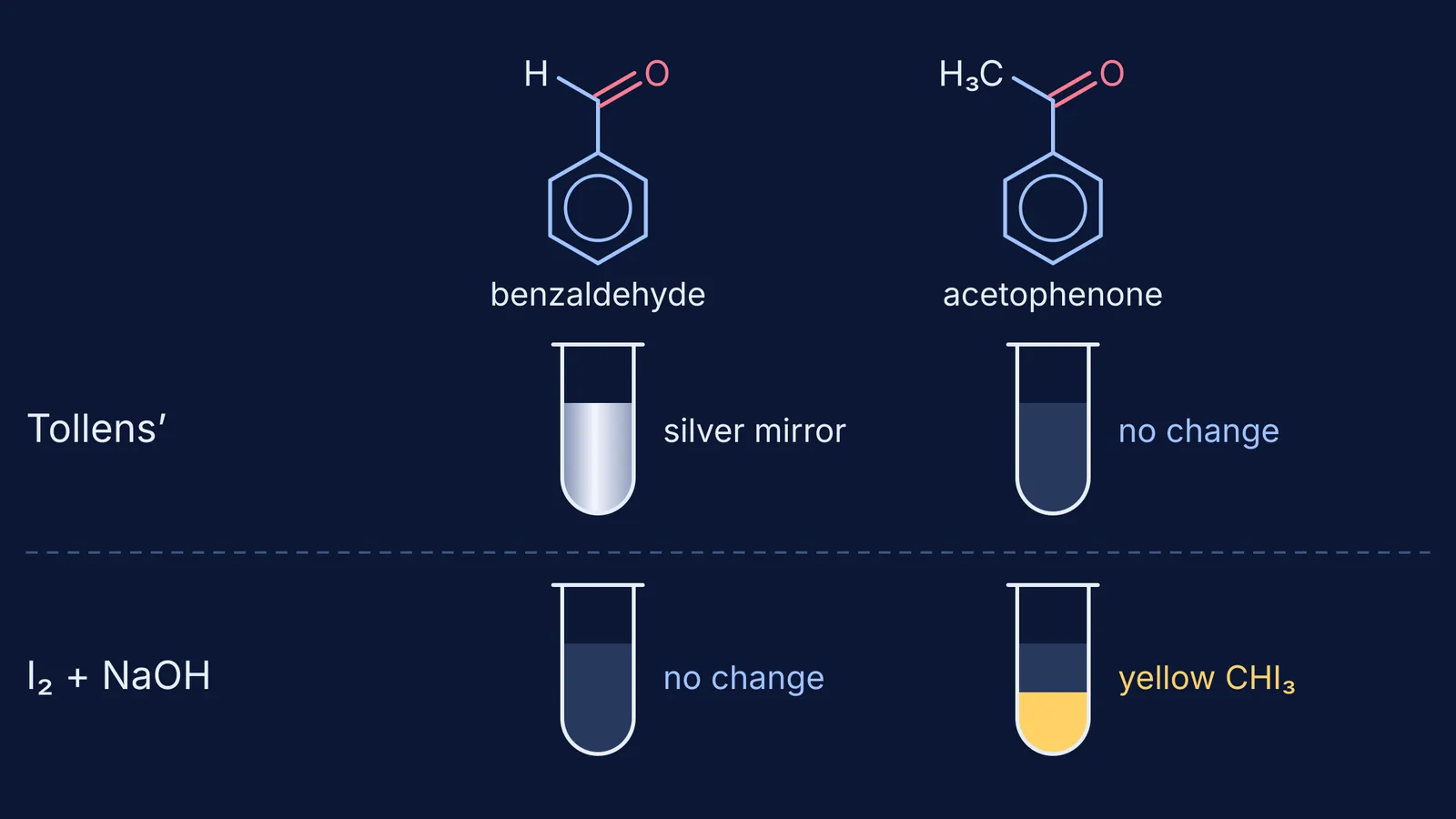
Benzaldehyde and acetophenone look almost the same on paper. Each is a benzene ring joined to a C=O group. The difference is what sits on the other side of that carbonyl carbon: a hydrogen in benzaldehyde (C₇H₆O) and a methyl group in acetophenone (C₈H₈O), as PubChem's entries for benzaldehyde and acetophenone show. That one swap decides every test below.
The pair appears by name in the exercises of NCERT Class 12 Chemistry, Unit 8: Aldehydes, Ketones and Carboxylic Acids (question 8.13, part vi), so it is worth having a clean answer ready before your boards.
Which test distinguishes benzaldehyde from acetophenone?
Two tests work, and each is positive for only one of the two compounds:
Tollens' test: benzaldehyde gives a silver mirror; acetophenone does not.
Iodoform test: acetophenone gives a yellow precipitate of iodoform (CHI₃); benzaldehyde does not.
Using both gives you a cross-check. Each compound passes exactly one test, so your conclusion never rests on a single "nothing happened".
Why does only benzaldehyde give a silver mirror with Tollens' reagent?
Tollens' reagent is freshly prepared ammoniacal silver nitrate solution, and warming it with an aldehyde produces a bright silver mirror, according to the NCERT Class 12 chemistry textbook. The aldehyde is oxidised to its carboxylate anion while silver ions are reduced to silver metal, in an alkaline medium:
RCHO + 2[Ag(NH₃)₂]⁺ + 3OH⁻ → RCOO⁻ + 2Ag + 2H₂O + 4NH₃
For benzaldehyde, R is the phenyl group, so the product is the benzoate ion. Acetophenone is a ketone, with no hydrogen on its carbonyl carbon. The same NCERT chapter explains that ketones are generally oxidised under vigorous conditions, with strong oxidising agents at elevated temperatures, so a mild oxidant like Tollens' reagent leaves acetophenone unchanged. NCERT's Example 8.4, whose answer turns out to be acetophenone, says the compound "neither reduces Tollens' or Fehlings' reagent".
The reagent is named after Bernhard Tollens (1841-1918), a professor of chemistry at the University of Göttingen, as the textbook's margin note records. To see why one carboxylic acid also passes this test, read why formic acid reduces Tollens' reagent.
Why is the iodoform test positive only for acetophenone?
The iodoform reaction with sodium hypoiodite (iodine plus sodium hydroxide) detects a CH₃CO group, or a CH₃CH(OH) group that is oxidised to one, as NCERT's Unit 8 explains. Acetophenone, C₆H₅COCH₃, is a methyl ketone. Its methyl group becomes iodoform, which separates as a yellow precipitate, and the rest of the molecule becomes sodium benzoate:
C₆H₅COCH₃ → (I₂, NaOH) → C₆H₅COONa + CHI₃ (yellow precipitate)
Benzaldehyde, C₆H₅CHO, has a hydrogen where acetophenone has its methyl group. There is no CH₃CO unit to cut off, so no yellow solid forms.
A quick way to remember both results: look at what is attached to the other side of the C=O. An H means the compound is an aldehyde and Tollens' will work. A CH₃ means the CH₃CO group is present and iodoform will work. If you want the reasoning behind how the two classes differ in other reactions too, see why aldehydes are more reactive than ketones to nucleophiles.
How do you write the answer in a board exam?
Here is a model answer for a short "distinguish between" question:
Name the test and the reagent: "Tollens' test. Warm each compound with Tollens' reagent (ammoniacal silver nitrate)."
Give the observation for both compounds: "Benzaldehyde forms a silver mirror. Acetophenone does not."
Write the equation for the positive result.
If the question carries more marks, add the second test: "Iodoform test. Warm each with I₂ and NaOH. Acetophenone gives a yellow precipitate of iodoform. Benzaldehyde does not."
Before you move on, run through this checklist:
Did you state what happens to both compounds? One observation is half an answer.
Did you avoid 2,4-DNP? It forms coloured derivatives with aldehydes and ketones alike; NCERT's Example 8.4 has acetophenone giving an orange-red one, so it cannot separate this pair.
Did you avoid Fehling's? It is negative for both.
Did you write "silver mirror" and "yellow precipitate", not just "positive"?
If the reason a reagent picks out one functional group still feels shaky, the Fermi Concept Library gives each concept in chemistry its own lesson and its place in the map, so you can revisit carbonyl oxidation before the next pair. For more practice, the Fermi Problem Library has worked problems with a step-by-step solver that explains the reasoning rather than printing an answer.
Next, try NCERT's other pairs in question 8.13, such as propanal and propanone, using the same "what is beside the C=O?" check.


