

On this page
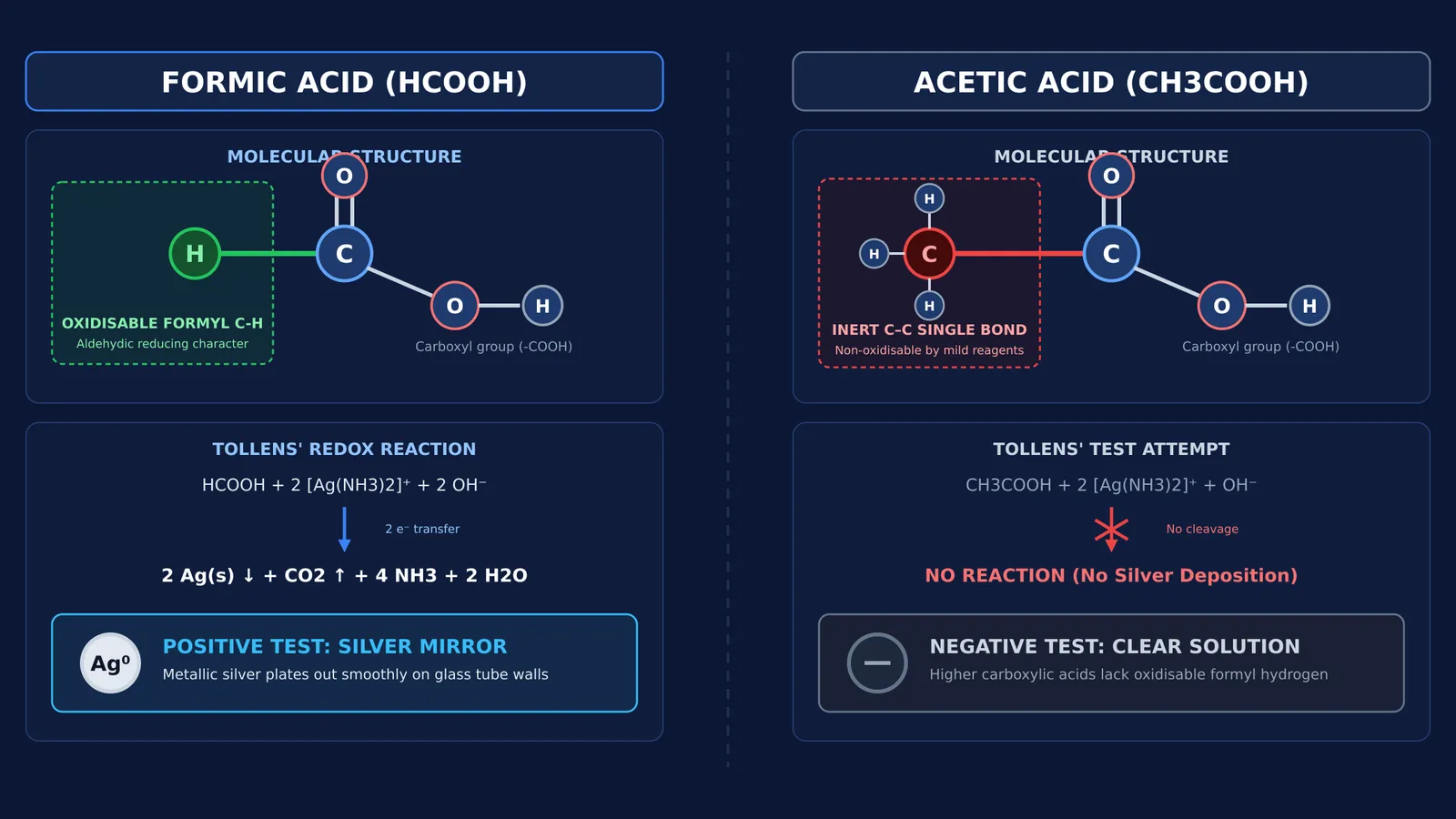
Formic acid (methanoic acid, HCOOH) occupies a unique place in organic chemistry. Testing typical carboxylic acids—such as acetic acid, propanoic acid, or benzoic acid—with ammoniacal silver nitrate produces no reaction; the solutions remain clear. But when you add formic acid to the same reagent and warm the tube gently, lustrous metallic silver coats the glass walls, forming a brilliant mirror.
Understanding why this single carboxylic acid gives a positive test while every other carboxylic acid fails is an essential concept for CBSE Class 12 chemistry and competitive exams like JEE and NEET. The explanation lies in the dual functional personality encoded into the five atoms of the formic acid molecule.
Why does formic acid reduce Tollens' reagent?
In every carboxylic acid other than formic acid, the carbonyl carbon is directly bonded to a hydrocarbon chain (R–COOH). Acetic acid (CH3COOH), for example, links a methyl group to the carboxyl carbon. Formic acid, with a molecular weight of 46.025 g/mol and a pKa of 3.75 in the PubChem formic acid entry, lacks an alkyl group. Its carboxyl carbon bonds directly to a lone hydrogen atom: H–C(=O)–OH.
This molecular geometry gives formic acid a split identity:
Look at the molecule from the right, and you see the characteristic carboxyl group (–COOH) that imparts typical acidic behaviour.
Look at the molecule from the left, and you see a formyl group (H–C=O), which is the exact functional group defining aldehydes.
Because of this oxidisable formyl hydrogen, formic acid behaves as an effective reducing agent. In 1882, the German chemist Bernhard Tollens introduced an ammoniacal silver solution to detect aldehydes and distinguish them from ketones, publishing his findings in Berichte der deutschen chemischen Gesellschaft. While designed for aldehydes, Tollens' reagent readily detects the formyl moiety in formic acid. Our companion review of Tollens' and Fehling's tests explores how this reagent behaves across other carbonyl families.
The Fermi Concept Library covers every concept in chemistry, each with its own lesson and its place in the map, showing where carboxylic acid reactions diverge into aldehyde redox pathways.
What is the chemical mechanism and balanced reaction?
Tollens' reagent consists of the diamminesilver(I) complex cation, [Ag(NH3)2]⁺, dissolved in an aqueous alkaline medium. As detailed in Chemistry LibreTexts/Aldehydes_and_Ketones/Reactivity_of_Aldehydes_and_Ketones/Tollens_Test), the reagent is prepared by precipitating silver oxide (Ag2O) from silver nitrate and sodium hydroxide, then dissolving it with dilute aqueous ammonia.
Because the solution is basic, formic acid deprotonates to form the formate ion (HCOO⁻). When warmed in a water bath, the diamminesilver(I) ions oxidise the formate carbon from an oxidation state of +2 to +4:
HCOOH + 2 [Ag(NH3)2]⁺ + 2 OH⁻ → 2 Ag(s) + CO2 + 4 NH3 + 2 H2O
In alkaline solution, the dissolved carbon dioxide converts into carbonate or bicarbonate ions:
HCOO⁻ + 2 [Ag(NH3)2]⁺ + 3 OH⁻ → 2 Ag(s) + CO3²⁻ + 4 NH3 + 2 H2O
Because diamminesilver(I) readily accepts electrons while the oxidation of formate to carbon dioxide is thermodynamically favourable, the overall redox reaction is strongly spontaneous, driving the transfer of two electrons from each molecule of formic acid to two silver ions. The resulting neutral silver atoms deposit evenly on the clean glass surface as a silver mirror.
How does formic acid compare to acetic acid and aldehydes?
To understand why formic acid stands alone, compare it with its homologue, acetic acid:
Acetic acid contains a strong C–C bond between the methyl group and the carbonyl carbon. Cleaving this bond requires harsh oxidants such as boiling acidic potassium permanganate; mild ammoniacal silver cannot attack it.
As explained in our guide to carboxylic acids and their derivatives, higher carboxylic acids lack any oxidisable hydrogen on the carboxyl carbon.
Simple aldehydes like ethanal reduce Tollens' reagent to form carboxylate salts (ethanoate ions). Formic acid oxidises to carbonic acid (H2CO3), which decomposes into carbon dioxide gas and water, completing a full two-electron oxidation.
This principle parallels the behaviour seen in reducing and non-reducing sugars, where only sugars possessing an available, open-chain carbonyl group can transfer electrons to diamminesilver(I).
How do you solve unknown acid problems in Class 12 exams?
Exam questions in practical viva and competitive chemistry often ask you to differentiate formic acid from acetic acid or other carbonyls. A four-step plan resolves the sample:
Confirm the acid group: Add aqueous sodium bicarbonate (NaHCO3). Rapid effervescence of carbon dioxide confirms a carboxylic acid, ruling out neutral aldehydes and ketones.
Run Tollens' test: Add freshly prepared Tollens' reagent and warm gently in a water bath. A silver mirror or black precipitate confirms formic acid; a clear solution indicates acetic acid or another higher acid.
Cross-check with Fehling's solution: Mix equal volumes of Fehling's A (aqueous copper(II) sulfate) and Fehling's B (alkaline sodium potassium tartrate), add the sample, and heat. Formic acid reduces the blue cupric tartrate to a red cuprous oxide (Cu2O) precipitate, whereas acetic acid gives no change.
Calculate stoichiometric yields: In redox problems, each mole of formic acid transfers two electrons to reduce two moles of diamminesilver(I) ions, depositing two moles of silver (215.74 g of Ag for every 46.03 g of HCOOH, matching silver's atomic weight in the PubChem silver entry).
When tackling complex multi-step organic synthesis problems and identifying unknown compounds, the Fermi Problem Library offers worked problems with a step-by-step solver that explains the reasoning rather than just printing an answer.


