

On this page
In Class 10 Science, Activity 2.6 (NCERT) introduces the idea that acids and bases do not just mix—they actively cancel each other out. This mutual cancellation is called neutralisation. To see it happening in the laboratory, the experiment relies on a synthetic indicator, which alters its chemical structure depending on the environment it sits in.
Why do we use phenolphthalein to test NaOH?
Sodium hydroxide (NaOH) and hydrochloric acid (HCl) are both clear, colourless liquids that look exactly like ordinary water. If you mix them together, the reaction produces sodium chloride (table salt) and water. Because there are no bubbles, no gases evolved, and no solid precipitates formed, the final mixture still looks indistinguishable from water.
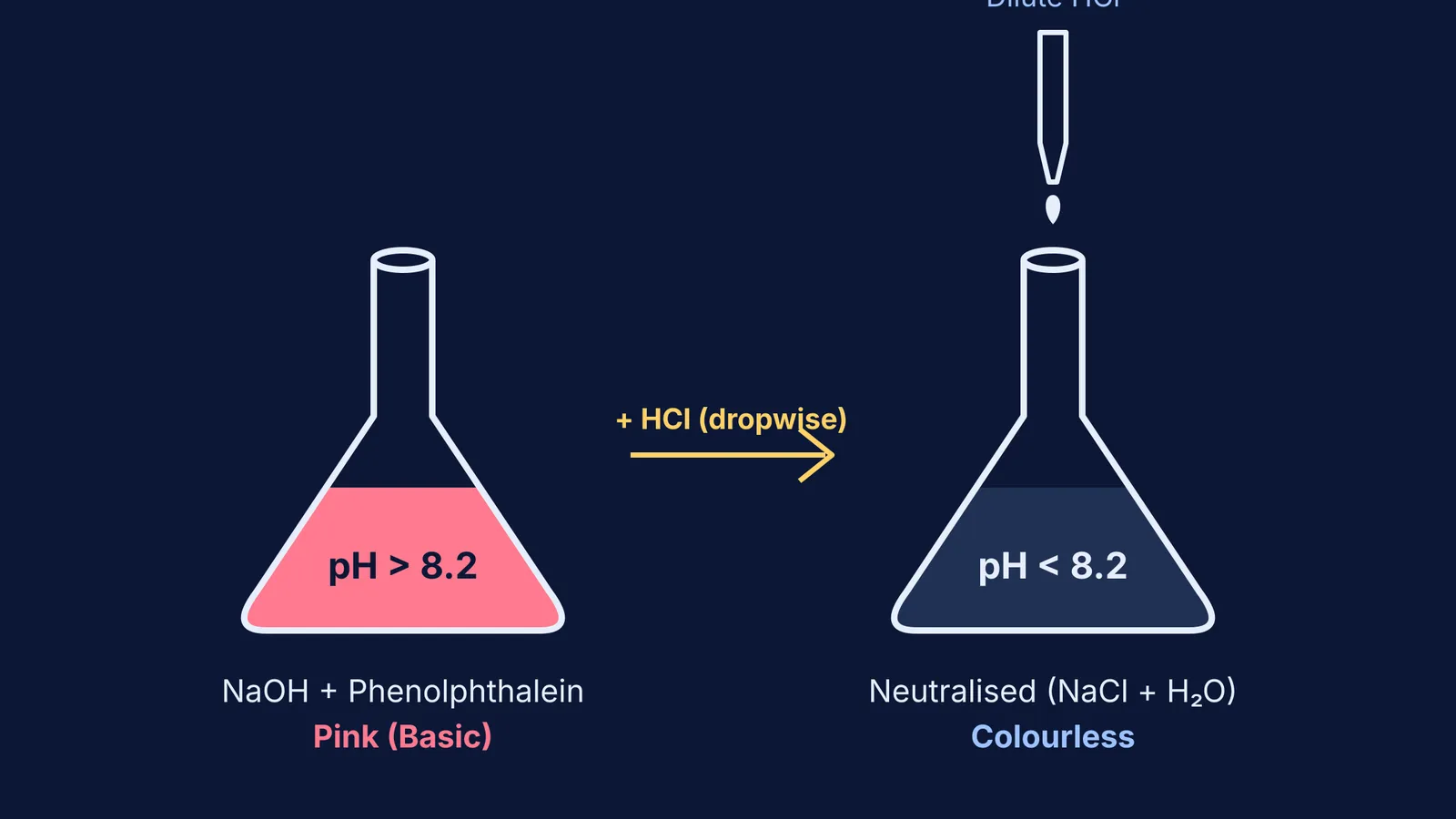
To track the chemical change, you need a visual marker. Phenolphthalein is a synthetic indicator that is naturally colourless in acidic or neutral conditions. However, when placed in a basic environment where the pH rises above 8.2 (LibreTexts/Acids_and_Bases/Acid_and_Base_Indicators/PH_Indicators)), it turns a vibrant pink. When you begin the activity by adding two drops of phenolphthalein to a 2 mL dilute NaOH solution in a test tube (NCERT), the liquid instantly turns bright pink. This confirms the presence of a base.
What happens when you add HCl to the pink solution?
The activity asks you to add dilute HCl to the pink NaOH solution, one drop at a time, while gently swirling the test tube.
At first, you might see the pink colour vanish exactly where the acid drop hits the liquid's surface, only to return when you swirl the tube and mix it. But as you continue to add acid, you reach a tipping point where a single drop makes the entire solution permanently colourless.
This happens because the acid has completely neutralised the base. The chemical reaction taking place is: NaOH(aq) + HCl(aq) → NaCl(aq) + H₂O(l). At this exact equivalence point, the base has been entirely consumed by the acid. The solution's pH drops below 8.2, and the phenolphthalein indicator returns to its natural colourless state. The solution is now essentially a mixture of salt and water.
If you touch the bottom of the test tube during this process, it will feel warm. Neutralisation is an exothermic reaction, meaning it releases heat energy to the surroundings. If you have concept gaps about how these ions swap partners and release energy, the Fermi Concept Library has a lesson for every concept in chemistry, including double displacement and neutralisation.
Why does the pink colour reappear with more NaOH?
The final step of Activity 2.6 asks you to observe what happens if you add a few drops of NaOH back into the now-colourless mixture. Immediately, the pink colour reappears.
This step is crucial because it proves that the neutralisation process did not destroy the indicator. The phenolphthalein molecules are still floating in the test tube. By adding more base, you overcome the acid you just added, raising the pH of the solution above 8.2 once again. Because the environment is basic once more, the indicator changes its structure and turns pink.
This reversible colour change forms the basis of titrations, a precise analytical technique you will use in higher secondary chemistry to find out exactly how concentrated an unknown acid or base is.
How do you write observation answers for exams?
When board exam questions ask about Activity 2.6, they are testing your ability to connect the visual changes in the test tube to the underlying chemical equation. Use this four-step checklist to structure a complete answer:
State the starting condition: NaOH is a strong base, so adding phenolphthalein makes the solution pink.
Explain the first change: Adding HCl neutralises the NaOH. The solution becomes neutral (or slightly acidic if excess is added), so the indicator turns colourless.
Write the balanced equation: Always include the state symbols to show that everything is dissolved in water: NaOH(aq) + HCl(aq) → NaCl(aq) + H₂O(l). Mention that heat is evolved.
Explain the reversal: Adding NaOH makes the mixture basic again, causing the pink colour to return.
Mastering this logic helps build a strong foundation for other chemical tests you will encounter. Once you understand how to track ions in a neutralisation, you can apply similar reasoning to drawing electron dot structures in Class 10 or understanding the more complex chemical properties of ethanol and ethanoic acid.


