On this page
In 1889 G. Tammann, writing from Dorpat, froze dilute solutions of hydrogen peroxide and concluded that its formula should be doubled, from H₂O₂ to H₄O₄. In 1893 W. R. Orndorff and John White repeated the measurement with purified peroxide and a glass stirrer, and found a molar mass of about 34 at every concentration. In the same volume of the same journal, Tammann withdrew his formula. The whole dispute turns on one Class 12 equation, ΔTf = Kf·m, and on a molecule that falls apart while you measure it.
The papers: W. R. Orndorff and J. White, "Das Molekulargewicht von Wasserstoffsuperoxyd und von Benzoylsuperoxyd", Z. phys. Chem. 12 (1893) 63–72, translated by M. Le Blanc from their English manuscript (scan); G. Tammann, Z. phys. Chem. 4 (1889) 441–443 (scan); and Tammann's reply, Z. phys. Chem. 12 (1893) 431–432 (scan). An 1892 study by Carrara reached the same result as Orndorff and White; we did not read it and cite it only as they report it. Translations are ours.
What did Tammann claim in 1889?
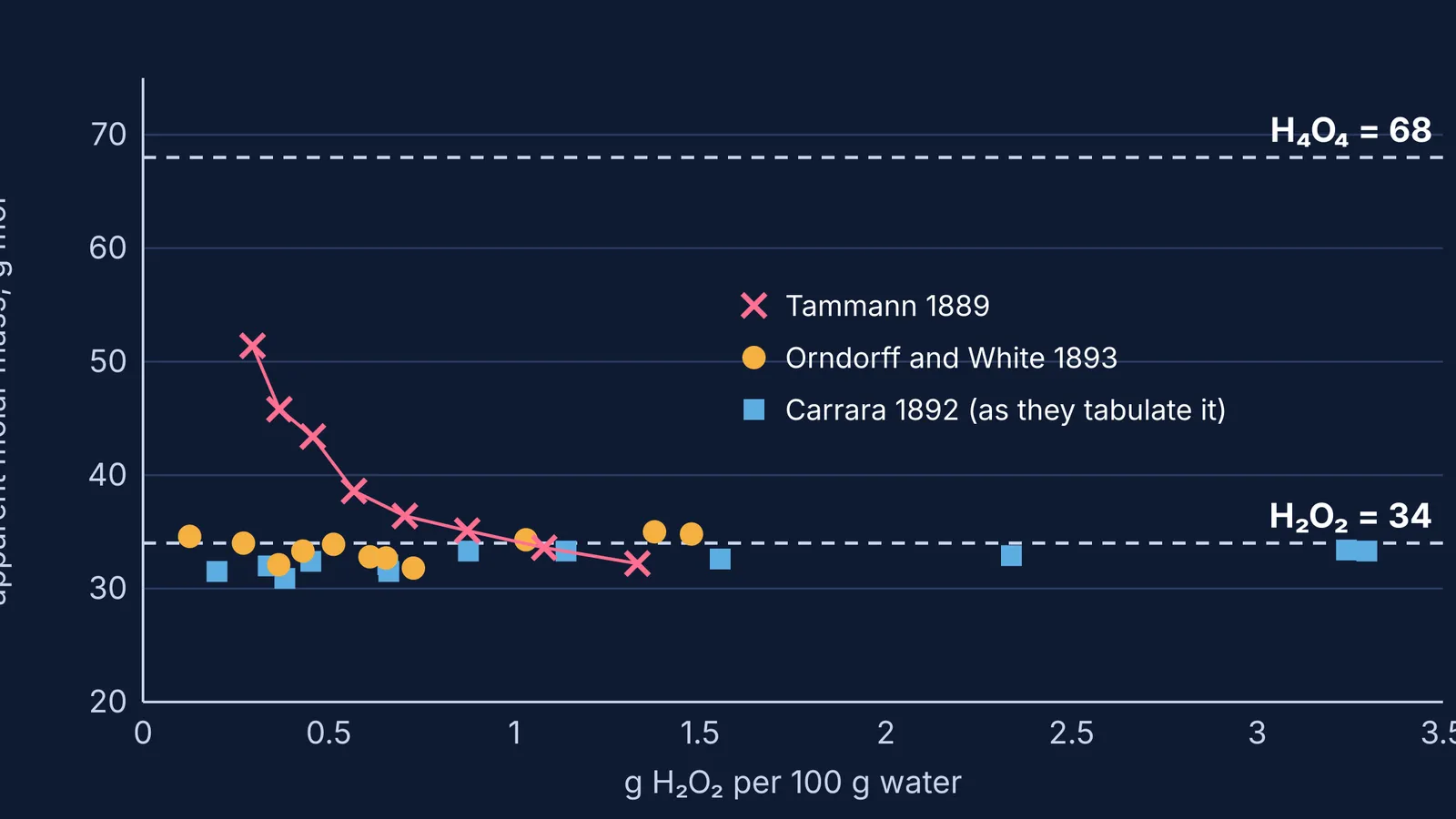
His table ran from 1.331 g down to 0.295 g of H₂O₂ per 100 g of water. The depression per gram fell steadily on dilution, from 0.590 to 0.370. He fitted two straight lines and extrapolated to zero concentration, which gave "the molecular depression 8.79, a number half as large as the normal molecular depression 18.5 of a non-electrolyte. Accordingly one would have to write the formula of hydrogen peroxide as H₄O₄."
The same short note reported that in alkaline solution, traces of iron oxide, probably from the glass vessels, sped up the decomposition of H₂O₂ enormously. That warning turned out to matter for his own freezing points.
Orndorff and White called the H₄O₄ conclusion "strange enough in itself, since it actually implies a theory of atomic linking in which oxygen is trivalent".
How do you get a molar mass from freezing-point depression?
Molality m = 1000w₂/(M·w₁), so M = 1000·Kf·w₂/(w₁·ΔTf). In the 1890s chemists quoted a "molecular depression": the depression for 1 mol of solute in 100 g of solvent. For water they used 19 (Tammann 18.5), which is Kf = 1.9 K kg mol⁻¹ in today's units. The modern value is 1.86.
Worked example: their first row
Orndorff and White's first row: 0.0207 g of H₂O₂ in 16.48 g of water, depression 0.069 °C.
Concentration: 0.0207 ÷ 16.48 × 100 = 0.1256 g per 100 g water, as printed.
Their way: M = 19 × 0.1256 ÷ 0.069 = 34.6, as printed.
Modern Kf: M = 1000 × 1.86 × 0.0207 ÷ (16.48 × 0.069) = 33.9 g mol⁻¹. H₂O₂ is 34.0.
Molality as H₂O₂: (0.0207 ÷ 34.01) ÷ 0.01648 kg = 0.0369 mol kg⁻¹, so ΔTf = 1.86 × 0.0369 = 0.069 °C, as observed.
The dimer test: if the molecule were H₄O₄ (68.0), there would be half as many particles, and the solution would freeze only 0.034 °C lower. They saw twice that.
Tammann's claim in the same terms: 18.5 ÷ 8.79 × 34 = 72, an apparent M near 68.
Association halves the particle count, halves ΔTf and doubles the apparent molar mass. It is the same algebra as acetic acid showing a molar mass of 120 in benzene. Here the real cause was the reverse problem: particles disappearing.
How did Orndorff and White get a cleaner answer?
They started from a commercial "medicinal" peroxide and found barium, calcium, sodium, aluminium, iron, hydrochloric, sulfuric and phosphoric acids and some silica in it. They cleaned it by precipitation with barium peroxide, removed the barium exactly with dilute sulfuric acid, distilled under reduced pressure and concentrated by freezing out water. The residue on evaporation was "only an extremely slight trace".
In the Beckmann freezing-point apparatus they used a glass stirrer and sharp-edged glass pieces to start the ice. "Platinum, as is well known, cannot be used, since it starts the decomposition of hydrogen peroxide." After each run they titrated the peroxide with permanganate, so the concentration was known at the end of the freezing run, not before it:
2MnO₄⁻ + 5H₂O₂ + 6H⁺ → 2Mn²⁺ + 5O₂ + 8H₂O
Eleven rows, from 0.13 to 1.48 g per 100 g of water, gave M from 31.8 to 35.0, with no drift. A footnote adds: "No determination has been omitted." Carrara's twelve rows, as they tabulate them, run 30.9 to 33.4.
Why did Tammann's solutions give the wrong answer?
Recalculated by Orndorff and White, Tammann's apparent M rose on dilution: 32.2 at 1.331 g per 100 g, 51.4 at 0.295 g. Usually the opposite happens.
Their explanation: "The only possible explanation for this strange behaviour of Tammann's solutions seems to us to be that he used a platinum stirrer, and probably platinum scraps" to seed the ice. Platinum would decompose the peroxide, and the error would be proportionally larger in the dilute solutions.
Tammann's 1893 reply gives a different detail. He had titrated only the most concentrated solution and made the rest by successive dilution, so "during the several hours of the measurements a not inconsiderable amount of hydrogen peroxide must have decomposed". A repeat on a 0.4% solution agreed with H₂O₂, and he wrote that H₄O₄ "must be rejected as based on insufficient observations". A new series by O. Paulsen, a degree candidate, gave molecular depressions of 18.49 to 18.87. Both accounts blame decomposition; whether platinum caused it was never settled.
Here is the arithmetic of a decomposing solute. If the concentration is fixed before the run and some peroxide breaks down (2H₂O₂ → 2H₂O + O₂), there are fewer solute particles, ΔTf is smaller and M comes out too high. At 0.295 g, 34 ÷ 51.4 = 0.66, so if decomposition were the only error, about a third of the peroxide had gone.
What did benzoyl peroxide add?
As a check they measured benzoyl peroxide, (C₆H₅CO)₂O₂, in which both hydrogens of H₂O₂ are replaced. In benzene (molecular depression 49) they found 227 to 244; boiling points in ether and chloroform led them to the same conclusion. The formula mass is 242.2; a doubled molecule would be 484. One O–O unit per molecule meant H₂O₂ is H–O–O–H, the molecule whose shape is explained in why H₂O₂ has an open book structure.
Where does this come up in JEE and NEET?
Class 12 Solutions: molar mass from depression in freezing point and the van 't Hoff factor. Class 11 Hydrogen: the structure of H₂O₂. Class 12 Kinetics: catalysed decomposition of H₂O₂.
If these numericals trip you up, the Fermi Problem Library has a step-by-step solver that explains the reasoning. The Concept Library covers colligative properties and every other chemistry concept, each with its place in the map.
Quick checklist
1889, Tammann: extrapolated molecular depression 8.79, half of 18.5, so "H₄O₄".
1893, Orndorff and White: purified H₂O₂, glass stirrer, titration after freezing: M ≈ 34.
Benzoyl peroxide ≈ 242, not 484: one O–O per molecule.
Same volume, Tammann: his solutions had decomposed; H₄O₄ withdrawn.