On this page
These eight questions run from easy to hard. Each has a worked solution, the answer as a plain integer, a quick check and a slip that gives a wrong number. Try each on paper first.
How are JEE Main numerical value questions marked?
The Information Bulletin for JEE (Main) 2027 from NTA says each subject in Paper 1 has Section A (multiple-choice questions) and Section B, whose answers are filled in as a numerical value. Mathematics has 5 Section B questions. A correct answer earns +4, an incorrect one −1 and an unanswered one 0, so a wild guess can cost you. You enter an integer on an on-screen keypad, and the answer should be rounded off to the nearest integer.
Every question below sits inside Unit 3, Matrices and Determinants, of NTA's Syllabus for JEE (Main) 2027. For the theory and a study plan, read how to prepare matrices and determinants for JEE Main.
Easy: can you get these right first time?
Q1 (easy). A is the 2 × 2 matrix with rows (2, 3) and (1, 4). What is det(3A)?
Answer: 45. det A = 2 × 4 − 3 × 1 = 5. For a 2 × 2 matrix, det(kA) = k² det A, so det(3A) = 9 × 5 = 45.
Check: 3A has rows (6, 9) and (3, 12), and 72 − 27 = 45. Slip: 15, from multiplying the determinant by 3 instead of 3².
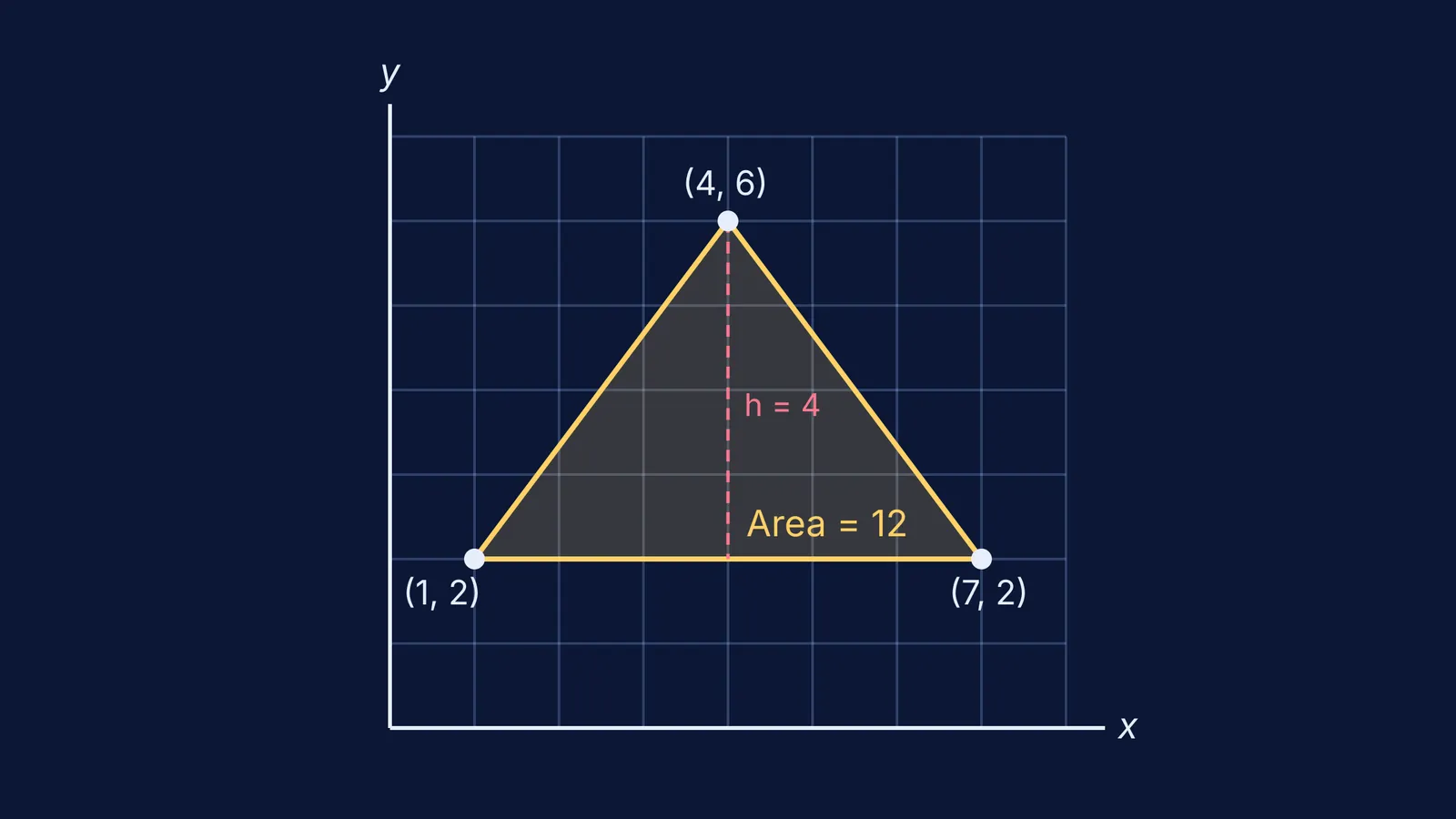
Q2 (easy). Find the area, in square units, of the triangle with vertices (1, 2), (4, 6) and (7, 2).
Answer: 12. Area = ½ |x₁(y₂ − y₃) + x₂(y₃ − y₁) + x₃(y₁ − y₂)| = ½ |1(4) + 4(0) + 7(−4)| = ½ × 24 = 12.
Check: the base from (1, 2) to (7, 2) is 6 and the height is 4, so ½ × 6 × 4 = 12. Slip: 24, from dropping the ½ in front of the determinant.
Q3 (easy). A has rows (1, 2) and (2, 3); B has rows (0, 1) and (1, 0). What is det(AB − BA)?
Answer: 4. AB has rows (2, 1) and (3, 2); BA has rows (2, 3) and (1, 2). So AB − BA has rows (0, −2) and (2, 0), with determinant 0 − (−4) = 4.
Check: AB − BA has trace 0, as every commutator must. Slip: 0, from assuming AB = BA. Only det(AB) = det(BA) is guaranteed.
Medium: where do the steps pile up?
Q4 (medium). A has rows (2, 1) and (1, 2), and A² = pA + qI. What is p − q?
Answer: 7. A² has rows (5, 4) and (4, 5). Comparing off-diagonal entries, 4 = p. Comparing diagonal entries, 5 = 2p + q, so q = −3 and p − q = 7.
Check: the characteristic equation is λ² − 4λ + 3 = 0 (trace 4, determinant 3), so A² = 4A − 3I. Slip: 1, from taking q = +3 without moving it across the equals sign.
Q5 (medium). Evaluate the 3 × 3 determinant with rows (1, 1, 1), (1, 2, 4) and (1, 4, 16).
Answer: 6. The rows have the form (1, a, a²) with a = 1, b = 2, c = 4, so the determinant is (a − b)(b − c)(c − a) = (−1)(−2)(3) = 6.
Check by expanding along the first row: 1(32 − 16) − 1(16 − 4) + 1(4 − 2) = 16 − 12 + 2 = 6. Slip: −6, from writing (a − b)(b − c)(a − c), which flips one sign.
Q6 (medium). The system x + y + z = 6, x + 2y + 3z = 10, x + 2y + kz = μ has infinitely many solutions. What is k + μ?
Answer: 13. The coefficient determinant works out to k − 3, so a unique solution fails only when k = 3. The third equation then reads x + 2y + 3z = μ, which agrees with the second only if μ = 10. So k + μ = 13.
Check: with k = 3 and μ = 10, x = 2 + t, y = 4 − 2t, z = t satisfies all three equations for every t. Slip: 3, from stopping at k; with μ ≠ 10 the same k gives no solution at all.
Hard: can you handle adjoints and powers?
Q7 (hard). A is a 3 × 3 matrix with det A = 2. What is det(adj(2A))?
Answer: 256. For an n × n matrix M, det(adj M) = (det M)ⁿ⁻¹. Here det(2A) = 2³ × 2 = 16, so det(adj(2A)) = 16² = 256.
Check with A = diag(2, 1, 1): 2A = diag(4, 2, 2), its adjoint is diag(4, 8, 8), and 4 × 8 × 8 = 256. Slip: 32, from treating adj(2A) as 2 adj A. In fact adj(kA) = kⁿ⁻¹ adj A.
Q8 (hard). A is the 3 × 3 matrix with rows (1, 0, 0), (2, 1, 0) and (3, 2, 1). What is the entry in row 3, column 1 of A¹⁰?
Answer: 210. Write A = I + N, where N has rows (0, 0, 0), (2, 0, 0) and (3, 2, 0). N² has a single non-zero entry, 4, in row 3, column 1, and N³ = O. Since I and N commute, the binomial theorem gives A¹⁰ = I + 10N + 45N². The (3, 1) entry is 10 × 3 + 45 × 4 = 210.
Check with the power 2: the same formula gives 2 × 3 + 1 × 4 = 10, and row 3 of A times column 1 of A is 3 × 1 + 2 × 2 + 1 × 3 = 10. Slip: 30, from dropping the N² term.
How do you avoid wrong numbers in matrices and determinants?
Write the order n first, then apply the scale rules: det(kA) = kⁿ det A, adj(kA) = kⁿ⁻¹ adj A, det(adj A) = (det A)ⁿ⁻¹.
Keep products in order. AB and BA are usually different matrices.
Check a determinant two ways: expand along another row, or test a diagonal matrix with the same determinant.
When the determinant is 0, test for consistency before answering.
In these questions a decimal answer often signals a slip; recheck, and if it stands, round only at the end.
For mixed practice, try our matrices and determinants JEE Main practice questions with solutions.
Answer won't match? The Fermi Problem Library has worked problems with a step-by-step solver that explains the reasoning rather than printing an answer. For the rest of your JEE preparation, start at Fermi Test Prep, our JEE Main and Advanced preparation.