On this page
In May 1893, A. F. Holleman signed off a paper in Groningen that did something no balance could do. He measured how much barium sulfate, silver chloride and other "insoluble" salts actually dissolve in water, by measuring how well the saturated solution conducts electricity. Every Class 12 "Ksp from conductivity" problem follows his route. His own numbers also show where the method stops working, and he said why.
The paper is A. F. Holleman, "Bestimmungen der Löslichkeit sogenannter unlöslicher Salze" (determinations of the solubility of so-called insoluble salts), Z. phys. Chem. 12 (1893) 125–139 (scan on the Internet Archive). Translations are ours.
How did van 't Hoff's hint turn conductivity into solubility?
It opens: "Last summer Prof. van 't Hoff drew my attention to the possibility of finding the salt content of very dilute salt solutions from their electrical conductivity."
A saturated solution of a barely soluble salt is so dilute that the salt is fully split into ions. Its molar conductivity has then reached the limiting value, Λ°, which no further dilution changes. Measure κ, know Λ°, and c = κ/Λ°. Holleman wrote it as v = μ∞ ÷ (measured conductivity), where v is the volume in litres that holds one gram-equivalent.
He used a Wheatstone bridge and telephone, after Wilhelm Ostwald. His water was distilled twice, the second time slowly over a trace of phosphoric acid through a condenser of pure tin. He first tested the method on salts he could also analyse directly: silver salicylate gave v = 256.8 by conductivity and 256.0 by Volhard titration.
How did Holleman get Λ° for BaSO₄ without measuring it?
Nobody had measured Λ° for barium sulfate, so he built it from Kohlrausch's values for soluble salts at 18 °C: ½BaCl₂ 115, KCl 122 and ½K₂SO₄ 128. These are old units, per equivalent, so only the method carries over.
The K₂SO₄–KCl difference, 6, is the sulfate-minus-chloride step. Adding it to ½BaCl₂ gives 115 + 6 = 121. But the same step came out as 1 for the lithium salts, 3 for sodium and 4 for zinc. He took "on average" 3.5 and used 115 + 3.5 = 118.5. 3.5 is the mean of the sodium and zinc pairs; all three average 2.7, and the paper does not say why lithium was left out.
His general rule, μ∞(MX) = μ∞(MX₁) + μ∞(M₁X) − μ∞(M₁X₁), is how NCERT gets Λ° for acetic acid; see Kohlrausch's law of independent migration.
Worked example 1: Λ°m, solubility and Ksp of BaSO₄
Use approximate 25 °C ionic values in S cm² mol⁻¹: Ba²⁺ 127.2, SO₄²⁻ 160.0, K⁺ 73.5, Cl⁻ 76.3.
Salts: Λ°m(BaCl₂) = 127.2 + 2 × 76.3 = 279.8; Λ°m(K₂SO₄) = 2 × 73.5 + 160.0 = 307.0; Λ°m(KCl) = 149.8.
BaCl₂ + K₂SO₄ contains BaSO₄ plus 2KCl, so Λ°m(BaSO₄) = 279.8 + 307.0 − 2 × 149.8 = 287.2 S cm² mol⁻¹. Subtracting only one KCl gives 437, a common slip.
Take an illustrative reading: the saturated solution conducts 3.10 × 10⁻⁶ S cm⁻¹ and the water alone 0.10 × 10⁻⁶. So κ(BaSO₄) = 3.00 × 10⁻⁶ S cm⁻¹.
s = 1000κ/Λ°m = 1000 × 3.00 × 10⁻⁶ ÷ 287.2 = 1.04 × 10⁻⁵ mol L⁻¹.
BaSO₄(s) ⇌ Ba²⁺(aq) + SO₄²⁻(aq), so Ksp = s² = 1.09 × 10⁻¹⁰, close to the textbook 1.1 × 10⁻¹⁰.
What did he find for BaSO₄, AgCl and the other salts?
His results (pp. 131–133):
BaSO₄ at 18.4 °C: v = 50,055 L per ½BaSO₄, "1 part BaSO₄ dissolves in 429,700 parts of water". Fresenius had given less than 1 in 400,000.
SrSO₄ at 16.1 °C: 1 part in 10,070.
AgCl at 13.8 °C: v = 102,710, 1 part in 715,800. At 26.5 °C, v = 55,120.
AgBr at 20.2 °C: v = 368,700. AgI at 28.4 °C: v = 252,000.
At 20–30 °C the AgCl conductivity kept creeping up, which he ascribed to dissolved alkaline glass attacking the AgCl to form NaCl or KCl, so he stirred hard and measured fast. He also measured calcium oxalate and three carbonates, but argued that the carbonates hydrolyse at such dilution, so those figures are not clean solubilities.
As a cross-check, solubilities at two temperatures gave heats of precipitation through van 't Hoff's equation. These matched Julius Thomsen's thermochemical values for BaSO₄ (5,500 against 5,583) and AgCl (15,992 against 15,850), but not for the carbonates.
Worked example 2: from v to Ksp
AgCl: one equivalent is one mole, so s = 1 ÷ 102,710 = 9.74 × 10⁻⁶ mol L⁻¹ at 13.8 °C.
In mass: 9.74 × 10⁻⁶ × 143.32 = 1.40 mg L⁻¹, or 1 part in about 716,600, close to his 715,800.
Ksp = s² = 9.5 × 10⁻¹¹. His 26.5 °C value gives s = 1.81 × 10⁻⁵. The textbook 25 °C figure, Ksp 1.8 × 10⁻¹⁰ (s = 1.34 × 10⁻⁵), sits between them.
BaSO₄: v is per ½BaSO₄, so molar s = 1 ÷ (2 × 50,055) = 9.99 × 10⁻⁶ mol L⁻¹ and Ksp = 1.0 × 10⁻¹⁰.
The trap: read v as litres per mole and s doubles to 2.00 × 10⁻⁵, so Ksp becomes 4.0 × 10⁻¹⁰, four times too big. Our guide to equivalent and molar conductance explains the n-factor link.
Why are his AgBr and AgI values far too high?
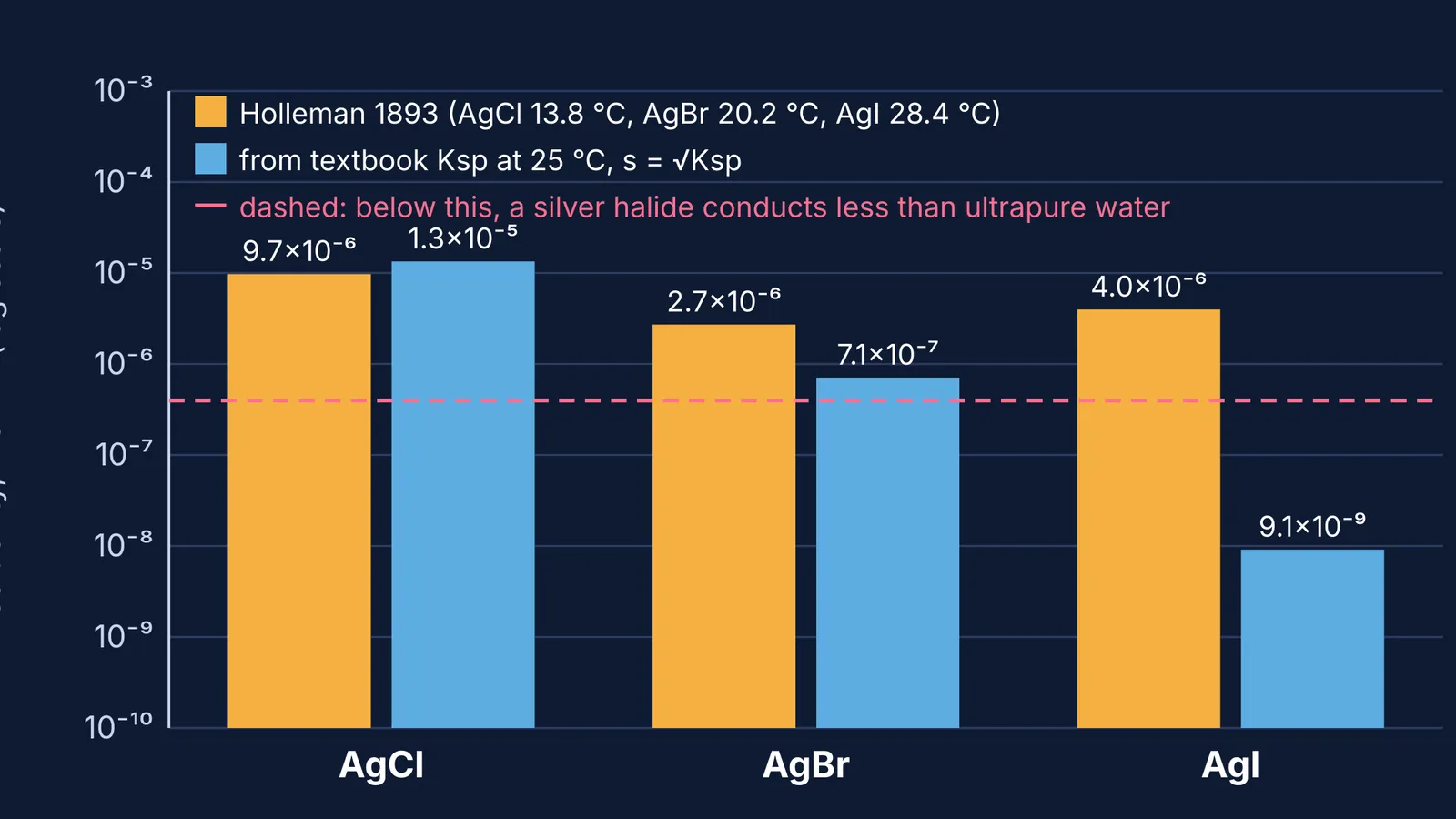
Compare with textbook Ksp values at 25 °C (AgBr 5.0 × 10⁻¹³, AgI 8.3 × 10⁻¹⁷). His AgBr solubility, 2.7 × 10⁻⁶ mol L⁻¹, is about 4 times the modern 7.1 × 10⁻⁷. His AgI, 4.0 × 10⁻⁶, is about 440 times the modern 9.1 × 10⁻⁹. He did get the order right: corrected to 13.8 °C, iodide came out least soluble, but only 7.5 times less soluble than AgCl, against about 1,500 times today.
He gave the reason himself: "the increase in the conductivity of the water on adding them was of the same order of magnitude as the conductivity of the water itself. The possibility is thereby given that, with still purer water, the solubilities would be found different."
By our rough conversion of his units, his water conducted about 1.3 µS cm⁻¹ and the AgI added about 0.6 µS cm⁻¹. Truly dissolved AgI would add only 9.1 × 10⁻⁹ × 138.7 ÷ 1000 = 1.3 × 10⁻⁹ S cm⁻¹, about 0.001 µS cm⁻¹. That is below even ultrapure water's 0.055 µS cm⁻¹. Most of what he measured was likely trace electrolyte from water, glass or salt. The method works only when the salt's conductivity is well above the water's, which holds for AgCl and BaSO₄ but not for AgI.
Where does this come up in JEE and NEET?
Class 12 Electrochemistry (Kohlrausch's law, κ to solubility) and Class 11 Equilibrium (Ksp). The modern recipe with ionic values is in Ksp of AgCl from conductivity, step by step.
For exam-style practice, Fermi Test Prep covers JEE Main and Advanced preparation with an AI tutor. If your unit conversions keep slipping, the Fermi Problem Library has a step-by-step solver that explains the reasoning.
Quick checklist
1893, Holleman, on a hint from van 't Hoff: solubility = κ/Λ° for very dilute salts.
Λ° for a salt nobody can dissolve comes from three soluble salts (Kohlrausch's law).
Watch equivalents: ½BaSO₄ v gives molar s = 1/(2v).
The method fails when the salt conducts less than the water, as with AgI.