

On this page
Friedrich Kohlrausch (14 October 1840 to 17 January 1910) was a German physicist who studied how solutions of electrolytes conduct electricity, according to his Wikipedia biography). One idea from that work is in the NCERT Class 12 chemistry textbook: when a solution is diluted far enough, each ion adds its own fixed share to the molar conductivity, whichever partner ion it came with.
Who was Friedrich Kohlrausch, and what did he measure?
Direct current electrolyses a salt solution, and the products at the electrodes spoil the measurement. Kohlrausch used alternating current to prevent them forming and invented a conductivity bridge that carries his name, as his biography) records. In 1874 he showed that an electrolyte has a definite, constant resistance. From 1895 to 1905 he was president of Germany's Physikalisch-Technische Reichsanstalt, where he succeeded Hermann von Helmholtz.
The University of Würzburg archive says he worked there from 1875 to 1888 on precise measurement and electrolytic conductivity. Your textbook's setup still uses his idea: NCERT describes a Wheatstone bridge fed with alternating current at 550 to 5000 cycles per second.
What is Kohlrausch's law of independent migration of ions?
Limiting molar conductivity (Λ°m) is the molar conductivity of a solution as its concentration approaches zero, as defined in NCERT Class 12 Chemistry, Unit 2. For a strong electrolyte you find it by plotting Λm against √c and extending the straight line back to zero concentration. NCERT does this with KCl data and gets 150.0 S cm² mol⁻¹.
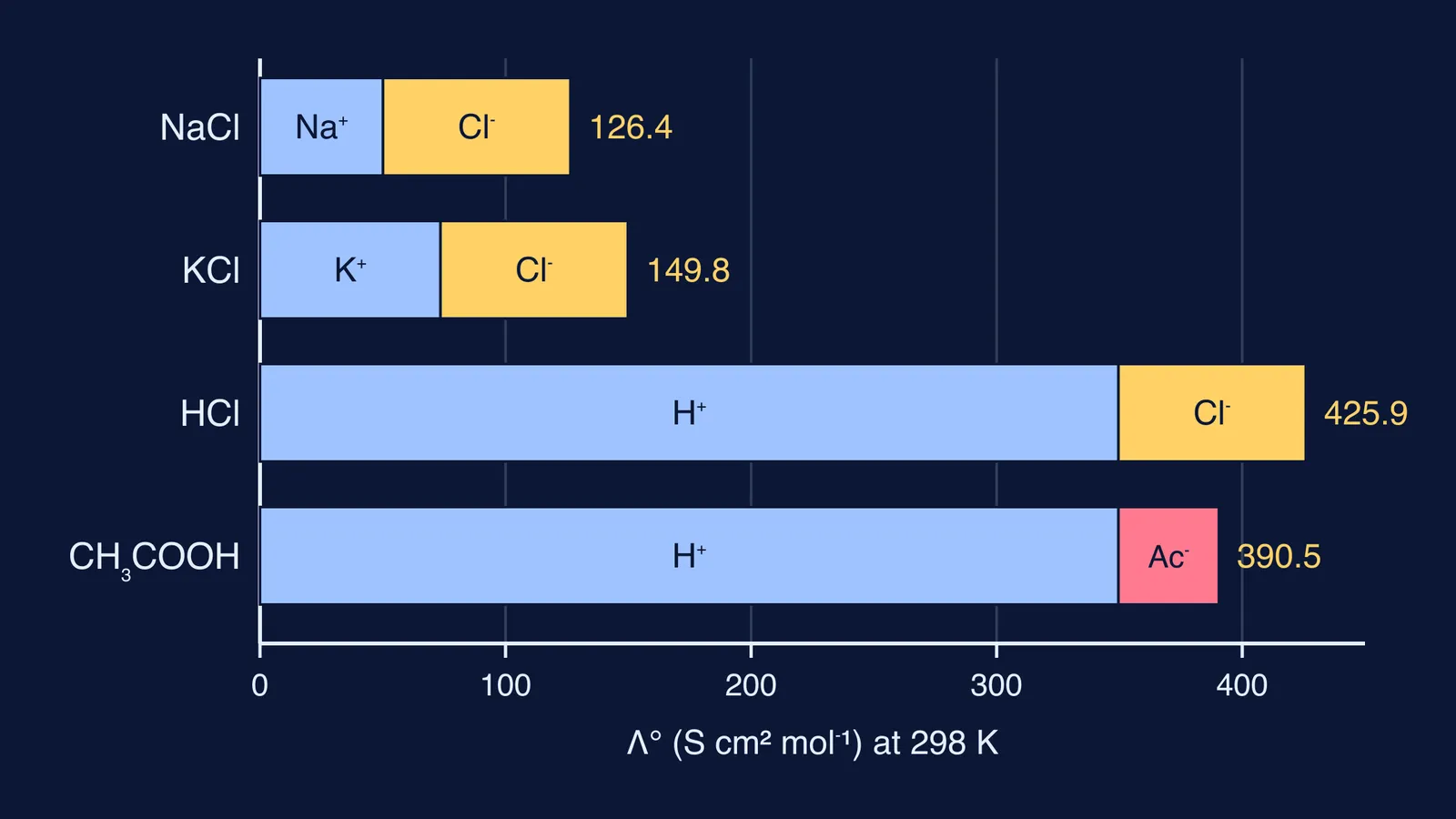
Kohlrausch compared these limiting values and spotted a pattern. At 298 K, Λ°(KCl) − Λ°(NaCl), Λ°(KBr) − Λ°(NaBr) and Λ°(KI) − Λ°(NaI) all come to about 23.4 S cm² mol⁻¹ (NCERT). Swapping Cl⁻ for Br⁻ adds about 1.8 S cm² mol⁻¹, whether the cation is Na⁺ or K⁺. That pattern fits if each ion brings a fixed amount, whatever its partner.
NCERT states the law like this: "limiting molar conductivity of an electrolyte can be represented as the sum of the individual contributions of the anion and cation of the electrolyte." In general, Λ°m = ν₊λ°₊ + ν₋λ°₋, where ν₊ and ν₋ are the numbers of cations and anions one formula unit releases. Wikipedia's article on the law dates this work to 1875 to 1879.
NCERT's Table 2.4 gives these ionic values (λ°) at 298 K, in S cm² mol⁻¹:
Cations: H⁺ 349.6, Na⁺ 50.1, K⁺ 73.5, Ca²⁺ 119.0, Mg²⁺ 106.0
Anions: OH⁻ 199.1, Cl⁻ 76.3, Br⁻ 78.1, CH₃COO⁻ 40.9, SO₄²⁻ 160.0
How do you find Λ° for acetic acid using Kohlrausch's law?
This is the application NCERT highlights. For a weak electrolyte like acetic acid, Λm rises steeply on dilution, so you cannot extend the graph back to zero. The NCERT chapter instead combines three strong electrolytes: HCl 425.9, sodium acetate (NaAc) 91.0 and NaCl 126.4 S cm² mol⁻¹.
Write the target: Λ°(HAc) = λ°(H⁺) + λ°(Ac⁻).
Pick strong electrolytes that contain those ions: HCl brings H⁺ and NaAc brings Ac⁻.
List the extra ions: HCl + NaAc also brings Na⁺ and Cl⁻, which together make NaCl.
Subtract NaCl: 425.9 + 91.0 − 126.4 = 390.5 S cm² mol⁻¹.
Use it. NCERT gives 0.001028 mol/L acetic acid a conductivity of 4.95 × 10⁻⁵ S cm⁻¹, so Λm = 48.15 S cm² mol⁻¹, α = Λm/Λ°m = 0.1233, and Ka = cα²/(1 − α) = 1.78 × 10⁻⁵ mol/L.
Step 5 is Ostwald's dilution law for weak electrolytes at work, which is why NCERT follows the Kohlrausch calculation (Example 2.8) directly with the Ka calculation (Example 2.9).
Before adding numbers, do an ion count. For the acetic acid sum: H⁺ (+1), Cl⁻ (+1 −1 = 0), Na⁺ (+1 −1 = 0), Ac⁻ (+1). If anything besides your target ions is left, the combination is wrong.
Where do students lose marks on Kohlrausch's law?
Check your answer against this list, built on the NCERT examples.
Forgetting ν. For CaCl₂, count chloride twice: 119.0 + 2(76.3) = 271.6 S cm² mol⁻¹.
Mixing up Λm and Λ°m. The degree of dissociation is the measured Λm divided by the limiting Λ°m, never the other way round.
Unit slips. 1 S cm² mol⁻¹ equals 10⁻⁴ S m² mol⁻¹. If the factor of 1000 in Λm = 1000κ/c confuses you, read where the factor of 1000 in molar conductivity comes from.
Extrapolating a weak acid's graph. Only a strong electrolyte gives a straight line against √c.
Leftover ions. Do the ion count before you calculate.
If you're unsure which salts are strong electrolytes, read strong, weak and non-electrolytes, with examples. If you keep choosing the wrong salts, the Fermi Problem Library has worked problems with a step-by-step solver that explains the reasoning rather than printing an answer. For gaps such as degree of dissociation, the Fermi Concept Library gives each concept its own lesson.
Next time you see a Λ° question, write the ion count first and the numbers second.


