

On this page
You turn on a tap, fill a glass, and drop in a spoonful of salt. To the naked eye, the salt simply vanishes. But on a microscopic level, you have just created an electrically conductive solution. Pure water is an excellent insulator, but adding certain substances turns it into a conductor. These substances are called electrolytes.
Understanding electrolytes is a core topic when studying acids, bases and salts in Class 10. It explains everything from how sports drinks rehydrate athletes to how your car battery holds a charge. The key difference between these solutions lies in their degree of ionisation—the percentage of dissolved molecules that physically split into charged ions.
What is the degree of ionisation?
When you dissolve a compound in water, the polar water molecules surround it and pull it apart. If the compound breaks down into charged particles—called ions—those ions are free to move and carry an electric current through the liquid. The fraction of the original molecules that successfully split into ions is called the degree of dissociation or ionisation, often represented by the Greek letter alpha (α).
Water is a polar molecule, meaning it has a slight positive charge on one end and a slight negative charge on the other. When an ionic solid like salt enters the water, the negative oxygen ends of the water molecules are attracted to the positive sodium ions, while the positive hydrogen ends are attracted to the negative chloride ions. This electrostatic tug-of-war is what ultimately pulls the crystal apart. If the solvent were non-polar, like benzene or hexane, this pulling force would not exist, and the salt would not dissolve or ionise.
According to OpenStax Chemistry, we classify substances into three broad categories based on how efficiently they undergo this ion-producing process: strong, weak, and non-electrolytes.
What are strong electrolytes?
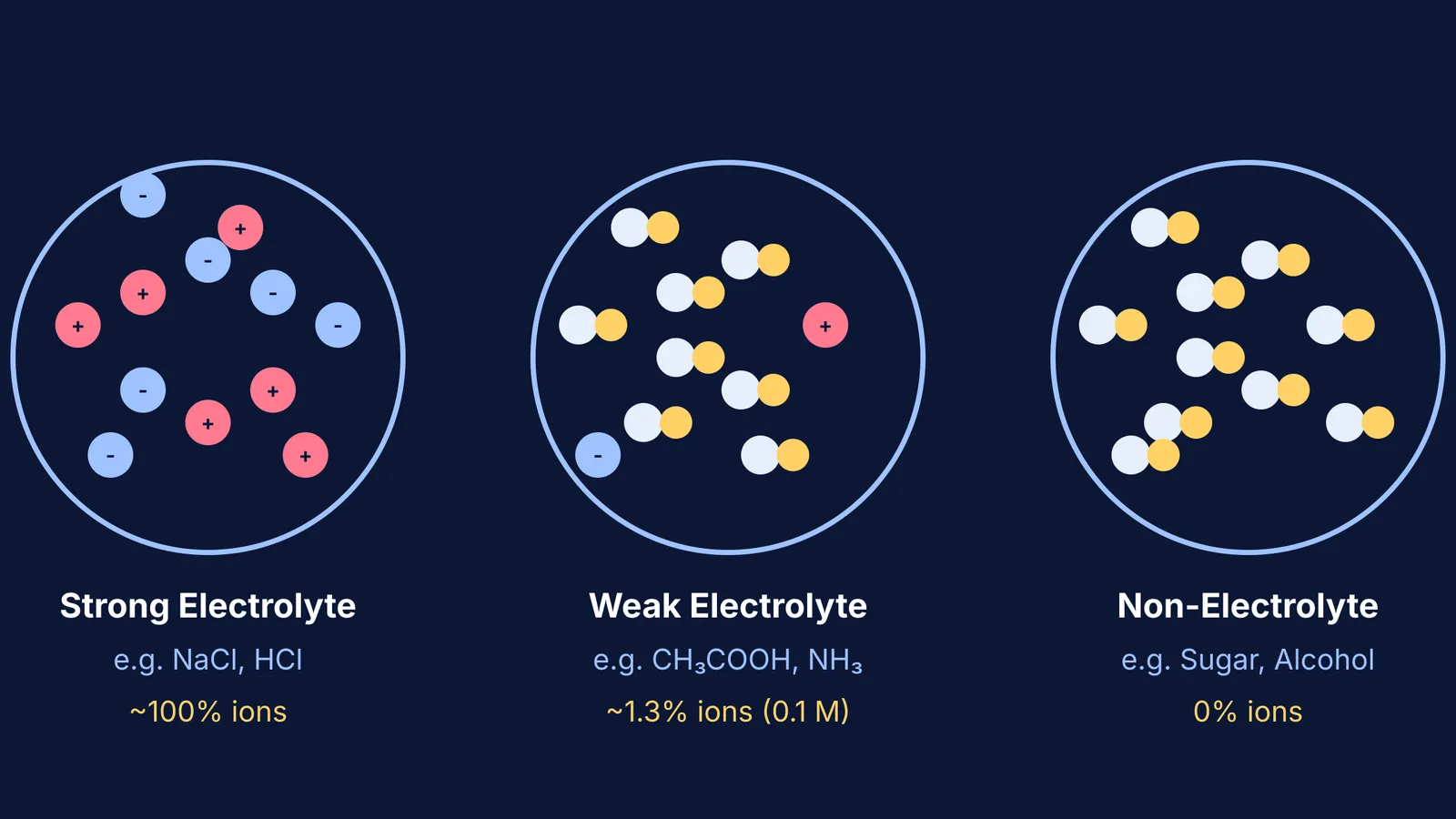
Strong electrolytes dissolve in water and ionise with essentially 100% efficiency. This means that every single molecule that goes into the solution breaks apart into positive and negative ions. Because they generate a massive number of mobile charge carriers, these solutions are excellent conductors of electricity.
The theory of strong electrolytes tells us that the classic examples are strong acids, strong bases, and soluble salts. For instance, if you dissolve table salt—sodium chloride (NaCl)—in water, the crystal lattice collapses completely, separating into sodium (Na⁺) and chloride (Cl⁻) ions. Hydrochloric acid (HCl), sulphuric acid (H₂SO₄), nitric acid (HNO₃) and sodium hydroxide (NaOH) are also common strong electrolytes.
What are weak electrolytes?
Weak electrolytes only partially ionise in water. When you dissolve them, a chemical equilibrium is established. The vast majority of the molecules remain intact and neutral, while only a very small fraction splits into ions. Because they produce very few ions compared to the total amount dissolved, they are poor conductors of electricity.
A standard example is acetic acid (CH₃COOH), which gives vinegar its sour taste. According to OpenStax Chemistry, in a 0.1 M solution of acetic acid, only about 1.3% of the molecules ionise into hydrogen (H⁺) and acetate (CH₃COO⁻) ions. The remaining 98.7% stay bound together as whole molecules. Ammonia (NH₃), carbonic acid (H₂CO₃), and calcium hydroxide (Ca(OH)₂) also fall into this weak electrolyte category.
If you are stuck trying to map out which molecules split, which stay whole, and how to write the equilibrium equations, the Fermi Concept Library can help you trace the microscopic steps of acid-base dissociation.
What are non-electrolytes?
Non-electrolytes dissolve in water but do not yield any ions at all. Their degree of ionisation is exactly 0%. Because there are absolutely no freely mobile, charged species in the solution, they cannot conduct an electric current, no matter how much you dissolve.
Typical non-electrolytes are covalent organic compounds like sugar (sucrose), alcohol (ethanol), and urea. When you stir a spoonful of sugar into water, the macroscopic crystals break down into individual sucrose molecules, but those molecular building blocks remain entirely intact and uncharged. Pure, distilled water itself is also considered a non-electrolyte for all practical purposes; it naturally ionises to such a minuscule extent at room temperature that it is not enough to carry a significant current.
How do you classify them in chemistry exams?
For ICSE chemistry and board exams, you will often be asked to classify a list of substances, predict their electrical conductivity, or explain the observations of a bulb-and-battery experiment. In the classic laboratory demonstration, two electrodes are immersed in the test solution and connected to a battery and a light bulb. The brightness of the bulb serves as a visual indicator of the number of mobile ions present. A strong electrolyte provides an unbroken path for the current, lighting the bulb brilliantly. A weak electrolyte offers a much higher resistance because there are so few ions, causing the bulb to glow faintly. A non-electrolyte leaves the circuit broken, so the bulb remains completely dark.
You can use this mental checklist to decide:
Is it a strong acid (like HCl or HNO₃) or a strong base (like NaOH or KOH)? It is a strong electrolyte. Expect a bright bulb in a conductivity test.
Is it a soluble salt (like NaCl, KCl, or CuSO₄)? It is a strong electrolyte.
Is it a weak acid (like acetic acid or citric acid) or a weak base (like ammonium hydroxide, NH₄OH)? It is a weak electrolyte. Expect a dim bulb.
Is it a sugar, an alcohol, or pure distilled water? It is a non-electrolyte. Expect the bulb to stay off.
By focusing on the degree of ionisation rather than just memorising lists, you can reliably predict not just what a solution is made of, but exactly how it will behave when an electric current is applied.


