On this page
Open an older question bank or a previous-year paper and you will meet answers in ohm⁻¹ cm² eq⁻¹, or in "mho". Your current notes use molar conductivity in S cm² mol⁻¹. The two are not rival ideas. They are the same measurement divided by two different counts of the dissolved salt, and one number, the n-factor, links them.
What is the relation between equivalent and molar conductance?
Molar conductivity is conductivity divided by molar concentration, Λm = κ/c, and its SI unit is S m² mol⁻¹, though values are often quoted in S cm² mol⁻¹ (Wikipedia: Molar conductivity).
Equivalent conductivity uses the same κ but divides by the equivalent concentration (normality) instead. For a salt, normality = n × molarity, where n is the total charge carried by the cations in one formula unit. So:
Λm = 1000 κ / M (κ in S cm⁻¹, M in mol L⁻¹)
Λeq = 1000 κ / N, with N = n × M
Therefore Λm = n × Λeq
IUPAC has recommended that the term equivalent conductivity be discontinued and that molar conductivity be used even for values divided by equivalent concentration (Wikipedia: Molar conductivity). Data tables still carry the old habit. The CRC Handbook table by Petr Vanýsek lists entries such as "1/2 Na2SO4" and "1/3 LaCl3", with units of 10⁻⁴ m² S mol⁻¹ (CRC Handbook: Equivalent conductivity of electrolytes). The "1/2" tells you the mole counted is half a formula unit: one equivalent.
That same table gives 129.8 for 1/2 Na2SO4 at infinite dilution, so Λm° for a full mole of Na2SO4 is 2 × 129.8 = 259.6 S cm² mol⁻¹ (CRC Handbook table).
Why is the n-factor of Al2(SO4)3 equal to 6?
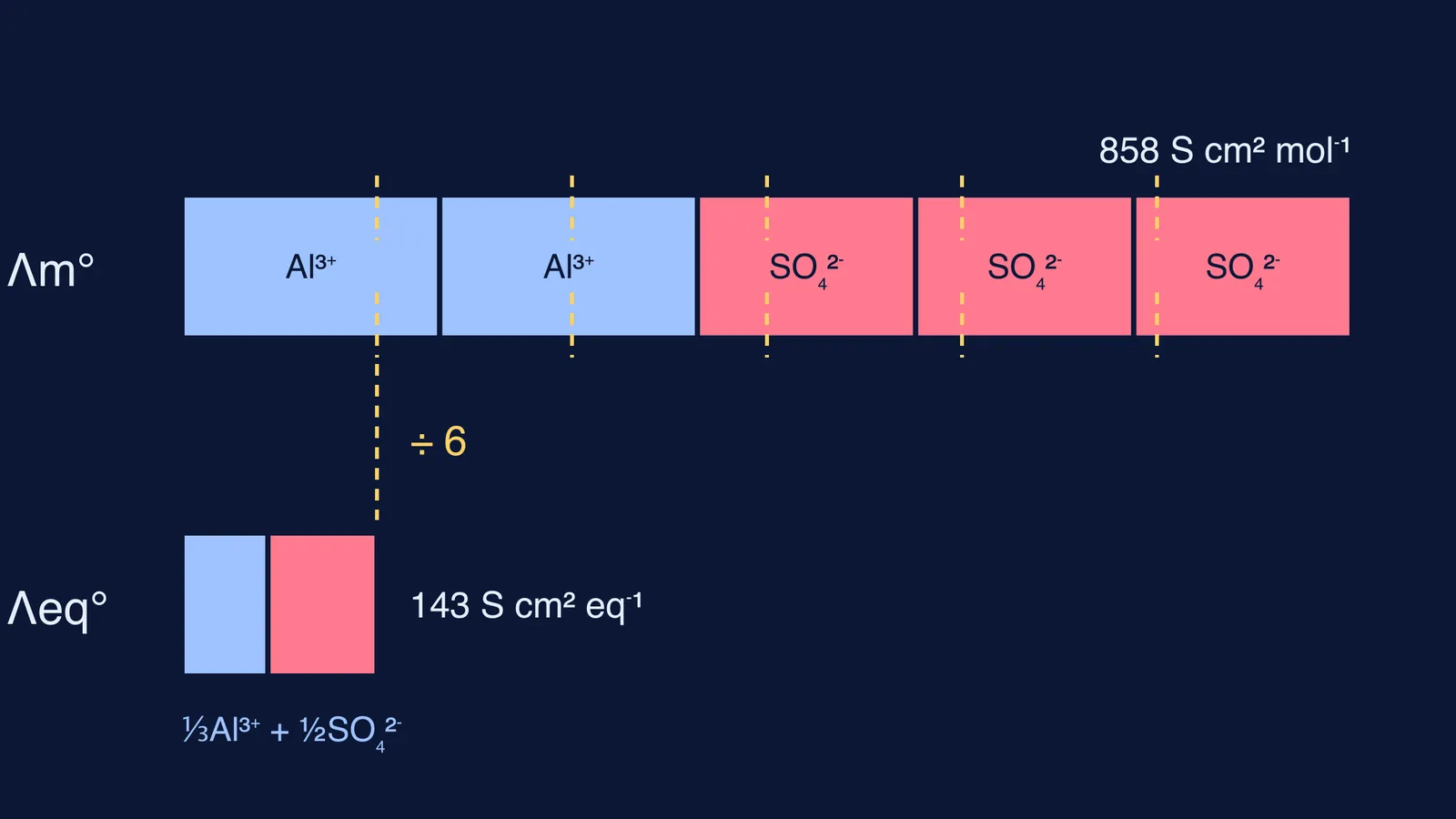
One formula unit dissociates as Al2(SO4)3 → 2 Al³⁺ + 3 SO4²⁻.
Positive charge: 2 ions × 3 = 6
Negative charge: 3 ions × 2 = 6
Both sides give 6, as they must for a neutral salt. So one mole of Al2(SO4)3 is six equivalents, a 0.1 M solution is 0.6 N, and Λm = 6 × Λeq. If n-factors still feel shaky, our guide to the n-factor and the equivalent concept covers acids, bases and redox cases too.
How do you convert an old-syllabus answer? A worked example
Here is a classic question, as posted on Sarthaks eConnect: ionic conductances at infinite dilution of Al³⁺ and SO4²⁻ are 189 and 160 mho cm² equiv⁻¹; find the equivalent and molar conductance of Al2(SO4)3. The posted solution gives Λm° = 2 × 189 + 3 × 160 = 858 and Λeq° = 189/3 + 160/2 = 143.
Notice what that working assumes. It treats 189 and 160 as values per mole of each ion, then divides by the ion's charge to get the per-equivalent values 63 and 80. That reading fits measured data: the limiting conductivity of 1/2 SO4²⁻ is listed as 80.0 S cm² mol⁻¹ (Wikipedia, citing Laidler and Meiser), so 160 is the value for a whole mole of sulfate ions.
The routine for any old answer:
Read the unit. Mho and ohm⁻¹ are the same as siemens, S (Wikipedia: Siemens)).
Write the dissociation and find n, the total cation charge per formula unit.
Per equivalent to per mole: multiply by n. Per mole to per equivalent: divide by n.
Change cm² to m² if asked: 1 S cm² mol⁻¹ = 10⁻⁴ S m² mol⁻¹.
Sanity check: Λm and Λeq are equal only when n = 1, as for NaCl or KCl.
For Al2(SO4)3: 143 S cm² eq⁻¹ × 6 = 858 S cm² mol⁻¹ = 8.58 × 10⁻² S m² mol⁻¹.
Which old units should you watch for?
mho cm² eq⁻¹ or ohm⁻¹ cm² (g equiv)⁻¹: equivalent conductance; multiply by n
ohm⁻¹ cm² mol⁻¹: already molar; just rename ohm⁻¹ as S
ohm⁻¹ cm⁻¹: conductivity κ, not a molar quantity at all
Our post on where the factor of 1000 in molar conductivity units comes from explains the 1000 in Λm = 1000 κ / M, and conductance and Kohlrausch's law shows where ionic sums like 2 × 189 + 3 × 160 come from.
If you want more salts to practise on, the Fermi Problem Library has worked problems with a step-by-step solver that explains the reasoning rather than printing an answer, so you can see where n enters. For the definitions behind κ, Λm and limiting conductivity, the Fermi Concept Library gives each concept its own lesson.
Next time you see eq⁻¹ in an answer key, write the dissociation, find n, and multiply.