On this page
The malic acid in an apple is one pure enantiomer. The food-grade malic acid in the Bureau of Indian Standards specification is not: BIS calls it "dl-malic acid" and says its solutions are "optically inactive". The reason sits in the same standard's impurity list, which names the two alkenes the acid is made from. One page gives you alkene hydration, E/Z isomers, racemisation, CIP rules and an n-factor titration.
What does BIS say about food-grade malic acid?
IS 14124:1994, Malic Acid, Food Grade says the compound "is also known as dl-malic acid and hydroxysuccinic acid", with formula C₄H₆O₅ and molecular weight 134.09. It is used "as an acidulant and as a flavouring agent", melts at about 130 °C, and clause 3.1 states: "Its solutions are optically inactive."
Table 1 of the standard sets the limits. The ones that matter here:
Purity as C₄H₆O₅, on dry basis: at least 99.0% by mass
Moisture: at most 0.3%
Fumaric acid: at most 1.0%
Maleic acid: at most 0.05%
Lead: originally 10 mg/kg, cut to 2 mg/kg by Amendment 2 (2008)
Compare that with natural malic acid. PubChem lists L-malic acid as (2S)-2-hydroxybutanedioic acid, "the naturally occurring form of malic acid present in apples and other plants", also written L-(−)-malic acid. It rotates plane-polarised light; the BIS material does not.
Why does the impurity list name fumaric and maleic acid?
Because they are the raw materials. The PubChem record for malic acid quotes the Hazardous Substances Data Bank: "dl-Malic acid is mfr by hydrating maleic and fumaric acids in presence of suitable catalysts & separating malic acid from equilibrium product mixture." Maleic acid itself comes from catalytic oxidation of benzene.
The reaction is the addition of water across a C=C bond:
HOOC–CH=CH–COOH + H₂O → HOOC–CH(OH)–CH₂–COOH
Check it: C₄H₄O₄ + H₂O gives C₄H₆O₅, and 116.07 + 18.02 = 134.09 g/mol. Maleic acid is the Z and fumaric acid the E isomer of but-2-enedioic acid; our post on why maleic acid is more acidic than fumaric acid, then less covers how the pair differ as acids.
"Equilibrium product mixture" is the key phrase. Hydration is reversible, so some alkene acid is always left over, and whatever survives purification shows up as an impurity. The standard measures both by polarography, where a dropping mercury electrode reduces the C=C bond. In an acid buffer, maleic and fumaric acid give one combined wave near −0.56 V. At pH 7, maleic acid alone gives a wave near −1.33 V, and fumaric acid is found by difference. The standard does not explain why the maleic limit is 20 times tighter than the fumaric one, so we will not guess.
Why does hydration of fumaric acid give a racemic mixture?
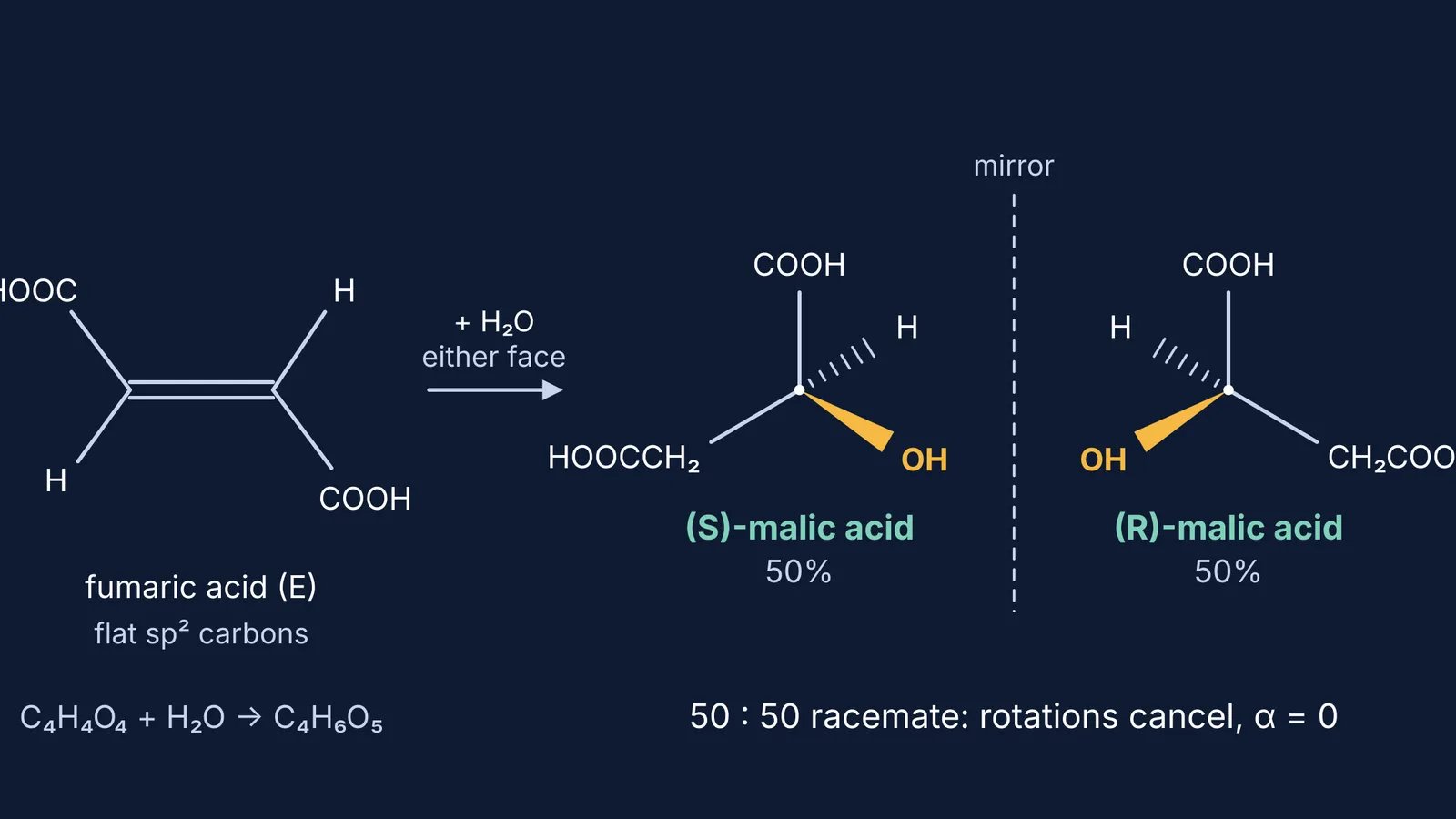
C-2 of malic acid carries four different groups (OH, COOH, CH₂COOH, H), so it is a stereocentre.
In fumaric or maleic acid that carbon is sp² and flat. The molecule is symmetric, so it does not matter which alkene carbon receives the OH: that carbon becomes C-2. The OH can bond to it from the top face or the bottom face of the plane. One face gives (R)-malic acid, the other gives (S)-malic acid.
Nothing prefers one face: the alkene, water and an ordinary acid catalyst are all achiral. The two pathways are exact mirror images with identical energies and rates. The product is a 50:50 mixture, a racemate. The two rotations cancel and the polarimeter reads zero, which is what BIS means by "optically inactive". For why a racemate reads zero, see our guide to racemic mixtures and how to resolve them.
The argument does not need the exact mechanism, which is useful because the HSDB record does not name the industrial catalysts. The textbook route through a flat carbocation, in our post on acid-catalysed hydration of alkenes, gives a racemate, but so would any route with no chiral influence.
Then why does the Krebs cycle make only one enantiomer?
Because its catalyst is chiral. The enzyme fumarase (fumarate hydratase) is listed in the ExPASy enzyme database with the reaction "(S)-malate = fumarate + H2O". Its chiral active site tells the two faces of fumarate apart, so the same alkene and water give only (S)-malate. Do not write "hydration of fumarate always gives a racemate": that is true only without a chiral catalyst.
How do you assign R or S to natural malic acid?
Rank the four groups on C-2 by the Cahn–Ingold–Prelog rules:
OH: attached atom O, the highest atomic number.
COOH: attached C carries (O, O, O), counting C=O twice.
CH₂COOH: attached C carries (C, H, H).
H.
Point H away from you. If 1 → 2 → 3 runs anticlockwise, the centre is S; natural L-malic acid is (S). Keep the labels apart: L is relative to glyceraldehyde, S comes from CIP rules and (−) is the measured rotation. None predicts the others.
How do you calculate purity from the BIS titration?
Annex A-2 titrates about 2 g with 1 N NaOH to a phenolphthalein pink that lasts 30 seconds, and adds: "Each ml of 1 N sodium hydroxide is equivalent to 67.04 mg of C₄H₆O₅."
Where does 67.04 come from? Both COOH groups are neutralised at the phenolphthalein end point:
C₄H₆O₅ + 2NaOH → Na₂C₄H₄O₅ + 2H₂O
So the n-factor is 2, and the equivalent weight is 134.09 ÷ 2 = 67.04 g per equivalent. One mL of 1 N NaOH is 1 milliequivalent, which matches 67.04 mg.
Worked example. A 2.000 g sample has a loss on drying of 0.20%. It needs 29.70 mL of 1 N NaOH. Does it pass?
Mass of malic acid titrated: 29.70 × 67.04 = 1991.1 mg.
Purity as is: 1991.1 ÷ 2000 × 100 = 99.55%.
Dry mass of sample: 2.000 × (1 − 0.0020) = 1.996 g.
Purity on dry basis: 1991.1 ÷ 1996 × 100 = 99.75%.
Limit is at least 99.0% on dry basis, so it passes.
Two traps hide here. First, if you multiply by the full molar mass, 134.09 mg per mL, you get about 199%. That is the n-factor error in one line. Second, the titration cannot tell malic acid from its impurities. Fumaric acid is also diprotic, with an equivalent weight of 116.07 ÷ 2 = 58.04, so 1.0% of fumaric acid uses as much NaOH as 1.0 × 67.04 ÷ 58.04 ≈ 1.16% of malic acid. That is why the alkene acids get their own test.
If n-factor sums keep catching you, the Fermi Problem Library has a step-by-step solver that explains the reasoning, not just the answer. For practice on stereochemistry and titration questions in the JEE pattern, Fermi Test Prep is built for JEE Main and Advanced preparation, with an AI tutor.
Where does this show up in JEE and NEET?
Class 11: E/Z isomerism (maleic vs fumaric acid) and acid–base titrations with n-factor 2.
Class 12 Alcohols: hydration of alkenes.
Class 12 Haloalkanes: racemisation through a planar intermediate, and R/S by CIP rules.
NEET Biology: fumarate → malate in the Krebs cycle, catalysed by a stereospecific enzyme.
Quick checklist
Can you explain, without a mechanism, why an achiral route gives 50:50?
Can you rank OH > COOH > CH₂COOH > H and get S for L-malic acid?
Can you derive 67.04 mg per mL from n = 2?
Can you say why the titration alone cannot catch fumaric acid?