On this page
Try each question on paper before you read the solution.
How are JEE Main numerical value questions marked?
The Information Bulletin for JEE (Main) 2027 from NTA says Mathematics has 5 Section B questions, whose answers are filled in as a numerical value. A correct answer earns +4, an incorrect one −1 and an unanswered one 0, so a wild guess can cost you. You type an integer on an on-screen keypad, and the answer should be rounded off to the nearest integer.
Every question below sits inside Unit 8, Integral Calculus, of NTA's Syllabus for JEE (Main) 2027. For the theory and a study plan, read how to prepare definite integrals and area for JEE Main.
Easy: can you get these right first time?
Q1 (easy). Evaluate ∫₀² (3x² + 2x) dx.
Answer: 12. An antiderivative is x³ + x², so the integral is (8 + 4) − 0 = 12.
Check: Simpson's rule is exact for this polynomial: (2/6)(f(0) + 4f(1) + f(2)) = (1/3)(0 + 20 + 16) = 12. Slip: 32, from writing 3x³ + 2x² without dividing by the new power.
Q2 (easy). Evaluate ∫ from −1 to 3 of |x − 1| dx.
Answer: 4. Split at x = 1, where x − 1 changes sign. The graph is two triangles, each with base 2 and height 2, so the integral is 2 + 2 = 4.
Check: ∫ from 1 to 3 of (x − 1) dx = 2, and the left piece mirrors it. Slip: 0, from dropping the modulus; the negative part then cancels the positive part.
Q3 (easy). A is the area bounded by y = x² and the line y = 4. Find 3A.
Answer: 32. The curves meet at x = ±2, so A = ∫ from −2 to 2 of (4 − x²) dx = 16 − 16/3 = 32/3, and 3A = 32.
Check: a parabolic segment is two-thirds of its 4 by 4 bounding rectangle, so A = 32/3. Slip: 16, from integrating from 0 to 2 only and forgetting the left half.
Medium: which properties save the most time?
Q4 (medium). Evaluate I = ∫₀⁶ √x / (√x + √(6 − x)) dx.
Answer: 3. Use ∫₀ᵃ f(x) dx = ∫₀ᵃ f(a − x) dx. Adding the two forms of I gives an integrand of 1, so 2I = 6 and I = 3.
Check: since f(x) + f(6 − x) = 1, the integrand averages ½ over the interval, and ½ × 6 = 3. Slip: 6, from stopping at 2I = 6.
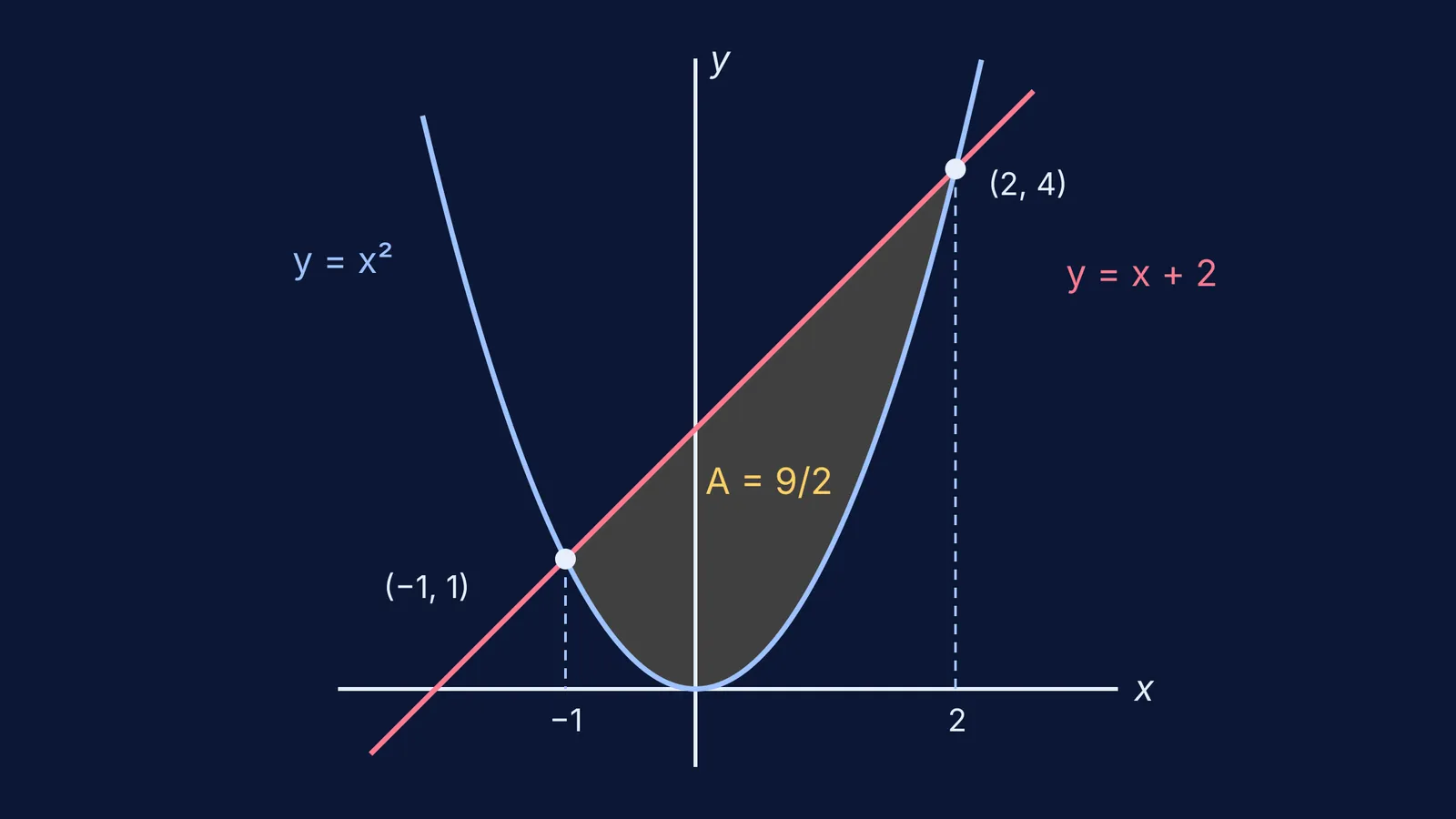
Q5 (medium). A is the area enclosed by y = x² and y = x + 2. Find 2A.
Answer: 9. The curves meet where x² = x + 2, at x = −1 and x = 2. The line is on top, so A = ∫ from −1 to 2 of (x + 2 − x²) dx = 10/3 − (−7/6) = 9/2, and 2A = 9.
Check: the area between y = x² and a chord from x = a to x = b is (b − a)³/6 = 27/6 = 9/2. Slip: −9, from subtracting the line from the parabola. An area is never negative.
Q6 (medium). F(x) = ∫ from 0 to x² of √(t + 9) dt. Find F′(4).
Answer: 40. By the fundamental theorem of calculus and the chain rule, F′(x) = √(x² + 9) × 2x. At x = 4 this is 5 × 8 = 40.
Check: F(x) = (2/3)[(x² + 9)^(3/2) − 27]; differentiating gives the same 2x√(x² + 9). Slip: 5, from forgetting the 2x that the upper limit x² brings.
Hard: can you handle jumps and limits of sums?
Q7 (hard). [x] is the greatest integer not exceeding x. Find ∫₀² [x²] dx + √2 + √3.
Answer: 5. [x²] jumps at x = 1, √2 and √3, taking the values 0, 1, 2 and 3, so the integral is (√2 − 1) + 2(√3 − √2) + 3(2 − √3) = 5 − √2 − √3. Adding √2 + √3 gives 5.
Check: the integral, about 1.85, lies between ∫₀² (x² − 1) dx and ∫₀² x² dx, as it must. Slip: 4, from treating [x²] as [x]², which gives 1 + √2 + √3 ≈ 4.15.
Q8 (hard). L is the limit, as n → ∞, of the sum from r = 1 to 3n of r / (n² + r²). Find e^(2L).
Answer: 10. Write each term as (1/n) × (r/n) / (1 + (r/n)²). As r runs to 3n, r/n runs from 0 to 3, so L = ∫₀³ x / (1 + x²) dx = ½ ln 10, and e^(2L) = 10.
Check: with n = 1 the sum is 0.5 + 0.4 + 0.3 = 1.2, already close to ½ ln 10 ≈ 1.15. Slip: 2, from taking the upper limit as 1 because the sum usually stops at n.
How do you avoid wrong numbers in definite integrals?
Sketch the region and mark where the curves meet.
Split the interval wherever a modulus or greatest-integer function changes form.
Subtract the lower curve from the upper one; an area is positive.
With a variable limit, multiply by that limit's derivative.
Check a second way: symmetry, a known area or a rough bound.
For more practice, try our definite integrals and area JEE Main practice questions.
Answer won't match? The Fermi Problem Library has a step-by-step solver that explains the reasoning rather than printing an answer. For the rest of your JEE preparation, start at Fermi Test Prep, our JEE Main and Advanced preparation.