On this page
The binomial theorem suits numerical-value questions well, because nearly every question reduces to one general term and an exact whole number. Unit 5 of the official JEE Main 2027 syllabus covers the binomial theorem for a positive integral index, the general term and middle term, and simple applications. The eight questions below are original, ordered easy to hard, and every answer is an integer you could type straight in.
How are JEE Main numerical value questions marked?
The JEE Main 2027 Information Bulletin from NTA sets the Paper 1 pattern: Mathematics has 20 multiple-choice questions in Section A and 5 numerical-value questions in Section B, for 100 marks. A correct numerical answer earns +4 marks, an incorrect one −1 and an unanswered question 0. You enter the integer value with an on-screen keypad, and the bulletin says the answer should be rounded off to the nearest integer.
With no options to check against, you need your own check. A right answer earns four marks and a wrong one costs one, so an answer you have worked and checked is worth entering; a blind guess at an integer almost never is.
Which Binomial Theorem questions come up as numerical values?
Q1. Find the coefficient of x⁴ in (1 + 2x)⁶.
T(r+1) = C(6,r)(2x)^r. Take r = 4: C(6,4) × 2⁴ = 15 × 16.
Answer: 240. Check: the power of 2 must equal the power of x. Slip: writing C(6,4) × 2 = 30, forgetting that the 2 is raised to the fourth power too.
Q2. Find the term independent of x in (2x² − 1/x)⁶.
T(r+1) = C(6,r)(2x²)^(6−r)(−1/x)^r = C(6,r) 2^(6−r) (−1)^r x^(12−3r). Set 12 − 3r = 0, so r = 4: 15 × 2² × 1.
Answer: 60. Check: r = 4 is even, so the sign is positive. Slip: using 2⁴ instead of 2², which gives 240.
Q3. Find the middle term of (x/2 + 2/x)⁸.
With n = 8 there are nine terms, so the middle one is T5 (r = 4): C(8,4)(x/2)⁴(2/x)⁴ = 70 × (x⁴/16) × (16/x⁴).
Answer: 70. Check: the middle term has no x, as the symmetry of the bracket promises. Slip: taking T4 as the middle term.
Q4. The sum of the coefficients in (1 + 3x)ⁿ is 1024. Find the coefficient of x².
Put x = 1: 4ⁿ = 1024, so n = 5. The coefficient of x² is C(5,2) × 3² = 10 × 9.
Answer: 90. Check: 4⁵ = 1024. Slip: reading 1024 as 2¹⁰ and taking n = 10.
What do the harder Binomial Theorem numerical questions look like?
Q5. Find the remainder when 7¹⁰³ is divided by 25.
7² = 49 = 50 − 1, so 7¹⁰³ = 7 × (50 − 1)⁵¹. Every term of that expansion except the last has a factor of 50, so 7¹⁰³ leaves the same remainder as 7 × (−1)⁵¹ = −7. Add 25 to make it a true remainder.
Answer: 18. Check: a remainder on division by 25 lies between 0 and 24. Slip: typing −7.
Q6. In (1 + x)ⁿ, three consecutive coefficients are in the ratio 1 : 5 : 20. Find n.
Let them be C(n,r−1), C(n,r) and C(n,r+1). Then (n − r + 1)/r = 5 and (n − r)/(r + 1) = 4, giving n = 6r − 1 and n = 5r + 4. So r = 5.
Answer: 29. Check: C(29,4) = 23751, C(29,5) = 118755 and C(29,6) = 475020, which step up by 5 and then by 4. Slip: setting the second ratio to 20 instead of 20 ÷ 5 = 4.
Q7. Using the binomial theorem, find 1000 × (1.02)¹⁰ rounded to the nearest integer.
(1 + 0.02)¹⁰ = 1 + 10(0.02) + 45(0.0004) + 120(0.000008) + 210(0.00000016) + … = 1 + 0.2 + 0.018 + 0.00096 + 0.0000336 + … ≈ 1.21899.
Answer: 1219 (1218.99, rounded). Check: the remaining terms add less than 0.000001, too little to change the rounding. Slip: stopping after three terms gives 1218.
Q8. Find the coefficient of x⁵ in (1 + x)¹⁰ + (1 + x)¹¹ + … + (1 + x)²⁰.
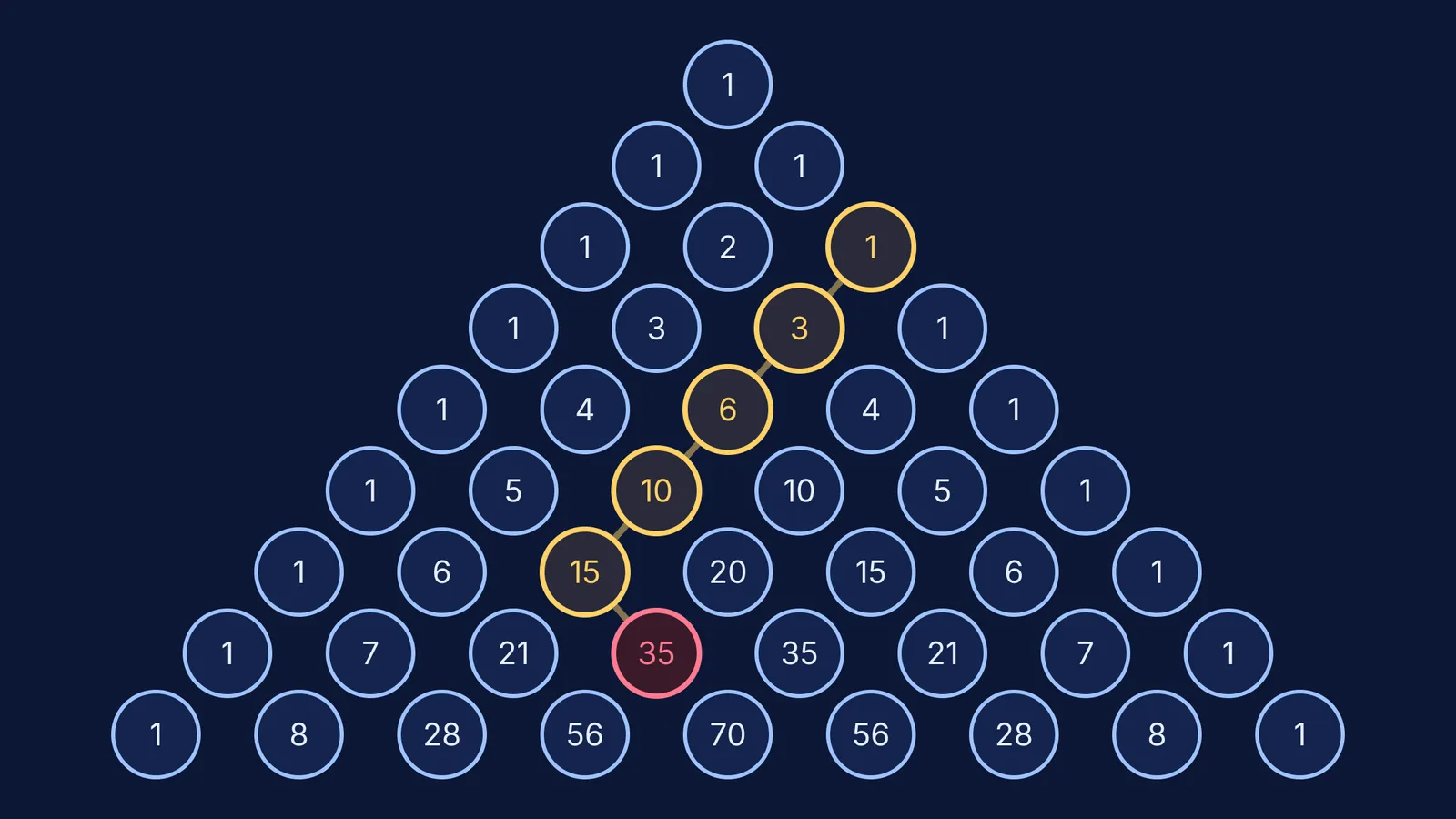
You need C(10,5) + C(11,5) + … + C(20,5). By the hockey-stick identity, C(5,5) + C(6,5) + … + C(20,5) = C(21,6) = 54264. Take away the terms you do not want, C(5,5) to C(9,5): 1 + 6 + 21 + 56 + 126 = 210, which is C(10,6).
Answer: 54054. Check: as a geometric series the sum is [(1 + x)²¹ − (1 + x)¹⁰]/x, whose x⁵ coefficient is C(21,6) − C(10,6) again. Slip: summing from C(5,5) and typing 54264.
How should you practise these before the exam?
Solve all eight with the solutions covered, writing the general term first.
Note each miss and its slip in one line.
Two days later, redo only the misses.
For option-based practice, work through our Binomial Theorem JEE Main practice questions with solutions; for the syllabus and a plan, read Binomial Theorem for JEE Main: syllabus, examples and a plan.
If a solution makes sense once you read it but you could not have started it yourself, the Fermi Problem Library has a step-by-step solver that explains the reasoning rather than just printing an answer. For the rest of your JEE preparation, Fermi Test Prep is our JEE Main and Advanced preparation.