On this page
Each question has a worked solution, the answer, a check and a wrong number that is easy to type by mistake.
How are JEE Main numerical value questions marked?
NTA's Information Bulletin for JEE (Main) 2027 says each Paper 1 subject has 20 Section A questions (MCQs) and 5 Section B questions answered as a numerical value. A correct Section B answer earns +4, a wrong one −1, a blank 0. You type an integer on an on-screen keypad, and the answer should be rounded off to the nearest integer.
Probability sits in Unit 13 of the mathematics Syllabus for JEE (Main) 2027: probability of an event, the addition and multiplication theorems, Bayes' theorem and the probability distribution of a random variable. Probabilities are fractions, so each question says what to type: 36P, 100P or m + n.
Easy: can you count the sample space right?
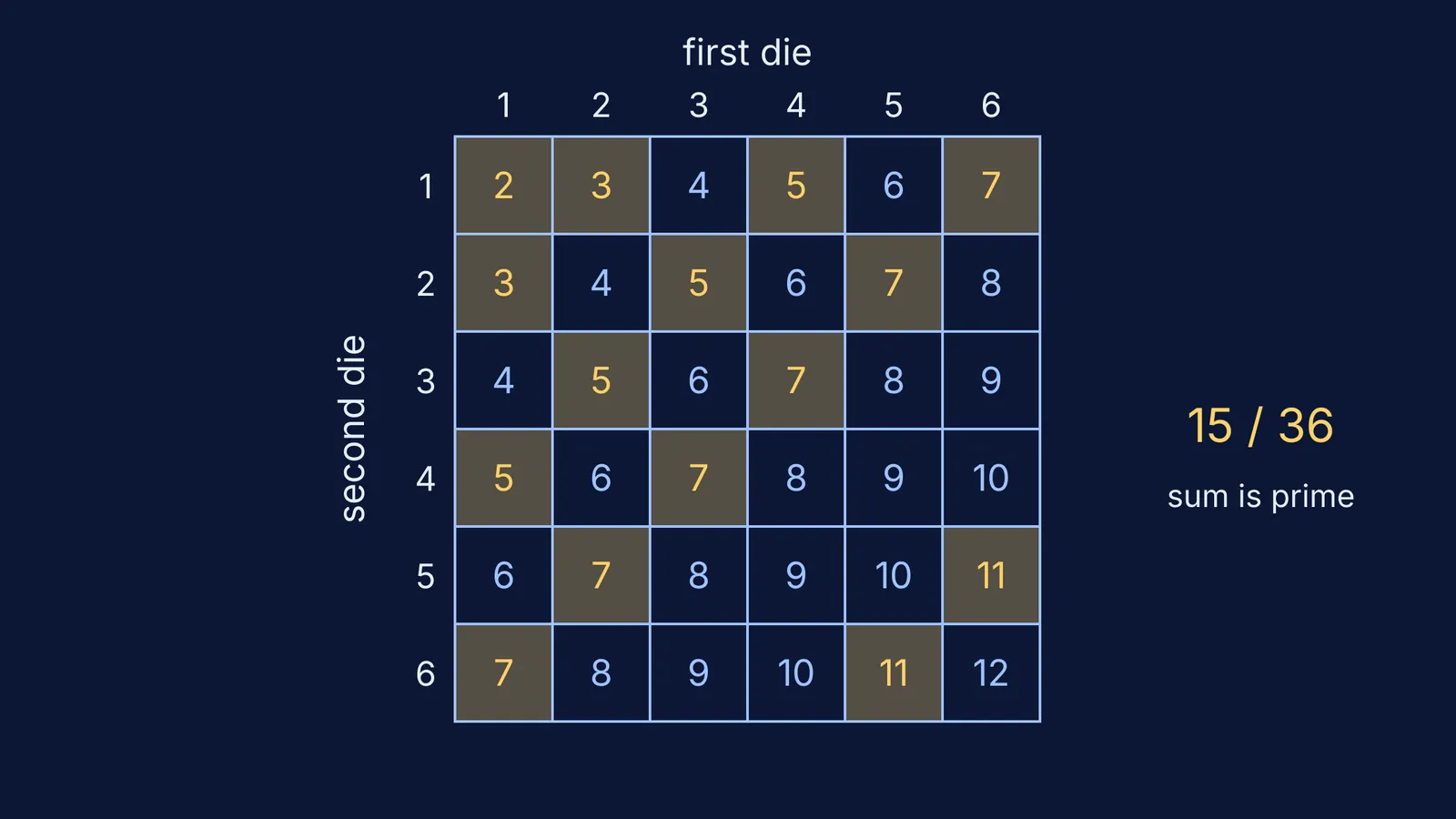
Q1 (easy). Two fair dice are thrown. If P is the probability that the sum is prime, find 36P.
Answer: 15. Prime sums are 2, 3, 5, 7 and 11, with 1, 2, 4, 6 and 2 ordered outcomes: 15 of 36.
Check: the other sums cover 21 outcomes, and 15 + 21 = 36. Slip: 8, from counting unordered pairs, so (1, 2) and (2, 1) become one.
Q2 (easy). P(A) = 0.5, P(B) = 0.4 and P(A ∪ B) = 0.7. Find 100 × P(exactly one of A, B occurs).
Answer: 50. By the addition theorem, P(A ∩ B) = 0.5 + 0.4 − 0.7 = 0.2. Exactly one = P(A ∪ B) − P(A ∩ B) = 0.5.
Check: A only is 0.3, B only is 0.2, total 0.5. Slip: 70, typing the union. More on this in the probability that exactly one of A and B occurs.
Q3 (easy). Three students solve a problem independently with probabilities 1/2, 1/3 and 1/4. If P is the probability that exactly one solves it, find 24P.
Answer: 11. (1/2)(2/3)(3/4) + (1/2)(1/3)(3/4) + (1/2)(2/3)(1/4) = (6 + 3 + 2)/24.
Check: none, two and all three give 6/24, 6/24 and 1/24; the four cases sum to 1. Slip: 26, from adding 1/2 + 1/3 + 1/4.
Medium: what does given change?
Q4 (medium). Two cards are drawn without replacement from a pack of 52. Given that at least one is an ace, the probability that both are aces is 1/k. Find k.
Answer: 33. Hands with at least one ace: C(52,2) − C(48,2) = 1326 − 1128 = 198. Both aces: C(4,2) = 6. So 6/198 = 1/33.
Check: P(both) = 1/221 and P(at least one) = 33/221; the ratio is 1/33. Slip: 17, from 3/51, assuming the first card is an ace.
Q5 (medium). Machines A, B and C make 0.5, 0.3 and 0.2 of a factory's bolts, and the fraction of their bolts that is defective is 0.02, 0.03 and 0.05. A bolt is defective. Find 100 × P(it came from C), to the nearest integer.
Answer: 34. By Bayes' theorem, 0.010/(0.010 + 0.009 + 0.010) = 10/29 ≈ 0.3448, so 34.48 rounds to 34.
Check: the posteriors 10/29, 9/29 and 10/29 add to 1. Slip: 20, typing the prior instead of the posterior.
Q6 (medium). A random variable X takes values 1, 2, 3 with P(X = x) = kx². Find 7E(X).
Answer: 18. k(1 + 4 + 9) = 1, so k = 1/14. E(X) = (1 + 8 + 27)/14 = 18/7.
Check: 18/7 ≈ 2.57 leans towards 3, the heaviest value. Slip: 252, from 7 × 36, skipping k.
Hard: can you reason backwards?
Q7 (hard). Bag 1 has 3 red and 2 black balls; bag 2 has 2 red and 4 black. One ball is moved from bag 1 to bag 2, then a ball drawn from bag 2 is red. If P is the probability that the moved ball was red, find 13P.
Answer: 9. Red moved: (3/5)(3/7) = 9/35. Black moved: (2/5)(2/7) = 4/35. So P = 9/13.
Check: 9/13 + 4/13 = 1. Slip: 8, from 13 × 3/5 = 7.8, the prior again.
Q8 (hard). Three distinct numbers are chosen at random from 1 to 20. The probability they form an AP is m/n in lowest terms. Find m + n.
Answer: 41. For common difference d, there are 20 − 2d progressions, d = 1 to 9: total 180 − 90 = 90. P = 90/C(20,3) = 90/1140 = 3/38.
Check: an AP is fixed by its outer two numbers, which must share parity: C(10,2) + C(10,2) = 90. Slip: 1230, from not reducing 90/1140.
How do you avoid the wrong number in probability?
List outcomes as ordered pairs (Q1).
For given, divide by the probability of the condition (Q4).
In Bayes questions, type the posterior, not the prior (Q5, Q7).
Multiply, reduce and round only at the end. A blank costs nothing; a wrong answer costs a mark.
Answer won't match? The Fermi Problem Library has worked problems with a step-by-step solver that explains the reasoning rather than printing an answer. For JEE Main and Advanced preparation, start at Fermi Test Prep.
Next, try Probability for JEE Main: 8 practice questions with solutions or read probability for JEE Main: how to prepare.