On this page
Questions about the probability that "exactly one" of two events happens come up often in school and entrance-exam probability. It is easy to reach for the union formula instead. The two answers differ by a single term.
What does "exactly one of A and B" mean?
"Exactly one" means A happens without B, or B happens without A. If both happen, it does not count. If neither happens, it does not count either.
In probability, "A or B" is inclusive: an outcome is in A OR B if it is in A, in B, or in both, as the OpenStax Introductory Statistics textbook defines it. "Exactly one" is the exclusive version. Its set is the symmetric difference A Δ B, the elements in either set but not in their intersection. We drew that set in symmetric difference of sets with Venn diagrams.
How do you derive P(A) + P(B) − 2P(A ∩ B)?
Split the event into two pieces that cannot happen together:
A but not B, written A ∩ B′. A is this piece plus the overlap, so P(A ∩ B′) = P(A) − P(A ∩ B).
B but not A, written A′ ∩ B. In the same way, P(A′ ∩ B) = P(B) − P(A ∩ B).
The two pieces never overlap, so their probabilities add:
P(exactly one) = [P(A) − P(A ∩ B)] + [P(B) − P(A ∩ B)] = P(A) + P(B) − 2P(A ∩ B).
Why the 2? P(A) counts the overlap once and P(B) counts it again. To remove it completely, you subtract it twice.
This formula does not assume the events are independent. It works for any two events, as long as you know P(A ∩ B).
Is "exactly one" the same as "at least one"?
No. The addition rule in OpenStax gives "at least one": P(A OR B) = P(A) + P(B) − P(A AND B). It subtracts the overlap only once, so "both" is still counted, which is right for "at least one".
Any two events split the sample space into four outcomes that add up to 1:
Neither: 1 − P(A ∪ B)
A only: P(A) − P(A ∩ B)
B only: P(B) − P(A ∩ B)
Both: P(A ∩ B)
So at least one = exactly one + both, and your "exactly one" answer can never be bigger than P(A ∪ B). For the neither case, see the probability of neither A nor B using De Morgan's laws. For many repeated trials, the 1 − qⁿ shortcut for at least one success is faster.
Worked example: two students, one problem
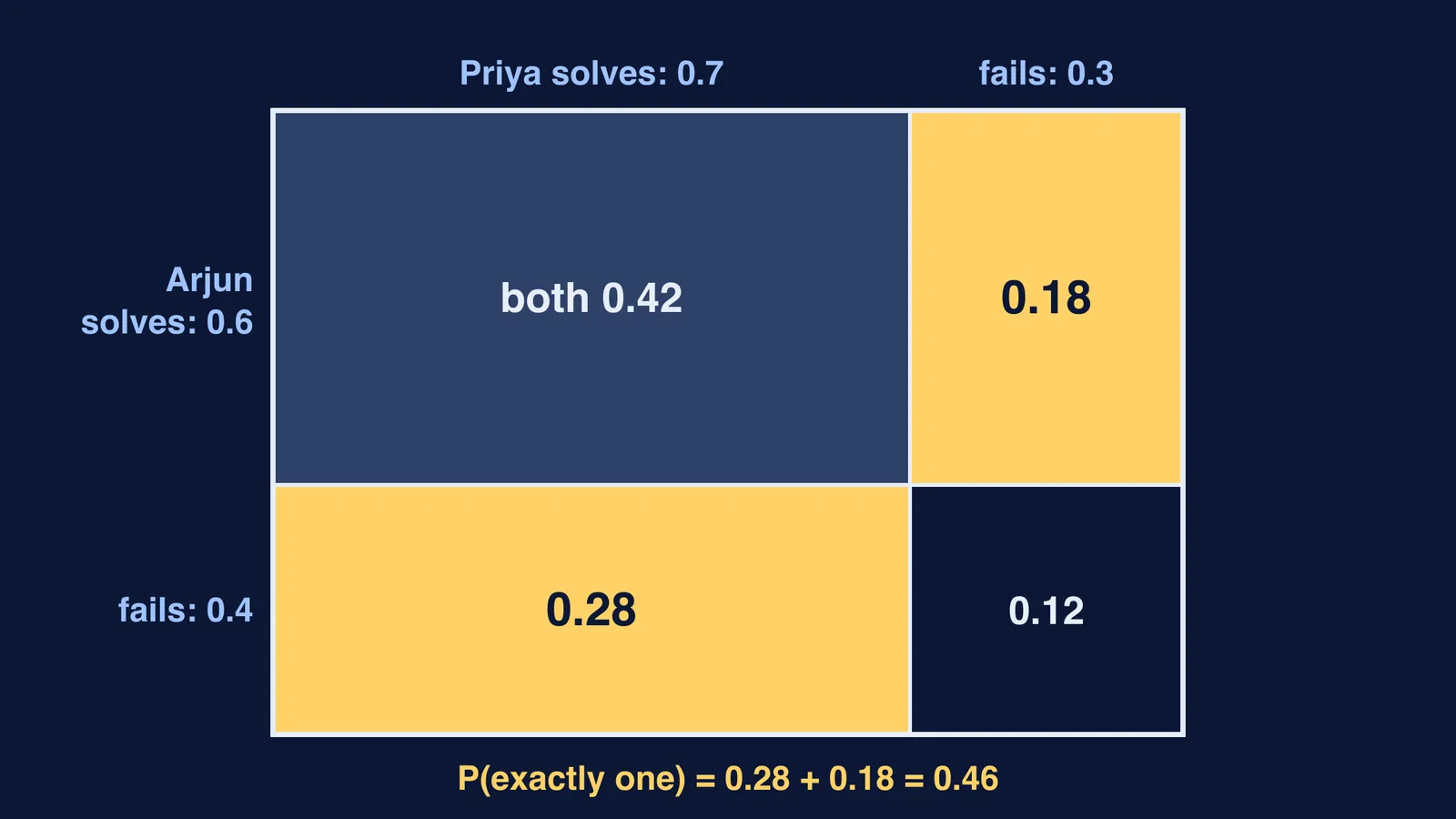
Priya and Arjun try the same problem independently. Priya solves it with probability 0.7 and Arjun with probability 0.6. Find the probability that (a) exactly one of them solves it, and (b) the problem gets solved.
Find the overlap. For independent events, P(A AND B) = P(A)P(B). So P(both) = 0.7 × 0.6 = 0.42.
Exactly one. 0.7 + 0.6 − 2(0.42) = 1.30 − 0.84 = 0.46.
Check by cases. Priya solves, Arjun fails: 0.7 × 0.4 = 0.28. Arjun solves, Priya fails: 0.3 × 0.6 = 0.18. Together, 0.46.
Solved means at least one. 0.7 + 0.6 − 0.42 = 0.88. Or by the complement: 1 − (0.3 × 0.4) = 0.88.
Check the total. Neither 0.12 + exactly one 0.46 + both 0.42 = 1.
Use the union formula for part (a) and you get 0.88 instead of 0.46, almost double.
What if A and B are not independent?
Pick a student at random from a class. The probability they take physics tuition is 0.5, maths tuition 0.4, and both 0.15. Then P(exactly one) = 0.5 + 0.4 − 2(0.15) = 0.60. Use the 0.15 you are given; multiplying 0.5 × 0.4 would be wrong, because nothing says the events are independent.
Where do students lose marks on this?
Run this checklist before you write the final answer:
Does the question say "exactly one" or "only one"? Subtract the overlap twice, not once.
Does it say the events are independent? Only then may you multiply to get P(A ∩ B).
For "A only", did you use the chance that B fails (0.4 above), not that B succeeds?
Do neither, exactly one and both add to 1?
If you keep reaching for the wrong formula, the Fermi Problem Library has worked problems with a step-by-step solver that explains the reasoning rather than printing an answer, so you can see which event a question is really asking about. To revisit the set ideas underneath, the Fermi Concept Library gives every concept in mathematics its own lesson.
Next time you see "exactly one", draw the four boxes first. The answer is the two boxes with only one event in them.