On this page
Say each try has a 3-in-10 chance of working. How many tries before you can be 90% sure that at least one works? Many students say three, because 3 × 0.3 = 0.9. That is wrong. The binomial distribution gives the right answer in one line.
What is the binomial distribution formula?
A binomial experiment has a fixed number of trials n, only two outcomes per trial (success and failure), and trials that are independent and repeated under identical conditions, as OpenStax Introductory Statistics sets out. In that textbook, p is the probability of success on one trial, q is the probability of failure, and p + q = 1.
The probability of exactly r successes in n trials is P(X = r) = nCr pʳ qⁿ⁻ʳ, where nCr = n!/(r!(n − r)!), as given in the NIST/SEMATECH e-Handbook of Statistical Methods.
In words: nCr counts which trials succeed, pʳ is the chance they do, and qⁿ⁻ʳ is the chance the rest fail.
Why is P(at least one success) equal to 1 − qⁿ?
"At least one" means X = 1, 2, 3 and so on up to n. But only one outcome is missing, X = 0, and the probabilities of all outcomes add to 1. Put r = 0 into the binomial formula: nC0 = 1 and p⁰ = 1, so P(X = 0) = qⁿ. That is the chance that every trial fails.
So P(X ≥ 1) = 1 − P(X = 0) = 1 − qⁿ.
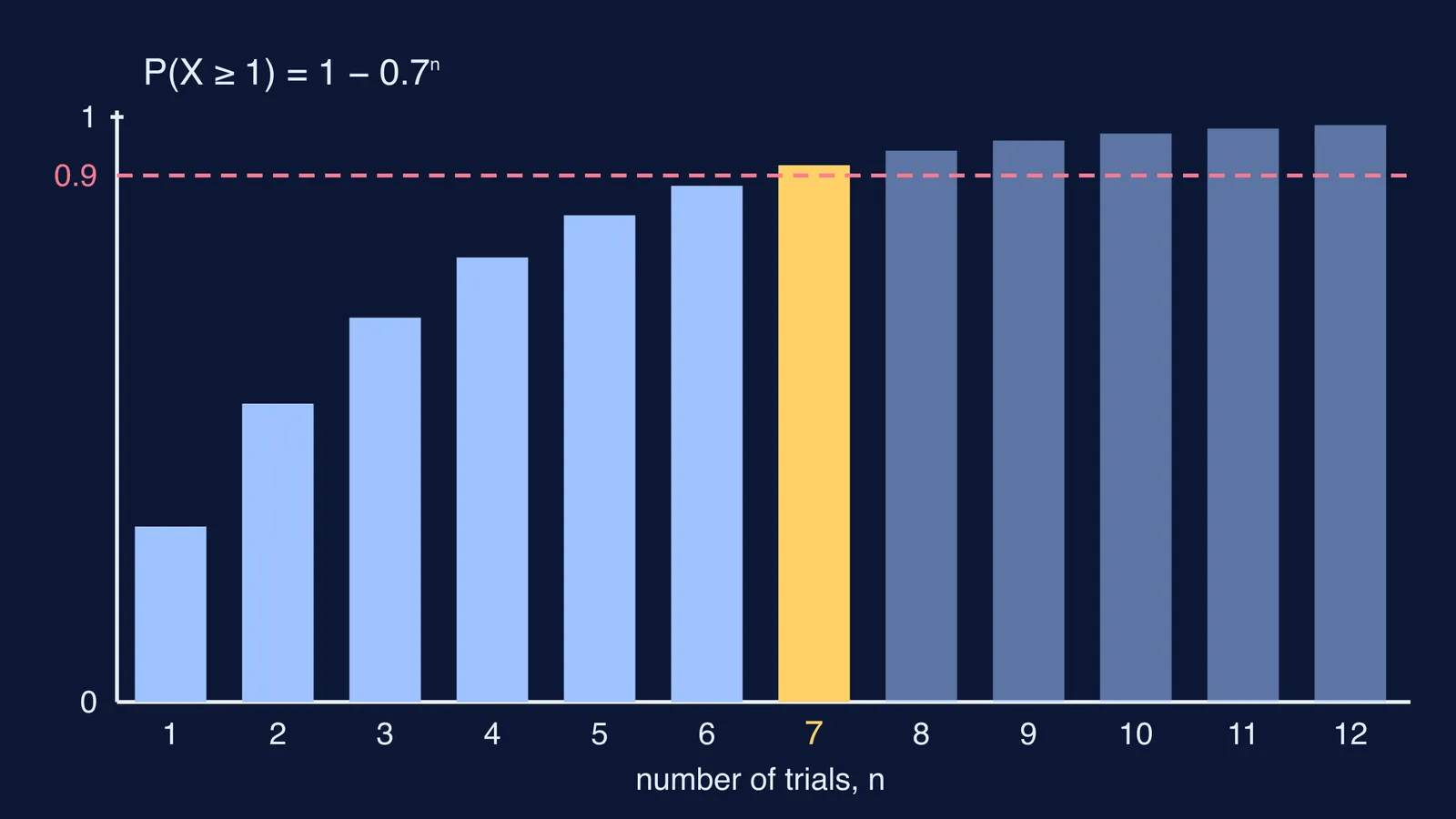
Check it with n = 7 and p = 0.3. The long way needs seven terms, P(X = 1) to P(X = 7): 0.2471, 0.3177, 0.2269, 0.0972, 0.0250, 0.0036 and 0.0002. Unrounded, they add to 0.9176. The shortcut gives 1 − 0.7⁷ = 1 − 0.0824 = 0.9176. Same answer, one power instead of seven terms.
How many trials do you need for a 90% chance?
Suppose each seed in a packet sprouts with probability 0.3, independently of the others, so the binomial model applies. How many seeds should you plant to be at least 90% sure that one sprouts?
Name the parts: p = 0.3, q = 0.7, and n is unknown.
Write the condition: 1 − 0.7ⁿ ≥ 0.9.
Move to the failure side: 0.7ⁿ ≤ 0.1.
Take logs: n log 0.7 ≤ log 0.1. Because log 0.7 is negative, dividing by it flips the inequality, so n ≥ log 0.1 / log 0.7 = (−1)/(−0.1549) ≈ 6.46.
n must be a whole number, so round up: n = 7.
Check both sides of the boundary. 0.7⁶ = 0.1176, so 6 seeds give 88.2%. 0.7⁷ = 0.0824, so 7 seeds give 91.8%.
Step 6 catches both common slips: forgetting to flip the inequality and rounding 6.46 down to 6.
The same steps work elsewhere:
Fair coin, at least one head with 90% probability: 0.5ⁿ ≤ 0.1 gives n = 4, since 0.5⁴ = 0.0625 (a 93.75% chance) and 0.5³ = 0.125 is too big.
Fair die, at least one six with 90% probability: (5/6)ⁿ ≤ 0.1 gives n ≥ 12.6, so 13 rolls. (5/6)¹² ≈ 0.112 falls short; (5/6)¹³ ≈ 0.093 is enough. Compare de Méré's dice problem, one six in four throws.
What if the question asks for at least two successes?
Now two outcomes are excluded, X = 0 and X = 1, so subtract both binomial terms: P(X ≥ 2) = 1 − qⁿ − n p qⁿ⁻¹.
With p = 0.3 and 7 seeds, that is 1 − 0.0824 − 0.2471 = 0.6706, only a 67% chance of two sprouts. With no tidy log step, test values of n. Eleven seeds give 88.7% and twelve give 91.5%, so you need 12 seeds for a 90% chance of at least two.
The general rule: list the outcomes you are excluding, find each with nCr pʳ qⁿ⁻ʳ, and subtract them from 1.
How do you spot an "at least one" question in an exam?
The wording says "at least one", "at least once" or "not all fail".
The trials are independent and p stays the same each time. Drawing cards without replacement changes p, so that is not binomial.
The target is a probability such as 0.9, and n is the unknown. Then: write qⁿ ≤ 1 − target, take logs, flip the inequality, round up, and check n − 1.
To watch the chance of zero successes shrink, try our binomial distribution coin-toss simulation. For more on the complement idea, read how many trials it takes, using the at-least-one complement rule.
If your slips are in the method, work a few problems in the Fermi Problem Library, where the step-by-step solver explains the reasoning rather than printing an answer. If the gap is earlier, in what independence or a complement means, the Fermi Concept Library gives each mathematics concept its own lesson.
Next time you see "at least one", write qⁿ first.