

On this page
When you work with sets, you often need to find elements that belong to one group but not another. The symmetric difference of sets A and B, written as A Δ B, collects every element that belongs to A or to B, but not to both.
In other words, it is the exact opposite of the intersection. If you are learning this in Class 11 or preparing for competitive exams, understanding how to read and draw these regions on a Venn diagram is a reliable way to solve counting problems without memorising too many rules.
What is A minus B and the symmetric difference of sets?
Before finding the symmetric difference, you must find the difference between two sets. The set A − B (read as "A minus B") contains all the elements that are in A but not in B.
For example, if A = {1, 2, 3, 4} and B = {3, 4, 5, 6}, then A − B removes the shared elements (3 and 4) from A, leaving {1, 2}. If you reverse the order, B − A removes the shared elements from B, leaving {5, 6}.
The difference A − B is also called the relative complement of B in A.
How to shade A minus B on a Venn diagram?
Venn diagrams, introduced by John Venn in an 1880 paper in the *Philosophical Magazine*, give a physical shape to these operations.
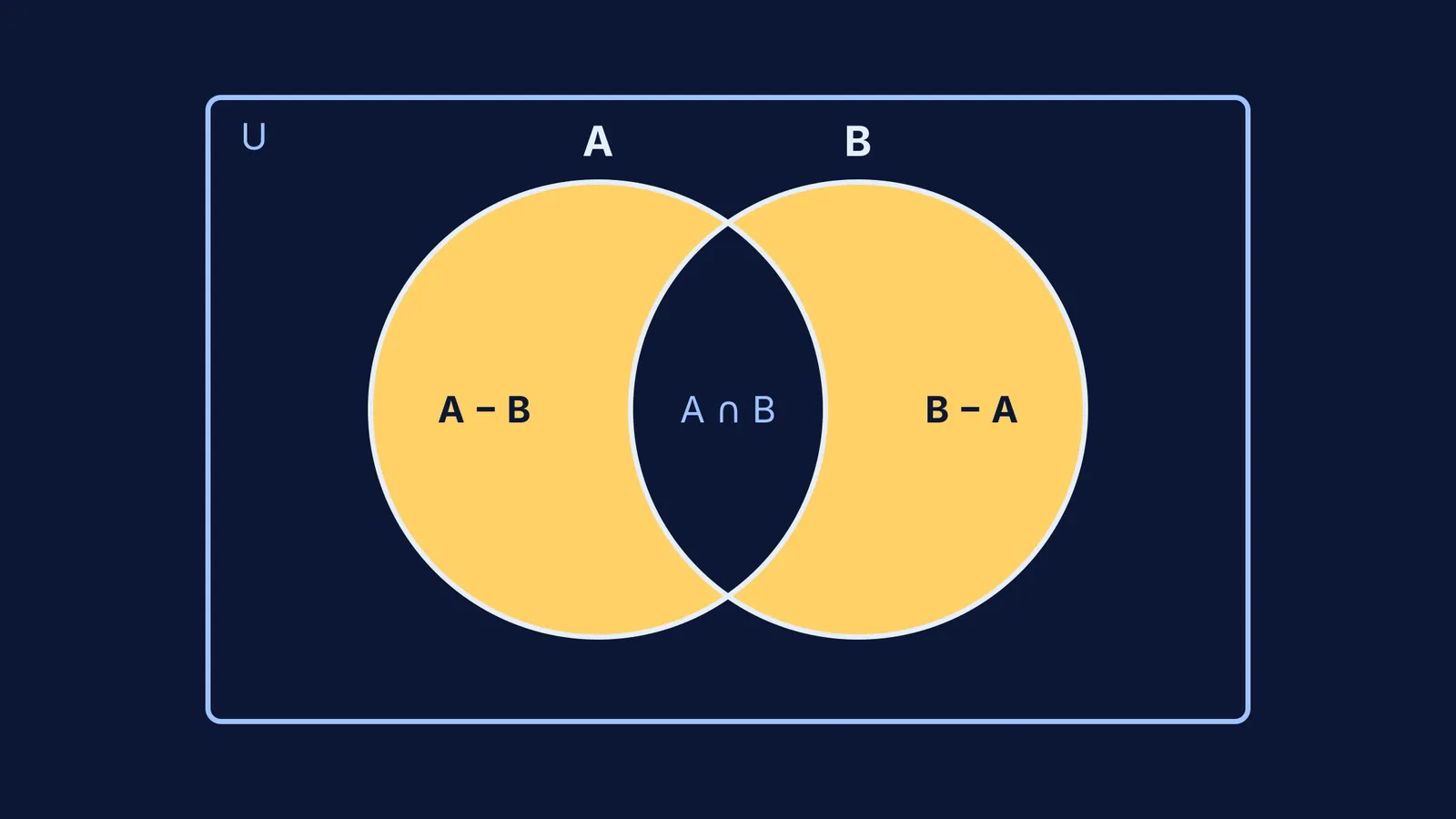
To shade A − B, you draw the two overlapping circles for A and B, and shade only the crescent moon shape of A that does not touch B. To shade B − A, you shade the opposite crescent moon on the side of B.
The symmetric difference, A Δ B, is the union of these two differences: (A − B) ∪ (B − A). On a Venn diagram, it looks like a figure of eight with the central overlap left blank.
If you struggle to picture how these regions combine when a third set is added, the Fermi Concept Library covers every concept in mathematics, each with its own lesson and its place in the map.
What is the formula for the symmetric difference of sets?
When you need to count the number of elements in a symmetric difference, you can use the sizes of the original sets and their intersection. The formula is:
n(A Δ B) = n(A) + n(B) − 2n(A ∩ B)
Why subtract the intersection twice? When you add n(A) and n(B), you have counted the overlapping region (the intersection) two times. To find the symmetric difference, you must remove the overlap completely. Subtracting it once gives you the union; subtracting it a second time hollows out the middle, leaving only the elements that belong to exactly one set.
This is a specific application of the inclusion-exclusion principle used in Three-set Venn problems: counting with inclusion-exclusion.
A worked example: counting exactly one property
Consider a hypothetical test question about a survey of 100 students where individuals can choose to study French, German, or both. The prompt states that 60 students study French and 50 students study German. If 20 students study both languages, how many students study exactly one language?
This is a classic symmetric difference problem. Let set F be the students studying French, and set G be the students studying German. The students studying exactly one language belong to the symmetric difference F Δ G.
First, list out the values you know:
n(F) = 60
n(G) = 50
n(F ∩ G) = 20
Now, apply the symmetric difference formula: n(F Δ G) = n(F) + n(G) − 2n(F ∩ G) n(F Δ G) = 60 + 50 − 2(20) n(F Δ G) = 110 − 40 = 70
Therefore, 70 students study exactly one language.
You can also solve this by finding F − G and G − F separately:
The students studying only French are n(F − G) = n(F) − n(F ∩ G) = 60 − 20 = 40.
The students studying only German are n(G − F) = n(G) − n(F ∩ G) = 50 − 20 = 30.
The union of these two disjoint sets is 40 + 30 = 70.
Both methods yield the same result, but the single formula is often faster in timed exams.
A step-by-step plan for symmetric difference problems
When an exam asks for the symmetric difference, follow this sequence:
Find the intersection: Identify the elements (or the number of elements) shared by A and B.
Apply the formula: If the question gives you counts, use n(A Δ B) = n(A) + n(B) − 2n(A ∩ B).
List the elements: If the question gives you the sets in roster form, find A − B and B − A separately, then combine them.
Draw the diagram: For word problems, draw the Venn diagram and write the count of elements starting from the intersection and working outwards.
If you keep getting stuck on these counting problems, Fermi's AI tutor works out what you already know, builds a plan for the session, and teaches through it — drawing the figure and checking understanding as it goes. Working step-by-step is often the only way to avoid double-counting errors in probability and set theory. You might also want to revise how to count Number of subsets and the power set: counting with 2ⁿ.


