

On this page
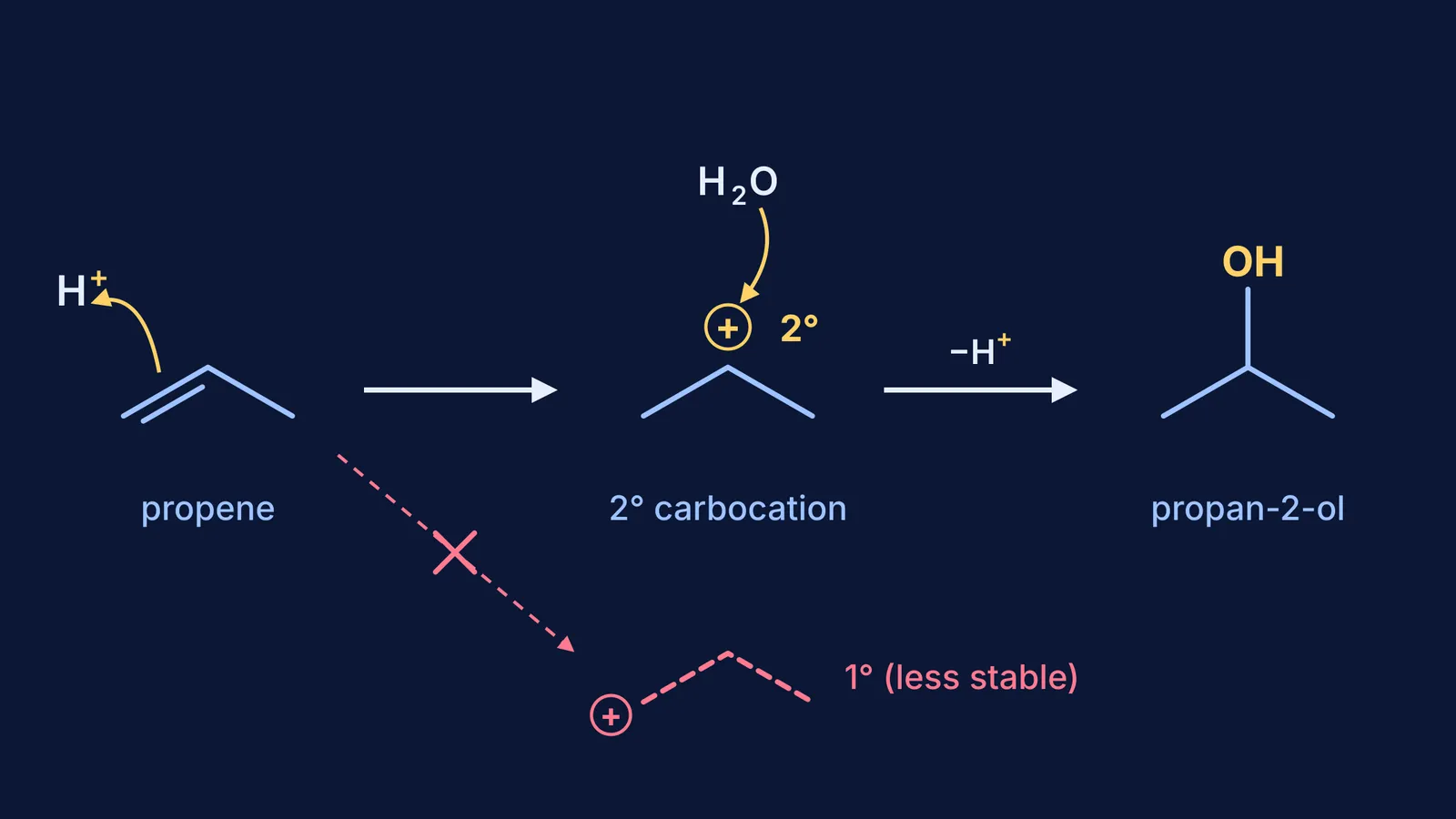
Add water to propene with a little acid and you get propan-2-ol, not propan-1-ol. The product is decided in the first step, before water touches the molecule. Once you see that, you can predict the product of most hydration questions.
What is acid-catalysed hydration of alkenes?
Acid-catalysed hydration adds a molecule of water, as H and OH, across the C=C double bond of an alkene to give an alcohol, using a strong acid such as sulfuric or phosphoric acid as a reusable catalyst (LibreTexts, Organic Chemistry I). The acid is not used up: the H+ it gives away in step 1 comes back in step 3.
The same chemistry runs at industrial scale. To make ethanol, ethene is mixed with steam and passed over solid silicon dioxide coated with phosphoric(V) acid at 300°C and about 60 to 70 atmospheres (Chemguide).
What are the three steps of the mechanism?
Both LibreTexts and Chemguide describe the same three steps:
Protonation. The pi electrons of the double bond grab an H+ from the acid. One carbon gets the new H, and the other carbon is left with a positive charge: a carbocation.
Attack by water. A lone pair on the oxygen of a water molecule bonds to the positive carbon, giving a protonated alcohol, ROH2+.
Deprotonation. That oxonium ion loses an H+, giving the neutral alcohol and regenerating the acid catalyst.
Why does propene give propan-2-ol and not propan-1-ol?
Propene, CH2=CH–CH3, has two different carbons in its double bond, so step 1 has two options.
If the H+ goes to the end carbon (C1), the positive charge sits on the middle carbon, which is bonded to two other carbons: a secondary (2°) carbocation.
If the H+ goes to the middle carbon (C2), the charge sits on the end carbon: a primary (1°) carbocation.
The secondary carbocation is more stable, and so easier to form, than the primary carbocation (Chemguide). The usual textbook explanation is that neighbouring alkyl groups help spread out the positive charge. Water can only bond where the charge is, so the OH lands on C2 and the product is propan-2-ol.
That is Markovnikov's rule in action: the H adds to the less substituted carbon of the double bond, the one that already carries more hydrogens (LibreTexts). The same logic decides HBr addition, which we walk through in our post on Markovnikov's rule for alkene addition.
How do you predict the product in an exam?
Use this four-step checklist on every hydration question:
Mark the two carbons of the double bond.
Draw both possible carbocations and label each 1°, 2° or 3°.
Keep the more stable one, then check whether a hydride or methyl shift from the next carbon would make it more stable still.
Put the OH where the positive charge finally sits, and name the alcohol.
Now try it on three alkenes, from easy to tricky.
Propene: 2° beats 1°, so the answer is propan-2-ol.
2-methylpropene, (CH3)2C=CH2: H+ on the CH2 end gives a 3° carbocation on the central carbon, so the product is 2-methylpropan-2-ol, the example LibreTexts works in its exercise.
3-methylbut-1-ene, CH2=CH–CH(CH3)2: H+ on C1 gives a 2° carbocation on C2. But C3 next door is a tertiary carbon carrying one H. That H shifts across with its electron pair (a 1,2-hydride shift), leaving a 3° carbocation on C3. Water adds there, so the major product is 2-methylbutan-2-ol, not 3-methylbutan-2-ol.
LibreTexts describes both hydride shifts and, where no H is available, methyl (alkyl) shifts. Step 3 of the checklist is the easiest one to skip, so if shifts still feel slippery, read our guide to carbocation rearrangements and hydride and methyl shifts.
If you keep putting the OH in the wrong place, work a few alkene problems in the Fermi Problem Library. Its step-by-step solver explains the reasoning rather than printing an answer, so you can see which step went wrong. If carbocation stability is the weak spot, the Fermi Concept Library has a lesson for every concept in chemistry.
When is acid-catalysed hydration the wrong choice?
It is the wrong reagent in two common exam situations.
You need the OH on the less substituted carbon. Acid-catalysed hydration cannot turn propene into propan-1-ol. For that anti-Markovnikov product, use hydroboration-oxidation of alkenes.
A rearrangement would move the OH. If a shift puts the charge elsewhere and you want the unshifted alcohol, acid and water will not give it.
The reaction is also reversible: LibreTexts notes that an alkene in water is in equilibrium with the alcohol. Excess water and lower temperatures favour the alcohol, while the reverse reaction, dehydration, needs higher temperatures.
Tonight, draw the three-step mechanism for propene from memory, then run the checklist on one alkene you have not seen before.


