On this page
Eight new JEE Main-style questions, easy to hard. Seven are single-correct; Q7 asks for a number. Each solution names the tempting wrong option and a quick check.
What does the JEE Main syllabus cover in matrices and determinants?
The NTA's Syllabus for JEE (Main) 2027 lists, in Mathematics Unit 3: algebra and types of matrices, determinants of order two and three, area of triangles, adjoint and inverse, and the consistency of linear equations in two or three variables. This set touches each one. New to the chapter? Start with our guide to preparing matrices and determinants for JEE Main.
Easy: types of matrices, properties and area
Q1 (easy). A = [[0, a, 3], [2, 0, b], [c, −1, 0]] is skew-symmetric. Then a + b + c equals
(A) −4
(B) 4
(C) 0
(D) −2
Answer: (A). Skew-symmetric means the (i, j) entry is minus the (j, i) entry, so a = −2, b = 1 and c = −3, giving −4. Trap: (B) copies entries as if A were symmetric. Check: the diagonal is all zeros, as a skew-symmetric matrix needs.
Q2 (easy). A is a 3 × 3 matrix with |A| = 4. Then |2A| is
(A) 8
(B) 16
(C) 32
(D) 64
Answer: (C). Multiplying A by 2 multiplies every one of its 3 rows by 2, so |2A| = 2³ × 4 = 32. Trap: (A) multiplies the determinant by 2 only once. Check with A = I: |2I| = 8 = 2³.
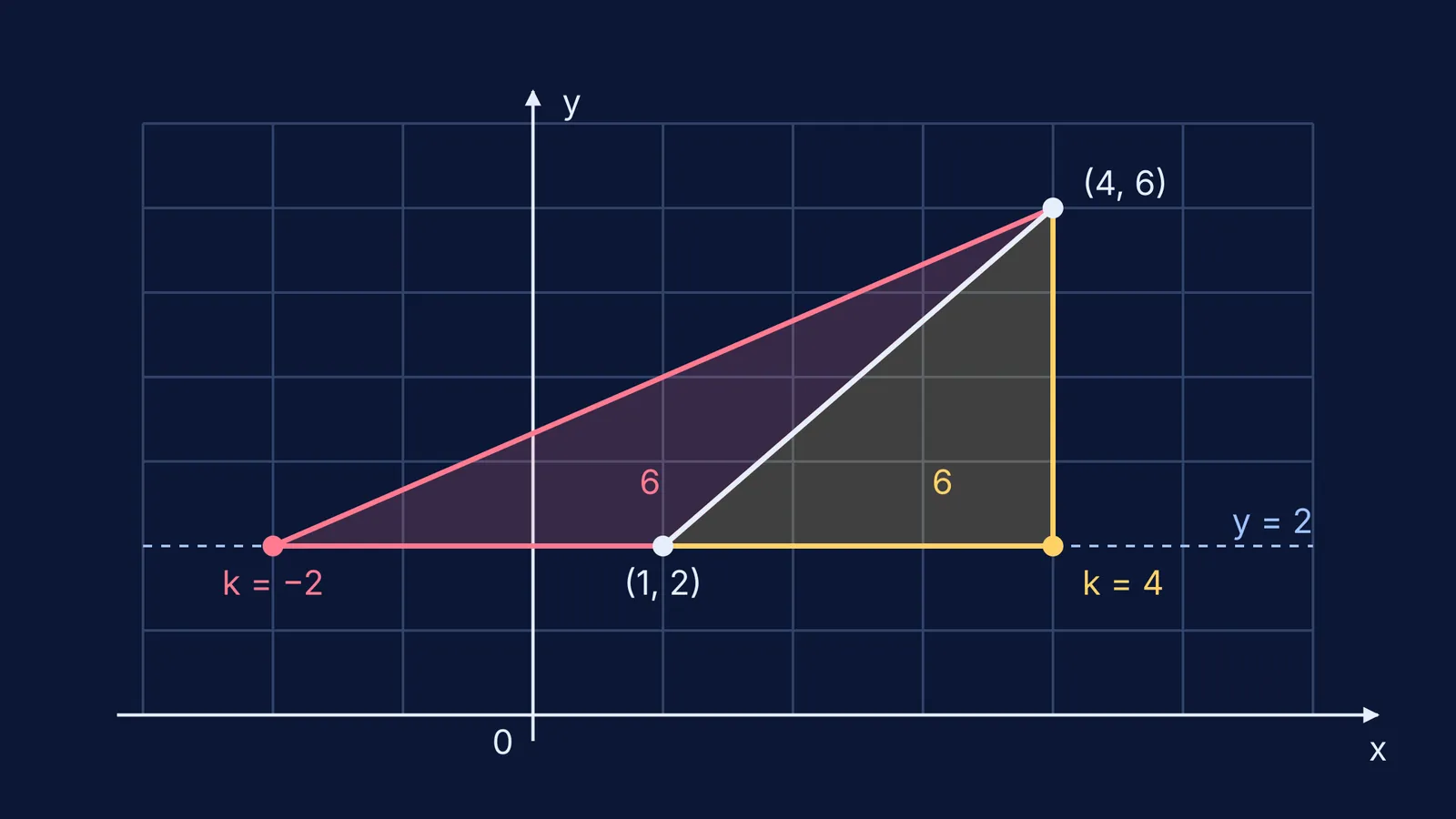
Q3 (easy). The triangle with vertices (1, 2), (4, 6) and (k, 2) has area 6 square units. Then k is
(A) 4 only
(B) −2 only
(C) 4 or −2
(D) 2 or −4
Answer: (C). The determinant with rows (1, 2, 1), (4, 6, 1), (k, 2, 1) works out to 4 − 4k, and the area is half its absolute value: 2|1 − k| = 6, so k = 4 or k = −2. Trap: (A) or (B) drops the absolute value. Check: height 4 needs a base of 3 along y = 2, on either side of (1, 2), as the diagram at the top shows.
Medium: adjoint, inverse and consistency
Q4 (medium). A is a 3 × 3 matrix with |A| = 3. Then |adj(2A)| is
(A) 72
(B) 144
(C) 576
(D) 36
Answer: (C). For an n × n matrix B, |adj B| = |B|ⁿ⁻¹. Here B = 2A, so |B| = 2³ × 3 = 24 and |adj B| = 24² = 576. Trap: (A) takes |adj A| = 9 and multiplies by 2³, forgetting that adj(2A) = 2² adj A, which scales the determinant by 2⁶. Check: 2⁶ × 9 = 576.
Q5 (medium). For A = [[1, 2], [3, 4]], A⁻¹ = αA + βI. Then α + β is
(A) −2
(B) 3
(C) 2
(D) −3
Answer: (A). A 2 × 2 matrix satisfies A² − (trace)A + (det)I = 0. Trace 5 and det −2 give A² − 5A − 2I = 0. Multiply by A⁻¹: A − 5I = 2A⁻¹, so α = 1/2, β = −5/2 and α + β = −2. Trap: (C) takes the determinant as +2. Check: A² = [[7, 10], [15, 22]] and A² − 5A = 2I.
Q6 (medium). The system x + y + z = 6, x + 2y + 3z = 10, x + 2y + λz = μ has no solution when
(A) λ = 3, μ = 10
(B) λ ≠ 3
(C) λ = 3, μ ≠ 10
(D) λ = 3 only
Answer: (C). The coefficient determinant is λ − 3, so λ ≠ 3 gives a unique solution. At λ = 3 the last two equations share a left side, so they agree only if μ = 10. Trap: (D) reads a zero determinant as "no solution"; it only means "not unique". Check: at λ = 3, equation 3 minus equation 2 gives 0 = μ − 10.
Hard: evaluating a determinant and a matrix power
Q7 (hard, numerical value). The roots of |[[x, 2, 3], [2, x, 3], [2, 3, x]]| = 0 are α, β, γ. The value of α² + β² + γ² is ____.
Answer: 38. Every row sums to x + 5, so adding all columns into the first takes out (x + 5); subtracting row 1 from rows 2 and 3 leaves (x − 2)(x − 3). The roots are −5, 2 and 3, and 25 + 4 + 9 = 38. Trap: 13, from cancelling (x + 5) and losing the root −5. Check: direct expansion gives x³ − 19x + 30, so the sum of squares is 0² − 2(−19) = 38.
Q8 (hard). For A = [[2, −1], [1, 0]], the sum of all entries of A⁵⁰ is
(A) 2
(B) 2⁵⁰
(C) 100
(D) 51
Answer: (A). Write A = I + N with N = [[1, −1], [1, −1]]. Then N² = 0, and I commutes with N, so A⁵⁰ = I + 50N = [[51, −50], [50, −49]]. The entries add to 2. Trap: (D) reads off only the (1, 1) entry. Check: the entries of A itself add to 2. This A cannot be diagonalised (its only eigenvalue is 1), but for matrices that can, see our post on finding large powers of a matrix by diagonalisation.
How should you use this set in revision?
Tag each miss: property slip (Q2, Q4), sign slip (Q1, Q3, Q5) or reasoning slip (Q6, Q7, Q8).
Two days later, redo only the tagged questions from a blank page.
Test every property you used, such as |kA| = kⁿ|A|, on the identity matrix before trusting it.
Then move to another chapter's set, such as these complex numbers and quadratic equations practice questions.
For more worked problems, the Fermi Problem Library has a step-by-step solver that explains the reasoning rather than printing an answer. For JEE Main and Advanced preparation, see Fermi Test Prep.