

On this page
You are asked for A¹⁰ for a 2x2 matrix. Multiplying A by itself nine times is slow and error-prone. Diagonalisation swaps that for one setup and a few powers of ordinary numbers. MIT teaches it in the linear algebra lecture Diagonalization and powers of A. This guide works one 2x2 example, then uses the same method to get a formula for every Fibonacci number.
What does A = PDP⁻¹ mean?
A square matrix A is diagonalisable if A = PDP⁻¹ for some invertible matrix P and diagonal matrix D (Diagonalizable matrix, Wikipedia).
The columns of P are eigenvectors of A, and the diagonal entries of D are the matching eigenvalues, in the same order (same source). If eigenvalues are new to you, start with our guide to what the eigenvalues of a 2x2 matrix mean and how to find them.
An n×n matrix with n distinct eigenvalues is always diagonalisable, though the converse is false (same source). A matrix without enough independent eigenvectors is called defective, and no choice of P will work for it.
Why does Aⁿ = PDⁿP⁻¹?
Square A and watch the middle cancel:
A² = (PDP⁻¹)(PDP⁻¹) = PD(P⁻¹P)DP⁻¹ = PD²P⁻¹.
The P⁻¹P in the middle is the identity. The same thing happens at every extra factor, so Aⁿ = PDⁿP⁻¹ for every positive whole number n (Diagonalizable matrix, Wikipedia). A diagonal matrix is raised to a power by raising each diagonal entry to that power, so Dⁿ is just λ₁ⁿ and λ₂ⁿ on the diagonal.
How do you find A¹⁰ for a 2x2 matrix?
Take A with rows (4, 1) and (2, 3).
Eigenvalues. det(A − λI) = (4 − λ)(3 − λ) − 2 = λ² − 7λ + 10 = (λ − 5)(λ − 2). So λ = 5 and λ = 2. Check: 5 + 2 = 7 is the trace and 5 × 2 = 10 is the determinant.
Eigenvectors. For λ = 5, A − 5I has rows (−1, 1) and (2, −2), so y = x and v₁ = (1, 1). For λ = 2, A − 2I has rows (2, 1) and (2, 1), so y = −2x and v₂ = (1, −2).
Build P and D. Put the eigenvectors in as columns: P has rows (1, 1) and (1, −2). D has 5 and 2 on its diagonal, in that order. det P = −3, so P⁻¹ = (1/3) × [rows (2, 1) and (1, −1)].
Raise D. Dⁿ has 5ⁿ and 2ⁿ on its diagonal.
Multiply out. Aⁿ = PDⁿP⁻¹ = (1/3) × [rows (2·5ⁿ + 2ⁿ, 5ⁿ − 2ⁿ) and (2·5ⁿ − 2·2ⁿ, 5ⁿ + 2·2ⁿ)].
Test it first. At n = 1 it gives back A; at n = 2 it gives rows (18, 7) and (14, 11), which is A × A by hand.
Now put n = 10. Since 5¹⁰ = 9,765,625 and 2¹⁰ = 1,024, A¹⁰ has rows (6,510,758, 3,254,867) and (6,509,734, 3,255,891).
How does the Fibonacci matrix give a formula for Fₙ?
Let Q have rows (1, 1) and (1, 0). Its powers carry the Fibonacci numbers: Qⁿ has rows (Fₙ₊₁, Fₙ) and (Fₙ, Fₙ₋₁) (Fibonacci sequence: matrix form, Wikipedia). For example, Q¹² has rows (233, 144) and (144, 89).
Diagonalise Q the same way. Its characteristic equation is λ² − λ − 1 = 0, with roots φ = (1 + √5)/2 ≈ 1.618 and ψ = (1 − √5)/2 ≈ −0.618, the golden ratio and its partner (same source). The eigenvectors are (φ, 1) and (ψ, 1): Q(φ, 1) = (φ + 1, φ), which equals φ(φ, 1) because φ² = φ + 1.
So P has rows (φ, ψ) and (1, 1), with det P = φ − ψ = √5. Work out PDⁿP⁻¹, read off the top-right entry, use φψ = −1, and you get Binet's formula:
Fₙ = (φⁿ − ψⁿ)/√5.
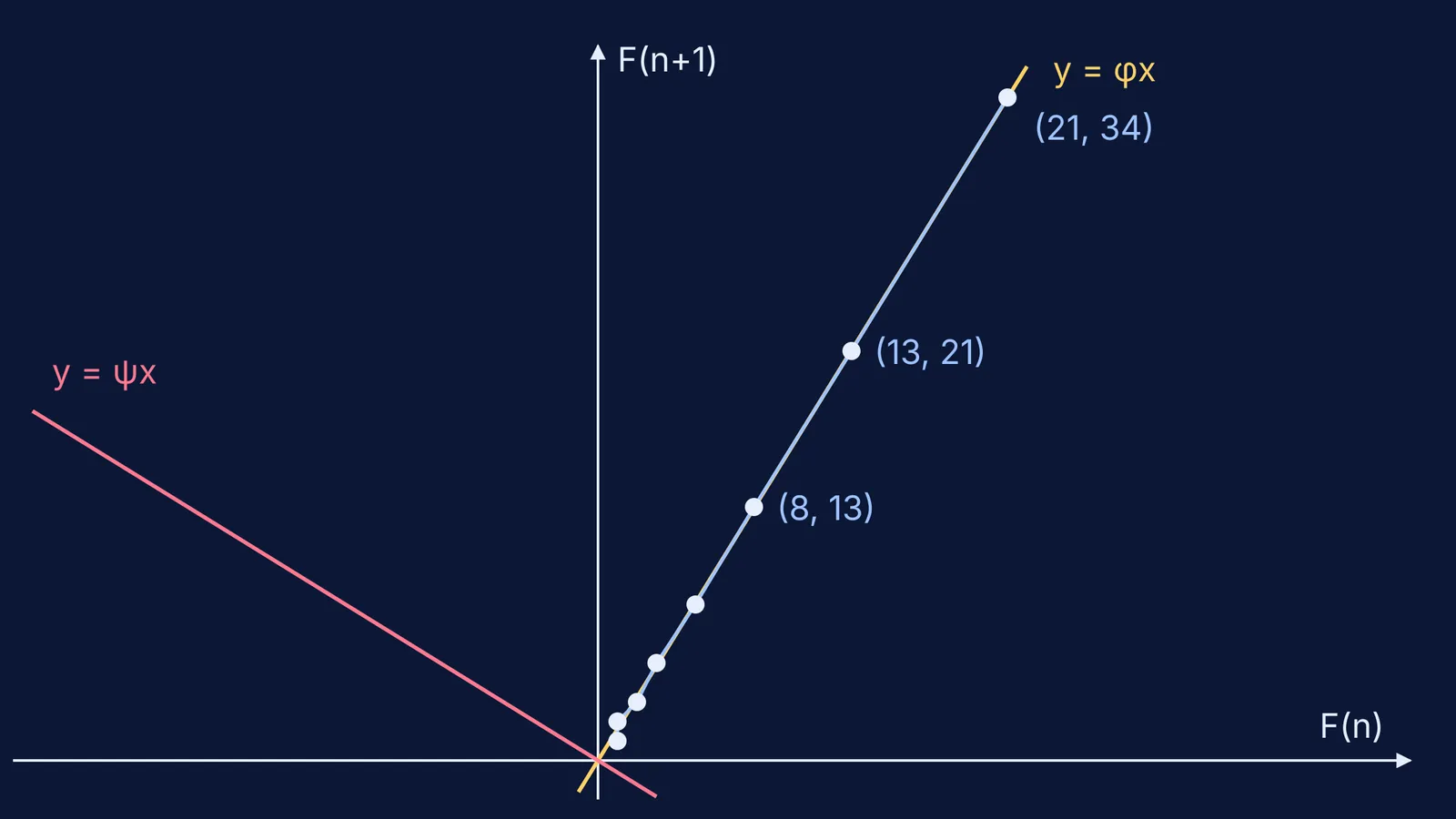
Because |ψ| < 1, the ψⁿ term fades, so Fₙ is the whole number nearest to φⁿ/√5 (Fibonacci sequence: computation by rounding, Wikipedia). That is also why the pairs (Fₙ, Fₙ₊₁) line up along the φ eigenvector in the diagram at the top of this post. The golden ratio turns up again in continued fractions, where its convergents are ratios of Fibonacci numbers.
Which mistakes should you check for?
Eigenvectors written as rows of P instead of columns.
D in a different order from the columns of P. Swap one, swap the other.
The 1/det P forgotten in P⁻¹.
Using P⁻¹DⁿP instead of PDⁿP⁻¹.
Trying it on a defective matrix, such as one with a repeated eigenvalue and only one eigenvector direction.
If a step goes wrong and you cannot see where, the Fermi Problem Library has worked problems with a step-by-step solver that explains the reasoning rather than printing an answer. If eigenvectors feel shaky, the Fermi Concept Library gives each mathematics concept its own lesson.
For where this fits in your JEE plan, read how to prepare matrices and determinants for JEE Advanced. Then practise: find A⁵ for rows (2, 1) and (1, 2), whose eigenvalues are 3 and 1.


