

On this page
You probably know √2 as an endless decimal, 1.41421356... A continued fraction describes it another way, and shows which fractions get closest.
What is a continued fraction?
A simple continued fraction is a fraction in which every numerator is 1, written a0 + 1/(a1 + 1/(a2 + ...)) and shortened to [a0; a1, a2, ...], as defined on Wolfram MathWorld. The a's are whole numbers, and every one after the first is positive.
The recipe: take the whole-number part, flip what is left over, repeat. For a fraction, this is exactly Euclid's division algorithm: the quotients you get become the terms of the continued fraction, as Stanford's notes on continued fractions explain. A rational number has a finite expansion and an irrational number has an infinite one, according to the Wikipedia article on continued fractions.
Here it is for 43/19:
43 = 2 × 19 + 5, so 43/19 = 2 + 5/19 = 2 + 1/(19/5).
19 = 3 × 5 + 4, so 19/5 = 3 + 1/(5/4).
5 = 1 × 4 + 1, so 5/4 = 1 + 1/4.
4 = 4 × 1, remainder 0: stop.
So 43/19 = [2; 3, 1, 4]. These are the same divisions you write when you find an HCF, which our Class 10 real numbers formulas guide walks through step by step.
How do you write the golden ratio and √2 as continued fractions?
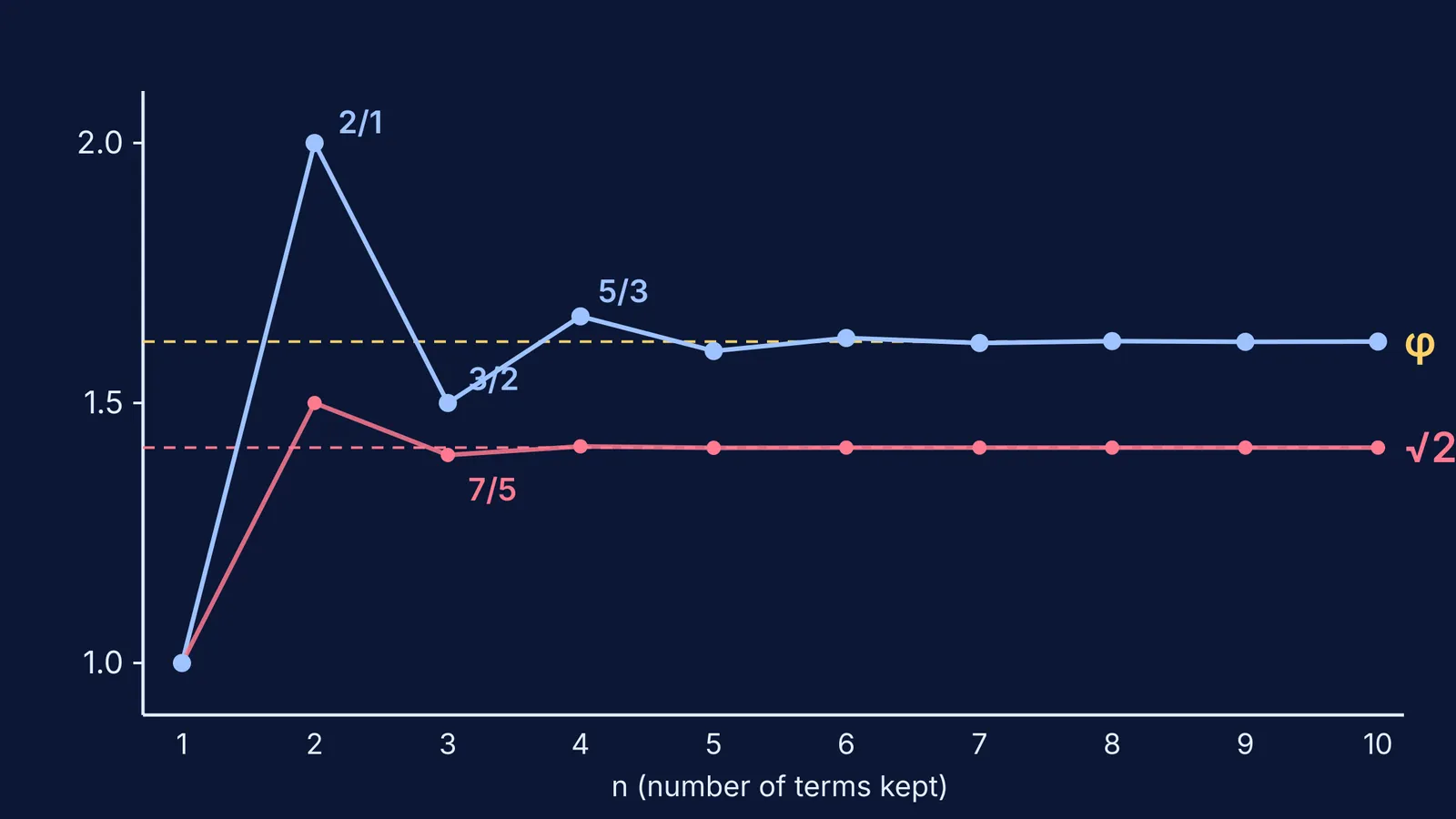
The golden ratio is φ = (1 + √5)/2 ≈ 1.6180339887, and its continued fraction is [1; 1, 1, 1, ...], every term a 1 (MathWorld: Golden Ratio). The reason is the identity φ = 1 + 1/φ: substitute it into itself forever and the 1s never stop (Wikipedia: Golden ratio). Its convergents, 1, 2, 3/2, 5/3, 8/5, ..., are ratios of consecutive Fibonacci numbers.
For √2, write √2 = 1 + (√2 − 1). Flip the leftover: 1/(√2 − 1) = √2 + 1 = 2 + (√2 − 1). The same leftover comes back, so the 2s repeat forever and √2 = [1; 2, 2, 2, ...]. MathWorld lists its convergents as 1, 3/2, 7/5, 17/12, 41/29, 99/70 (MathWorld: Pythagoras's Constant).
What are convergents, and why are they the best approximations?
A convergent is what you get by cutting a continued fraction off after a finite number of terms (MathWorld: Convergent). Each new numerator is the current term times the last numerator plus the one before it, and the denominators follow the same rule. It is a recurrence, like those in our guide to sequences and series (Wikipedia: Continued fraction). For [2; 3, 1, 4] you get 2/1, then 7/3, then (7 + 2)/(3 + 1) = 9/4, then (4 × 9 + 7)/(4 × 4 + 3) = 43/19.
Three results from Stanford's notes on convergence explain why convergents matter:
If p/q is a convergent of a number and some other fraction is closer to that number, the other fraction has a larger denominator.
The error of the convergent p/q is at most 1/(q × q'), where q' is the next convergent's denominator, and so less than 1/q².
If a fraction r/s in lowest terms is within 1/(2s²) of the number, then r/s is one of its convergents.
π's expansion starts [3; 7, 15, 1, 292, ...], with convergents 3, 22/7, 333/106 and 355/113 (MathWorld: Pi Continued Fraction). 355/113 = 3.14159292..., while π = 3.14159265..., so the gap is less than 3 ten-millionths.
Why is the golden ratio so hard to approximate with fractions?
Adolf Hurwitz's 1891 theorem (the original paper in Mathematische Annalen) says that every irrational number has infinitely many fractions m/n within 1/(√5 n²) of it. The constant √5 is the best possible: replace it with anything larger and the golden ratio has only finitely many such fractions (Wikipedia: Hurwitz's theorem)). MathWorld notes that φ is particularly difficult to approximate by fractions because of its continued fraction, every term of which is 1 (MathWorld: Golden Ratio).
Multiply each convergent's error by its denominator squared (our arithmetic):
φ with 34/21: about 0.447, close to 1/√5 ≈ 0.4472.
√2 with 41/29: about 0.354.
π with 355/113: about 0.0034.
A smaller score means a better fraction for its denominator size. Of these three, the golden ratio does worst.
How can you practise continued fractions?
Expand 157/68 with Euclid's divisions. Check yourself: [2; 3, 4, 5].
Build its convergents with the recurrence; the last should be 157/68.
Expand √3 using the flip-the-leftover method. You should find [1; 1, 2, 1, 2, ...].
Choose one convergent of √3 and check on a calculator that its error is below 1/q².
Most slips come from flipping the whole number instead of only the leftover, so write the remainder down before you invert it.
If a step in your own working goes wrong, the Fermi Problem Library has worked problems with a step-by-step solver that explains the reasoning rather than printing an answer. Euclid's algorithm, irrational numbers and recurrences each have a lesson in the Fermi Concept Library.


