On this page
Sequences and Series is Chapter 6 of the CBSE Applied Mathematics Class XI book (second edition, April 2026). It sits inside Unit II, Algebra, of the 2026-27 Applied Mathematics (241) course. Below: what to study, how it differs from core Maths, and a worked savings example.
How many marks is Sequences and Series in Applied Maths Class 11?
The CBSE 2026-27 Applied Mathematics curriculum gives Unit II, Algebra, 18 marks out of an 80-mark theory paper, with 20 marks for internal assessment. Those 18 marks are shared with sets, relations and mathematical logic, so CBSE prints no separate figure for this chapter.
The curriculum lists five things for this chapter:
the difference between a sequence and a series
the arithmetic mean (AM) of two positive numbers
geometric progressions (GP): the nth term, the sum of n terms and the sum to infinity
the geometric mean (GM) of two positive numbers, and the AM-GM relation
application problems on AP and GP
The book follows the same order. AP itself (nth term and sum) is treated as recall from Class 10, but appears in mixed problems.
How is this different from core Maths?
The core Mathematics (041) course covers the same ideas from the NCERT textbook; our Class 11 Maths guide to sequences and series walks through that version. The applied course differs in three ways:
The book. Applied Maths uses CBSE's own support material, not NCERT (see our overview of CBSE Applied Mathematics).
The questions. Problems are set in money and growth: savings plans, machine depreciation, population growth and the spending multiplier.
Where it leads. GP sums return in Unit VI, Basics of Financial Mathematics (15 marks in the same curriculum), where annuities are a GP of equal payments. Our explainer on annuity and perpetuity present value shows that step.
Which formulas do you need?
With first term a, common difference d and ratio r:
AP: a_n = a + (n − 1)d, and S_n = n/2 [2a + (n − 1)d]
GP: a_n = ar^(n−1), and S_n = a(r^n − 1)/(r − 1) for r ≠ 1
Infinite GP: S = a/(1 − r), only when |r| < 1
AM of a and b: A = (a + b)/2; GM: G = √(ab)
For positive a and b, A ≥ G, with equality only when a = b
The proof is short: A − G = (√a − √b)²/2, and a square is never negative. For 4 and 25, A = 14.5 and G = 10.
Worked example: AP or GP savings plan?
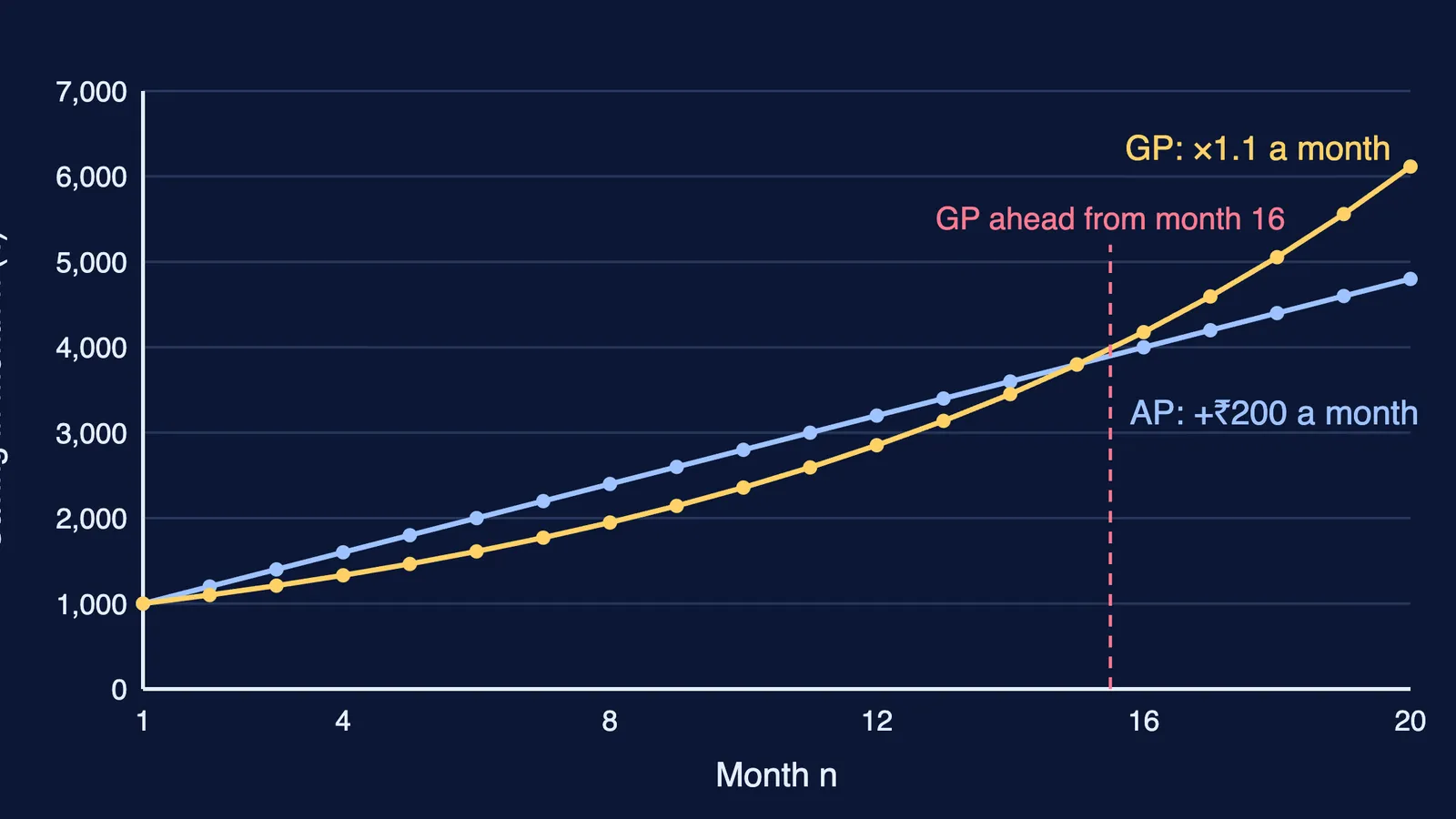
Riya and Kabir each save ₹1,000 in month 1. Riya adds ₹200 more each month (an AP with a = 1000, d = 200). Kabir saves 10% more each month (a GP with a = 1000, r = 1.1). Who has saved more after 12 months?
Riya: S₁₂ = 12/2 [2(1000) + 11(200)] = 6 × 4,200 = ₹25,200.
Kabir: S₁₂ = 1000(1.1¹² − 1)/(1.1 − 1). Since 1.1¹² ≈ 3.138428, S₁₂ ≈ 1000 × 2.138428/0.1 ≈ ₹21,384.28.
Riya leads after a year. Now compare each month's saving. In month 15 Riya saves ₹3,800 and Kabir about ₹3,797.50. In month 16 Riya saves ₹4,000 and Kabir about ₹4,177.25, so Kabir's monthly saving overtakes in month 16. Running totals take longer: Kabir's total first passes Riya's in month 21 (about ₹64,002.50 against ₹63,000). Over 24 months Riya saves ₹79,200 and Kabir about ₹88,497.33.
Adding a fixed amount grows in a straight line; multiplying by a fixed ratio starts slowly, then overtakes. That is why compound interest is a GP.
Depreciation works the same way: a machine bought for ₹2,40,000 that loses 15% a year (r = 0.85) is worth 2,40,000 × 0.85³ = ₹1,47,390 after 3 years.
Practice questions
These are our own questions; the mark values are our suggestion, not CBSE's.
(1 mark) Find the GM of 3 and 27.
(2 marks) Insert two arithmetic means between 7 and 22.
(3 marks) A scooter bought for ₹90,000 loses 10% of its value each year. Find its value after 4 years.
(5 marks) A firm's sales are ₹5 lakh in year 1 and grow 20% a year. Find total sales over the first 5 years, and the first year in which annual sales exceed ₹10 lakh.
Answers: 1. 9. 2. 12 and 17 (d = 5). 3. 90,000 × 0.9⁴ = ₹59,049. 4. 5(1.2⁵ − 1)/0.2 ≈ ₹37.21 lakh; year 5, since 5 × 1.2³ ≈ 8.64 and 5 × 1.2⁴ ≈ 10.37.
How should you revise this chapter?
Write each formula from memory, then check it against the book.
For every word problem, first write a, d or r, and n before calculating.
Redo the savings example with your own numbers: find when the GP's monthly amount overtakes, then when its running total does.
Stuck on a step? Fermi's AI tutor teaches, explains and works through problems alongside the student.