

On this page
A rupee today is worth more than a rupee next year because you can invest money today to earn interest. This fundamental idea is known as the time value of money. Whenever you buy a two-wheeler on monthly instalments, plan a student loan repayment schedule, or calculate corporate equipment leasing costs, you are managing a structured stream of regular cash flows.
To compare different payment options fairly, economists and financial analysts pull all future cash flows back to a single baseline: their worth today. This unified figure is called the present value.
What is the present value of an annuity?
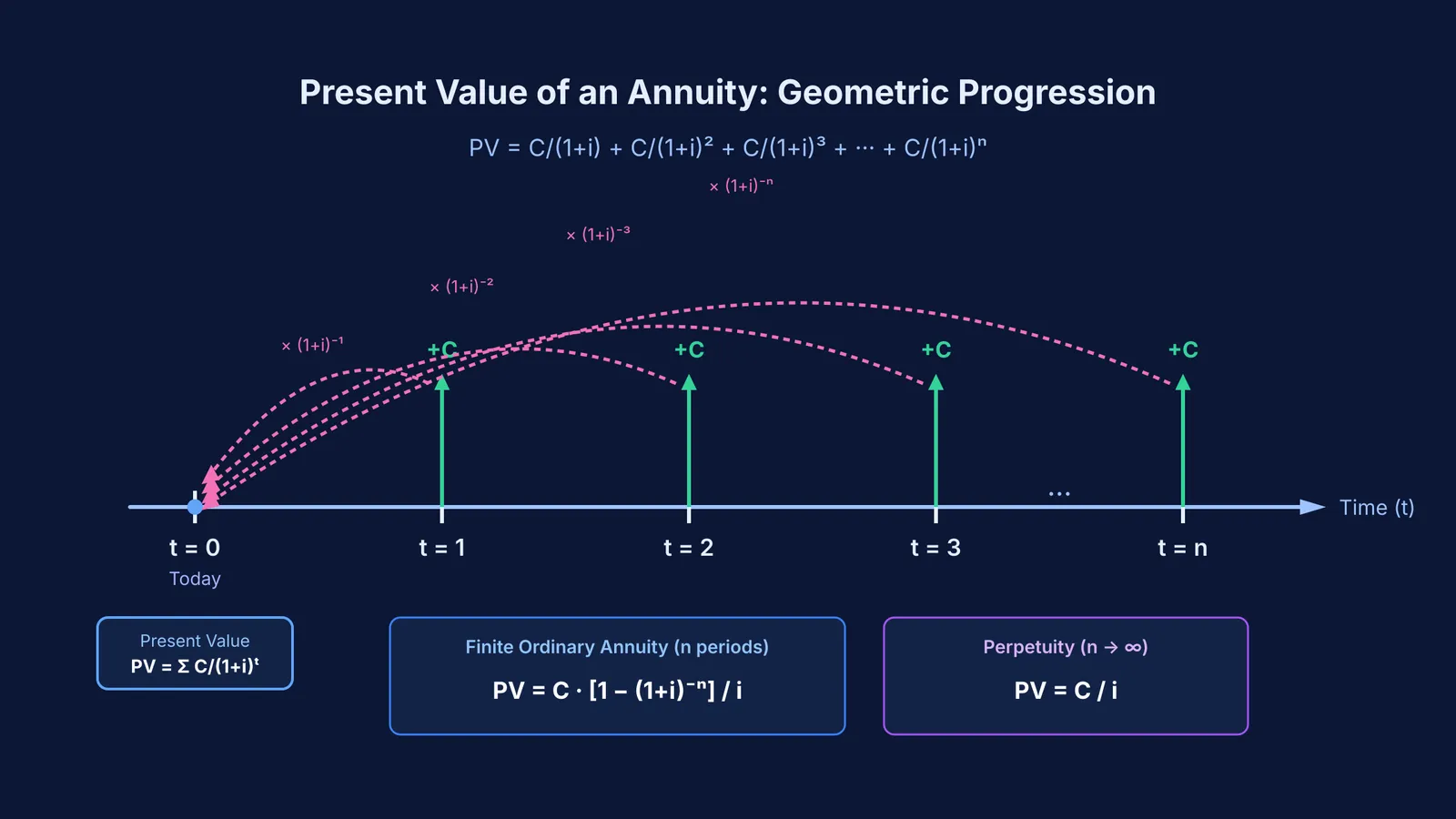
In financial theory, an ordinary annuity consists of a stream of equal periodic cash payments, denoted by C, made at the end of each period for a fixed duration of n compounding periods. According to financial mathematics principles for present value, valuing such a stream requires discounting each future payment back to time zero.
Suppose the effective interest rate per period is i. A cash payment of C received one period from now has a present value of C / (1+i). A payment received two periods from now is discounted twice, yielding C / (1+i)². Continuing this pattern across all n periods, the total present value (PV) equals the sum of all individual discounted payments:
PV = C / (1+i) + C / (1+i)² + C / (1+i)³ + ··· + C / (1+i)ⁿ
This progression forms a finite geometric series. The first term a is C / (1+i), and the common ratio r is 1 / (1+i). For any geometric series where the common ratio r is not equal to 1, the sum of the first n terms is given by the formula Sₙ = a(1 − rⁿ) / (1 − r).
To simplify the algebra, observe the denominator first: 1 − r = 1 − 1 / (1+i) = [(1+i) − 1] / (1+i) = i / (1+i)
Now divide the first term a by this denominator: a / (1 − r) = [C / (1+i)] / [i / (1+i)] = C / i
Notice that the factor (1+i) cancels out completely from the denominator. Finally, multiplying this result by the remaining factor (1 − rⁿ), where rⁿ = (1+i)⁻ⁿ, gives the classic closed-form formula for the present value of an ordinary annuity:
PV = C × [1 − (1+i)⁻ⁿ] / i
What is the present value of a perpetuity?
A perpetuity is a special type of annuity where equal periodic cash flows continue indefinitely without an end date, meaning the number of periods n approaches infinity. Perpetual bonds, university endowment funds, and certain preferred share dividends operate under perpetuity valuation principles.
Summing the discounted cash flows of a perpetuity produces an infinite geometric series. In mathematics, an infinite geometric series with first term a and common ratio r converges to the finite sum S = a / (1 − r) if and only if |r| < 1. Because any practical market interest rate i is positive, the ratio r = 1 / (1+i) is strictly between 0 and 1, ensuring that the infinite sum always converges.
As n approaches infinity, the exponential growth of (1+i)ⁿ in the denominator causes the discount factor (1+i)⁻ⁿ to shrink toward zero. When you substitute (1+i)⁻ⁿ → 0 into the annuity formula, the bracket [1 − 0] simplifies to 1. The formula collapses into an elegant limit:
PV = C / i
This compact formula demonstrates that an infinite stream of payments still has a finite, measurable capital value today.
How do you calculate present value in applied maths?
Class 12 Applied Mathematics and introductory undergraduate finance syllabi regularly test students on setting up these financial progressions. Consider this standard problem in applied financial calculations: You purchase a commercial asset by agreeing to pay four annual instalments of 3000 at the end of each year. The market interest rate is 5% per annum. What is the present value of these instalments?
Here, the recurring payment is C = 3000, the annual interest rate is i = 0.05, and the duration is n = 4 years. First, compute the multi-year discount factor: (1 + 0.05)⁻⁴ = (1.05)⁻⁴ ≈ 0.82270
Substitute the known values into the annuity formula: PV = 3000 × [1 − (1.05)⁻⁴] / 0.05 PV = 3000 × [1 − 0.82270] / 0.05 PV = 3000 × [0.17730 / 0.05] PV = 3000 × 3.5460 = 10638
The present value of the four instalments is 10638. If the seller offers an outright cash discount for paying anything less than 10638 today, paying cash is the superior financial decision. If the upfront price is higher than 10638, taking the four-year instalment schedule is cheaper in real purchasing power.
You can verify this result by discounting each instalment individually:
Year 1: 3000 / 1.05 = 2857.14
Year 2: 3000 / (1.05)² = 2721.09
Year 3: 3000 / (1.05)³ = 2591.51
Year 4: 3000 / (1.05)⁴ = 2468.11
Total sum: 2857.14 + 2721.09 + 2591.51 + 2468.11 = 10637.85 ≈ 10638
If you need to revisit geometric sequences or series summation rules, the Concept Library has a lesson for every concept in mathematics and its place in the map. When you want to practise annuity and loan amortisation problems, the Fermi Problem Library provides worked problems with a step-by-step solver that explains the reasoning rather than printing an answer.
You can also see how geometric progressions appear in other disciplines, such as modelling arithmetic vs geometric growth in plant biology, or using algebraic reduction techniques for sums like 9 + 99 + 999.


